A breakdown after dark in Sherman Oaks can turn stressful fast. The right next step depends on whether you’re on Ventura Boulevard, inside a parking structure, or beside the 101 or 405.
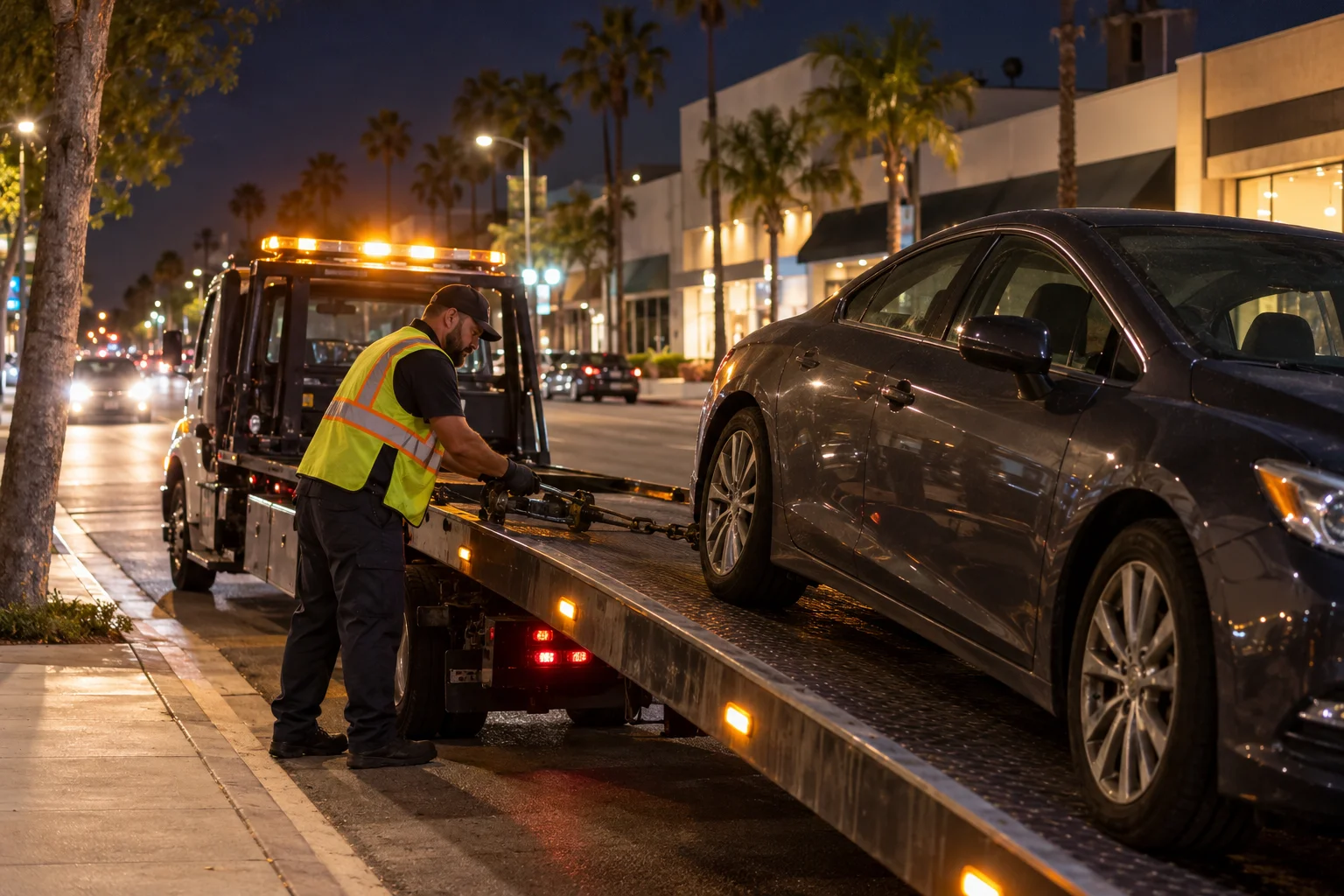
Quick Tow LA connects drivers with local, licensed towing and roadside operators. Call any time, day or night, and describe your location clearly. Dispatch can then seek an operator suited to the vehicle and setting.
Late-night pickups on Ventura Blvd and the 101/405
Sherman Oaks sits around several very different driving environments. Ventura Boulevard has storefronts, restaurants, side streets, and busy parking lots. Sepulveda Boulevard carries traffic toward the Sepulveda Pass. Nearby freeway lanes converge around the 101 and 405.
Those differences matter after a breakdown. A car at the curb near Ventura Boulevard presents a different pickup than one stopped near an interchange. The operator needs the correct setting before heading out.
Start with the road name and nearest cross street. Say which direction you were traveling. If you’re on a freeway, share the route, direction, and nearest exit. A phone map can help identify your position, but don’t walk into traffic to inspect a sign.
Tell dispatch where the vehicle is actually sitting. It might be at a curb, in a travel lane, on a shoulder, or inside a lot. Nearby businesses can help, but provide a street address when possible. Business names may be unclear after closing.
Freeway incidents can involve CHP-directed towing through its Rotation Tow Program. That process isn’t the same as arranging a voluntary roadside tow. The California Highway Patrol uses participating operators for disabled and collision vehicles on CHP-served highways. CHP doesn’t publish one uniform statewide towing rate.
For a voluntary request, our emergency towing service connects you with operators serving Los Angeles County. No arrival window should be assumed. Traffic, access, vehicle condition, and operator availability can all affect the call.
Street, structure, and freeway calls are not the same
A street pickup usually starts with curb access. The driver sent out needs enough room to approach and load safely. Parked cars, narrow lanes, medians, and late-night traffic can change the equipment needed.
Parking structures create different limits. Tell dispatch if the vehicle is underground or above ground. Share the posted clearance and the level where the car stopped. Note any tight ramps, locked gates, ticket arms, or restricted entrances. A standard towing setup may not fit every garage.
Don’t guess about clearance. Read the posted sign if you can do so safely. The operator needs that figure before entering. Also explain whether the wheels roll, the steering turns, and the transmission can shift into neutral.
Freeway calls carry another layer. Give your exact direction of travel and stay away from moving lanes. Follow instructions from law enforcement or emergency personnel at the scene. The NHTSA roadside safety resource also provides national guidance for roadside emergencies.
A collision call isn’t just a dead-battery call. Fluid leaks, damaged steering, deployed airbags, or a wheel pushed out of position can affect recovery. Report what you see without touching damaged parts.
Some problems may only need roadside assistance. A jump start, tire issue, lockout, or fuel problem doesn’t always require towing. However, a car with crash damage, failed steering, or unsafe wheel damage needs professional handling.
If you’re comparing roadside options before the next breakdown, read our guide to roadside assistance in Los Angeles. It explains how to match the service request to the problem.
What to have ready when you phone
Good location details prevent confusion. Sherman Oaks addresses can place a vehicle near Ventura Boulevard, along Sepulveda Boulevard, or closer to the Studio City and Encino edges. A map pin helps, but it shouldn’t replace a spoken location.
Have these details ready:
- Your street address or freeway location
- The nearest cross street, exit, or visible landmark
- Your direction of travel
- The vehicle’s year, make, model, and color
- Whether the vehicle is all-wheel drive or four-wheel drive
- The vehicle’s current condition
- Whether any wheel is locked, damaged, or missing
- The pickup and requested destination
- Any garage clearance, gate, or access restriction
Describe the symptoms in plain words. Say whether the engine cranks, the dashboard lights appear, or the tire is visibly damaged. Don’t diagnose a mechanical failure unless you already know the cause.
Mention passengers, pets, or unusual cargo. Tell dispatch if the vehicle is blocking traffic or sitting somewhere exposed. If emergency personnel are controlling the scene, follow their directions first.
Ask the operator about charges before service begins. Quick Tow LA doesn’t publish a brand rate card. The driver contracts with and pays the operator, so the operator sets the price for that voluntary service. Confirm the towing charge, mileage, destination, payment method, and any storage arrangement directly with that operator.
Never accept an unclear destination. Repeat the facility name and address before the vehicle leaves. Save the operator’s information and any paperwork you receive.
Valley drop-off choices without inventing yards
The nearest tow destination isn’t always the right destination. A disabled car might need a repair shop, dealership, tire shop, private residence, or another lawful location. The answer depends on the vehicle, the problem, and whether the destination will accept it.
Confirm the destination before requesting the tow. Call the shop yourself when possible. Ask whether it accepts after-hours arrivals and where the operator should leave the vehicle. Some properties may be closed even when towing service is available.
Quick Tow LA doesn’t run a Sherman Oaks or Valley tow yard. We won’t invent a yard address or imply that a vehicle will be stored at a company-owned facility. The operator must identify any proposed storage location and its terms.
A shop near Ventura Boulevard may be convenient for a local breakdown. A destination toward Encino, Studio City, Van Nuys, or elsewhere in Los Angeles may make more sense for your repair plan. Distance can affect an operator’s charge, so confirm it before authorizing service.
Don’t leave keys in an unapproved location. Ask the receiving business how it handles late arrivals. If nobody there has confirmed the drop, choose another approved destination or discuss storage directly with the operator.
Police-directed impounds follow a different path. City of Los Angeles agency tows are handled through designated Official Police Garages. Drivers don’t choose an ordinary repair shop as the initial destination for that impound.
The West Valley also presents different routes and pickup conditions. Our Canoga Park after-hours towing guide covers that area separately. It shouldn’t be treated as a substitute for Sherman Oaks location details.
What we could not confirm about city after-hours rules
We couldn’t confirm a special City of Los Angeles after-hours rule for voluntary roadside towing in Sherman Oaks. We also couldn’t confirm a city-set nighttime surcharge for those private service calls. The operator sets the terms, so ask before authorizing the tow.
CHP freeway rotation calls are different. CHP uses its Rotation Tow Program on CHP-served highways, but it doesn’t publish one uniform statewide rate. The participating operator’s approved rate applies to that call. Ask the responding operator or CHP how the specific tow is being handled.
City-directed impounds also have their own process. Los Angeles Official Police Garages list business hours from 7:00 a.m. to 7:00 p.m., with release handled in person. The approved City schedule doesn’t contain a separate after-hours gate-fee line item.
That doesn’t mean an impounded vehicle can be released whenever a driver arrives. Release requires the City process, required documents, and payment of applicable tow and storage charges. A voluntary late-night pickup shouldn’t be described as an impound release.
If another company claims a special city rule, ask for the written source. The correct authority depends on who ordered the tow. It may be the City of Los Angeles, CHP, another law-enforcement agency, or the private-property party that authorized removal.
Private-property towing has separate state requirements under California Vehicle Code 22658. Those requirements shouldn’t be confused with a driver voluntarily requesting emergency towing.
The safest approach is simple. Identify who ordered the tow, confirm the destination, and request the operator’s terms. If a specific rule or fee can’t be verified, don’t rely on a verbal guess.
When to call us
Call when the vehicle can’t be moved safely, has collision damage, or needs professional towing equipment. Quick Tow LA will connect you with a local, licensed towing or roadside operator.
Call (213) 410-1414 to reach dispatch.