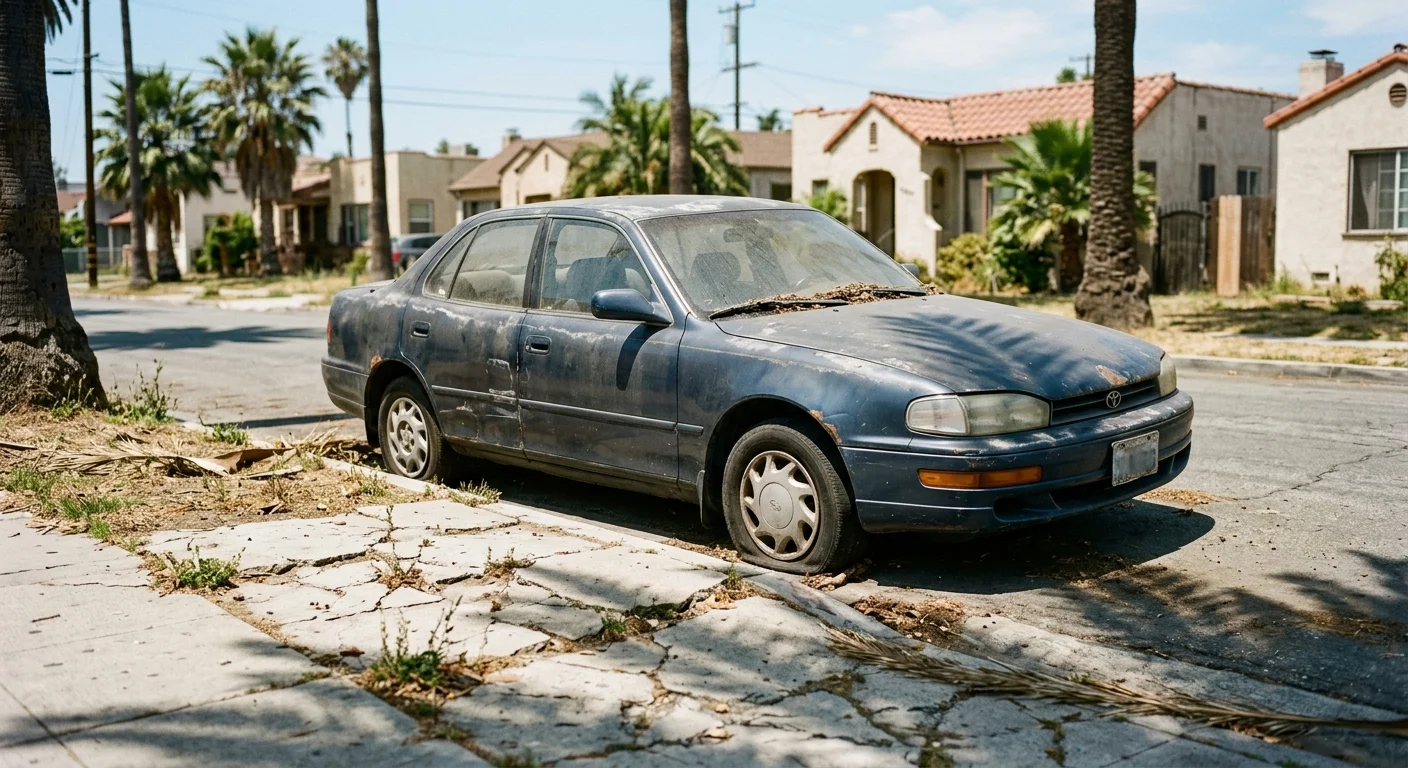
A weathered sedan can sit on a cracked South Los Angeles curb for weeks, while the same car on a freeway shoulder is gone the same day. Abandoned vehicle laws in California follow the ground under the tires: a City of LA street, a private lot, a CHP shoulder, or a Sheriff’s station area. The search is statewide. The rules you actually hit are local.
What abandoned means on LA County streets and lots
People treat “abandoned” as if California stamps a date on the windshield. It doesn’t, not as one countywide title event with a single code cite. What we can quote is how the City of Los Angeles treats a car that sits, how a private lot is different, and how a freeway shoulder is different again.
Inside the City of Los Angeles, a vehicle may not stand on a city street or alley for 72 or more consecutive hours. That is Los Angeles Municipal Code 80.73.2, read with the California Vehicle Code. A Traffic Officer has to inspect the car and observe it over that period. The street-storage clock, including what a report does and does not do, is on the 72-hour rule. A complaint alone doesn’t move it. If the car hasn’t moved after that watch, the city may impound it. That 72-hour rule is also how long a car can sit in front of your house on a City of LA curb. The curb is still a public street.
If the car is inoperable and a public hazard, California Vehicle Code 22669 authorizes an immediate tow.
California Vehicle Code 22651 lists other times a peace officer may remove a vehicle, including a hazard, five or more unpaid citations, 72-plus hours, and expired or missing registration. Under 22651(o)(1)(A), a vehicle may be removed when its registration has been expired more than six months before it is found or operated on a highway, public land, or an off-street parking facility.
A private lot doesn’t run on that city-street clock. An ex’s car in your driveway for eight months is usually a private-property problem. Sitting that long still doesn’t make the car yours.
On CHP-served highways, the California Highway Patrol clears disabled and collision vehicles through its Rotation Tow Program. Unincorporated county roads fall to the LA County Sheriff’s Department, which runs no central impound. Each station directs its own tow. A sitter in Pacoima that’s still inside City of LA limits goes through the city’s Official Police Garage system. A sitter on an unincorporated stretch, or in Long Beach, Burbank, or Pasadena, does not. City of LA Official Police Garage rates don’t apply outside the City of Los Angeles.
Who can report or remove an abandoned vehicle
You can report a car. You can’t take it. On a City of LA street, use the Parking Violations Bureau stored and abandoned vehicle process, or dial 311. Have the location, the plate or VIN if you can see one, and a short description. A Traffic Officer still has to observe a 72-hour sitter. They can move faster when the car is a public hazard.
A report isn’t a bid for your neighbor’s title. The city isn’t handing you the car.
In unincorporated Los Angeles County, contact the local LA County Sheriff’s station. On a freeway or other CHP-served highway, contact the California Highway Patrol. Long Beach, Burbank, and Pasadena each run their own programs. Long Beach stores city tows at 3111 E. Willow Street. Pasadena handles abandoned and abated releases in person at its Parking Office. Burbank requires an impound release from Burbank PD, then payment at the yard.
If the car is already in a City of LA Official Police Garage, search the OPGLA VIIC public database at opglaviic.com by plate or VIN. There are 17 designated Official Police Garages. Release still runs through the impounding LAPD Area station, then payment at the garage.
On a private lot, the owner or manager may authorize a licensed operator when California Vehicle Code 22658 conditions are met. We keep that statute on its own page so this one stays on public abandonment. If the car is in your space or on your driveway, start with private property towing.
Quick Tow LA connects LA County callers with local, licensed operators. We don’t hold a Motor Carrier Permit. The operator you’re connected with does the pickup, and you contract with that operator.
How junk removal differs from an abandoned-vehicle tow
The fork is ownership.
If the car is yours, and you want it gone, that’s a junk or scrap pickup, not an abandoned-vehicle enforcement tow. You’re hiring an operator to take a vehicle you have the right to dispose of. The pros we send handle junk car and abandoned vehicle removal as a referred job. You contract with the operator. We don’t buy the car, store it, or run a yard.
If the car isn’t yours and it sits on a public street, you report it. You don’t call a junk driver and point at your neighbor’s Civic. An enforcement tow goes to an Official Police Garage in the City of LA, or to the lot that city or Sheriff’s station uses. Storage and release follow that agency. As of January 1, 2026, City of LA Official Police Garage daily storage for a standard vehicle is $68.00 on a credit card and $66.00 if you pay another way, plus a $115.00 vehicle release fee under LAMC 80.77.1. Those city figures don’t apply in Long Beach, Burbank, Pasadena, or Sheriff’s station tows.
If the car isn’t yours and it sits on your private property, you’re in the private-property lane, not the junk-title lane. You still need the 22658 process, not a scrap run that pretends you own it.
Families mix these up after a breakup, a death, or a roommate who left. If the registered owner will sign, you may be in junk-removal territory. If they won’t, and the car is on your lot, you need a private-property tow. If it’s on the curb, you file a stored-vehicle report.
A junk pickup also doesn’t replace what happens if you leave a car in a tow yard. An impounded car accrues storage. It can move into a keeper’s lien. That’s a yard process, not a way to skip ownership.
Title and paperwork issues before the car leaves
Don’t treat an abandoned-looking car as a free title. California’s DMV has a lien sales and abandoned vehicles process. That process is for keepers, public agencies, and people who actually have a legal path. It isn’t a DIY claim on the Civic that’s been on your block since spring.
If you own the junker, gather the paperwork before the operator arrives. We already mapped that path in paperwork to junk a car in California. This page won’t repeat those forms.
A garage keeper’s or tow lien under Civil Code 3068 depends on possession. It covers repairs, labor, supplies, and storage or parking. It arises when a written statement of charges is presented, or 15 days after the service, whichever is first. That’s when a lien can arise. It isn’t a published timeline for a sale, and it isn’t a dollar figure.
After a vehicle is stored 30 days, California Vehicle Code 10652 requires the keeper to report it to the Department of Justice, which notifies the owner. That’s a reporting trigger before a lien sale, not the sale procedure itself. Lien-sale processing fees follow California Civil Code 3074. This page doesn’t list a specific lien dollar amount from that schedule.
Taking ownership of an abandoned vehicle as a private person is a common search. We couldn’t confirm a clean private-person title pathway. Don’t assume you can wait out an ex, file a form, and walk into DMV for a title. Ask DMV. If a yard already has the car, you’re in a storage and lien problem, not a found-car windfall.
If you’re the registered owner trying to recover a car the city already towed, you’re in a release process, not an abandoned-title process. City of LA release still needs the police release from the impounding LAPD Area station, then payment at the Official Police Garage.
What we could not confirm and who to call to check
Some questions that sit next to this search don’t have a number we can publish.
We couldn’t confirm a single statewide hour count that turns every parked car in California into an “abandoned” vehicle for title purposes. The 72-hour rule we cite is a City of Los Angeles street and alley rule, tied to LAMC 80.73.2 and the Vehicle Code, with officer observation. We couldn’t confirm the same hour count as a published LASD, CHP-shoulder, or unincorporated-county figure.
We couldn’t confirm that a private person can take title to a car left at their home, even after eight months. We couldn’t confirm holding periods, auction dates, or low-value disposal steps beyond the Civil Code 3068 lien trigger and the CVC 10652 thirty-day DOJ report. We don’t publish a Glendale impound-release dollar amount, an LASD release admin fee, or any Santa Monica tow schedule. Secondary sources conflict, or no primary page turned up.
CHP doesn’t publish one uniform statewide rotation rate. We also couldn’t confirm CVC 2424 as the specific rotation authority, so we don’t cite it. City of LA Official Police Garage hours for release are 7:00 a.m. to 7:00 p.m., in person. There is no City-set after-hours gate fee on the LA OPG schedule.
For City of LA streets, use the Parking Violations Bureau stored and abandoned vehicle page, or 311. For a freeway shoulder, use CHP. For unincorporated roads, use the local Sheriff’s station. For title and lien-sale procedure, use the California DMV handbook linked above. For a car you own and want hauled, call us and we connect you with a licensed operator.
Don’t guess a code section from a forum post. If a rule isn’t on the city, CHP, or DMV page that sets it, treat it as unconfirmed.
When to call us
Call when the car is yours to dispose of, or when you’re the property owner asking for a lawful private-lot pickup, and you need a licensed operator rather than a DIY drag off the curb. We connect you with local pros for junk and abandoned pickups. Call any time, day or night. Call (213) 410-1414 to reach dispatch.