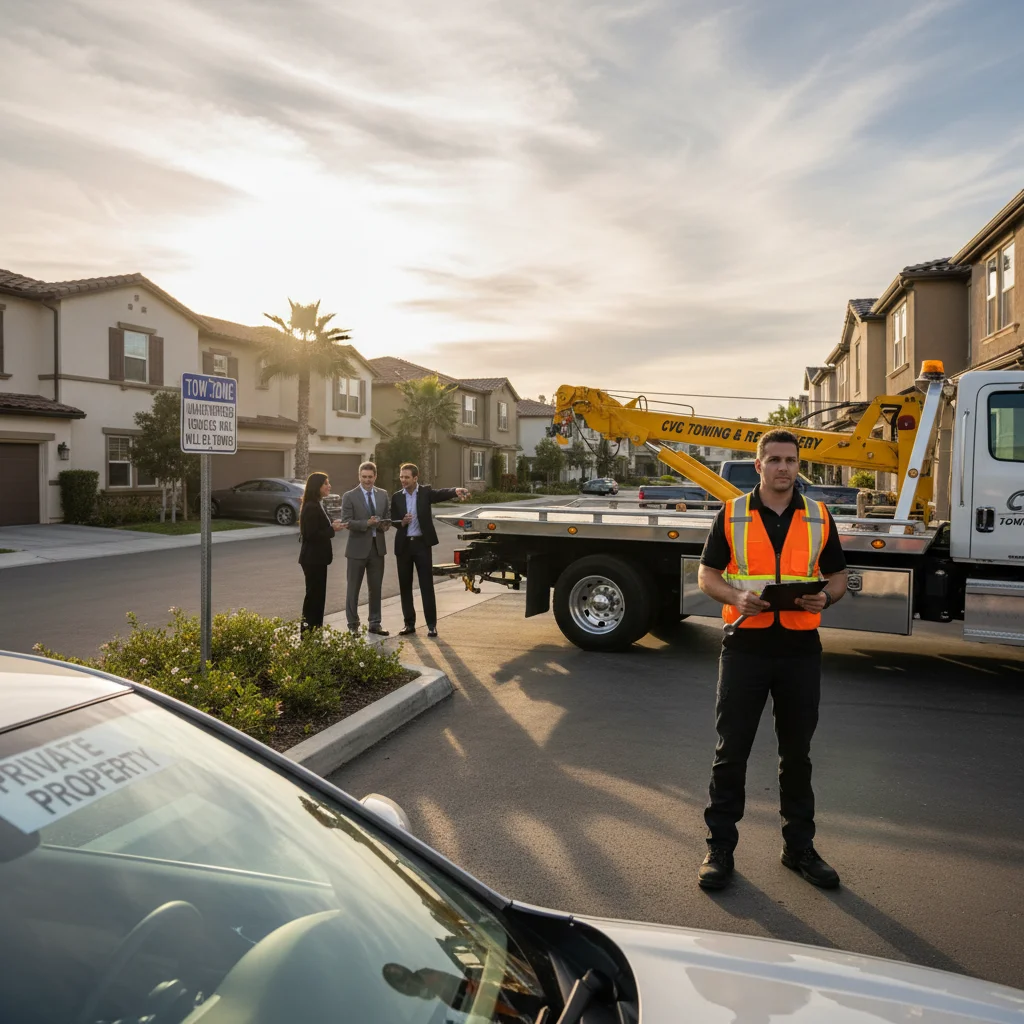
If you manage an apartment complex in Reseda, an HOA in Long Beach, a condo association in Pasadena, a retail center in Glendale, or any other LA County property where vehicles are parked, California Vehicle Code 22658 governs every private property tow you authorize. Get the details wrong and your property ends up on the wrong side of a four-times damages claim. Here is the plain-English version, with the parts people most often get backwards, written for LA County properties.
This is general information about a public statute, not legal advice. For a specific situation, talk to a California attorney.
What does CVC 22658 actually do
CVC 22658 is the California statute that lets private property owners have unauthorized vehicles removed, and it dictates exactly how. It cuts both ways. Vehicle owners get specific rights, and property owners and tow companies carry specific obligations.
What gives a property the right to tow
Here is the part most explainers get wrong. The statute says an owner may cause a vehicle’s removal “under any of the following circumstances,” then lists four. They are alternatives. You need one.
- Compliant signage posted in plain view at all entrances.
- A notice of parking violation was issued and 96 hours have passed since it was issued.
- The vehicle is inoperable (missing an engine, transmission, wheels, tires, doors, windshield, or another major part needed to drive safely), local traffic law enforcement was notified, and 24 hours have passed.
- The lot is improved with a single-family dwelling.
Most apartment, HOA, and retail enforcement runs on the first one. That is why signage gets so much attention. But if your signs are down and a car has been sitting on flat tires with no engine for a week, ground three still exists.
CVC 22658 only covers a property owner removing an unauthorized vehicle. It has nothing to do with a lender taking a car back over missed payments. That is repossession, and different rules apply.
What signage does CVC 22658 require
The statute is specific. Signs must be:
- At least 17 by 22 inches, with lettering at least one inch high.
- Displayed in plain view at all entrances to the property.
- Prohibiting public parking, and stating that vehicles will be removed at the owner’s expense.
- Carrying the telephone number of the local traffic law enforcement agency.
- Carrying the name and telephone number of each towing company that is party to a written general towing authorization agreement with the property.
That law enforcement phone number is the requirement properties miss most often. A sign with your tow company’s name and number but no police or sheriff number does not meet the statute.
Faded, obscured, or missing signs undercut a tow taken on ground one. If signage is your basis and the signage does not comply, you do not have a basis.
Do you need written authorization for every private property tow
Yes, and the requirement is stricter than most property managers think.
Under CVC 22658(l)(1)(A), a towing company cannot remove or start removing a vehicle without first getting written authorization from the property owner or lessee, or an employee or agent, who is present at the time of removal and verified the violation. An HOA or common interest development association counts as the property owner here.
There is one narrow exception. Presence and verification are not required when all of this is true:
- The property is a residential rental of 15 or fewer units with no onsite owner, agent, or employee.
- The person authorizing is the owner or the owner’s agent, and that agent is not a tow operator.
- A tenant verified the violation and requested the tow from that tenant’s own assigned space.
- The tenant provided a signed request or email, or called and provided one within 24 hours.
- The owner or agent gives that request to the towing company within 48 hours.
The written authorization itself has to record the vehicle’s make, model, VIN, and plate; the name, signature, job title, address, and working phone of the person authorizing; the grounds for removal; and the times the vehicle was first observed and the tow was authorized.
Can you just let the tow company patrol and pull cars
Mostly no, and this is the single most expensive misunderstanding on this topic.
CVC 22658(l)(1)(E)(i) says general authorization to remove a vehicle at the towing company’s discretion cannot be delegated to a tow company, with three exceptions. A tow company can act on standing authorization only when a vehicle is:
- Unlawfully parked within 15 feet of a fire hydrant.
- In a fire lane.
- Parked so it interferes with an entrance to or exit from the property.
Outside those three, a roving patrol pulling cars on its own judgment is the setup that generates wrongful-tow claims against both the tow company and the property. A written service agreement is still worth having. It just cannot substitute for someone present who verified the violation.
Is there a one-hour wait before towing
Sometimes, and it is not in CVC 22658 at all.
The one-hour rule is CVC 22953. It applies to “private property that is held open to the public, or a discernible portion thereof, for parking of vehicles at no fee.” That means retail lots, shopping centers, and similar free public parking. On that kind of property, the owner cannot tow a vehicle within one hour of it being parked.
CVC 22953 expressly exempts residential property parking, along with designated hotel and motel parking. So if you run an apartment complex, condo, or HOA lot, the one-hour rule is not your rule. Plenty of guides tell HOA boards the wait is mandatory. It is not, and acting on that misreading can cost you enforcement you are entitled to.
Even where the one-hour rule does apply, a vehicle can be removed immediately when it is within 15 feet of a fire hydrant, in a fire lane, interfering with an entrance or exit, or parked in a space designated for disabled persons.
What are the notification requirements after a tow
CVC 22658(f) requires notice to the local traffic law enforcement agency within one hour after authorizing the tow, by telephone or, if that is impractical, by the fastest means available.
Treat that as a duty with a clock on it, not a formality. It is how a vehicle owner finds their car. It is also one of the first things examined when a tow gets disputed.
How does vehicle release work
- Vehicles must be available for release during normal business hours, defined in the statute as Monday through Friday, 8 a.m. to 5 p.m., except state holidays. Many yards run broader hours.
- The yard must accept a valid bank credit card or cash. Cash-only is not compliant.
- If the vehicle is released within 24 hours, only one day of storage may be charged.
- Proof of ownership, typically registration plus a driver’s license, is standard.
CVC 22658 does not set a dollar cap on release or storage fees. Rates in LA County vary by operator and by jurisdiction. What the statute does is tie excessive charges to approved law enforcement and CHP rates rather than to a fixed number. If you have seen a specific dollar ceiling quoted as the legal maximum, treat it with suspicion and check the ordinance that supposedly sets it.
What happens when someone gets this wrong
CVC 22658 has real teeth. A violation can carry a fine of up to $2,500 and up to three months in county jail. Separately, a party that violates the section can be civilly liable to the vehicle owner for four times the amount of the charges involved.
That four-times exposure is why the written authorization and presence requirements are worth taking literally.
What should HOA boards and property managers do in LA County
- Audit your signage at every entrance. Check the 17 by 22 minimum, the one-inch lettering, the current tow company name and number, and the local law enforcement number. Check it is legible at driving speed.
- Fix the authorization workflow. Decide who is authorized to verify a violation and sign, and make sure that person is actually present when a tow happens. Put the list in writing.
- Know which grounds you are towing on. Signage, 96-hour notice, inoperable vehicle, or single-family lot. Whoever authorizes should be able to name it.
- Document every violation with a timestamped photo. If a resident disputes it later, the photo is the record.
- Do not hand over discretion. Keep standing tow-company discretion limited to fire lanes, hydrants, and blocked entrances, which is where the statute allows it.
- Communicate with residents. Post rules clearly, remind people about assigned parking, and give notice before a crackdown. Predictable enforcement produces fewer tows and fewer complaints.
What mistakes lead to wrongful-tow claims in LA
- Treating the four grounds as a checklist. They are alternatives. Requiring all four of yourself just costs you enforcement.
- Towing on signage that does not comply, most often because the law enforcement phone number is missing.
- Letting a tow company patrol and decide, outside the fire lane, hydrant, and blocked-entrance exceptions.
- Authorizing by phone with nobody present who verified the violation, when the 15-or-fewer-unit tenant exception does not apply.
- Applying the CVC 22953 one-hour rule to a residential lot where it does not apply, or ignoring it on a free public lot where it does.
- Refusing to release a vehicle over a dispute between the owner and the HOA. That is never a valid reason to hold a car.
How Quick Tow LA fits in
Quick Tow LA is a referral line that matches LA County properties (apartments, HOAs, condo associations, retail lots) with local licensed operators who run compliant enforcement: a sign audit at every entrance, written authorization on every tow, and photo documentation. Operators dispatch with the proper presence and the proper paperwork. The vehicle owner pays the tow and storage fees, not the property.
If your enforcement is haphazard or your board is nervous about liability, we can walk through your setup and point out the gaps.
One note on enforcement philosophy
The best private-property enforcement prevents tows by being predictable. Residents who know the rules and see them applied consistently stop testing them. Retail customers who see clear signage tend to park in the right spot.
Random, aggressive enforcement generates complaints, claims, and resident turnover. Consistent, documented enforcement generates compliance.
Related reading
For the practical step-by-step on calling a tow for illegal parking on your property, see how to tow a car from your Los Angeles property. For signage requirements specifically, see California private property towing sign requirements. If you think a tow done to your car was wrongful, see when a private property tow is illegal in California. For a broader look at what towing costs in LA County, see the LA tow cost breakdown.
Frequently asked questions
Does a tow company have to wait an hour before towing from private property in California?
Only on property held open to the public for free parking, and that rule is CVC 22953, not 22658. CVC 22953 expressly exempts residential parking, so it does not apply to apartment, condo, or HOA resident lots. Even where it applies, vehicles in a fire lane, within 15 feet of a hydrant, blocking an entrance, or in a disabled space can be removed immediately.
What size do private property tow signs need to be?
At least 17 by 22 inches with lettering at least one inch high, posted in plain view at every entrance. The sign must prohibit public parking, state that vehicles will be removed at the owner’s expense, and carry both the local traffic law enforcement phone number and the name and phone number of each tow company under written agreement with the property.
Can a property manager authorize a tow over the phone?
Usually not. CVC 22658(l)(1)(A) requires written authorization from someone who is present at the time of removal and verified the violation. The exception is a residential rental of 15 or fewer units with no onsite staff, where a tenant verified the violation and requested the tow from their own assigned space in writing.
Can an HOA tow a car with expired registration from the parking lot?
Not on that basis alone. Expired registration is a DMV and law enforcement matter, not one of the four grounds in CVC 22658(a). If the vehicle is genuinely inoperable and missing major parts, ground three may apply after notifying law enforcement and waiting 24 hours.
Does the tow company have to notify police after a private property tow?
Yes. CVC 22658(f) requires notice to the local traffic law enforcement agency within one hour after the tow is authorized, by phone or the fastest available means.
If you have questions about how this applies to your LA County property, talk to a California attorney. For dispatch of a compliant private-property tow, call Quick Tow LA at (213) 410-1414.