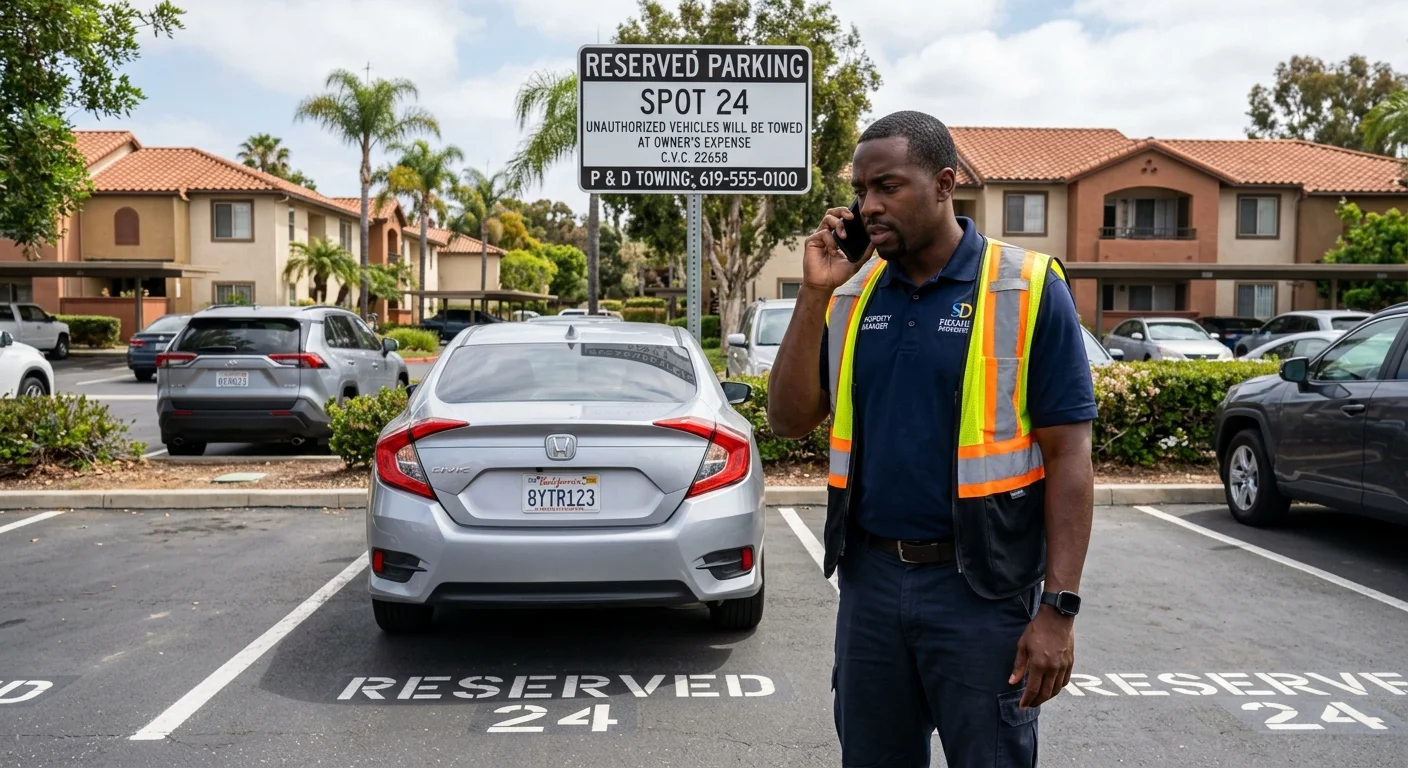
A vehicle parked illegally on your property in LA County can be removed under California Vehicle Code 22658. Six steps make the tow hold up legally. Skip one and the tow can be reversed, and your property ends up exposed. Here is the order, written for LA property owners and managers.
Quick Tow LA is not the tow operator that runs the hookup. We connect LA County properties with local licensed operators who handle the removal under the statute, and we make sure each step above is signed off before the truck is called.
Step 1: Confirm the parking violation
Before anything else, make sure the vehicle is actually parked illegally. The most common triggers in LA County apartments, condos, retail centers, and HOAs:
- Blocking a fire lane, driveway, or entrance
- Parked in a reserved or permit-only spot without a valid pass
- Occupying a handicapped space without a placard
- A vehicle left abandoned for a stretch in a common area
- An unauthorized vehicle in a tenant-only or employee-only lot
Check for any permits, placards, or passes visible on the car. If you are unsure, wait and confirm before calling. A tow you cannot prove was justified creates more problems than the original violation.
Your property’s signage also matters here. If your signs don’t meet California’s requirements, you may not have standing to tow at all. See our California private property towing sign requirements guide to confirm your lot is covered before you dispatch.
Step 2: Document everything with photos
Take photos before you call anyone. The photos are your protection if the vehicle owner disputes the tow afterward.
Photograph:
- The license plate, make, model, and color of the vehicle
- The specific violation (blocked fire lane, wrong spot, no permit visible)
- The posted signage indicating parking restrictions
- The surrounding area to establish location context
- Timestamp data, which most phones embed automatically
Write down the date and time you first noticed the violation, the plate number, and the exact location on your property. For abandoned vehicles, note each observation over multiple days. This record proves the tow was authorized under CVC 22658.
Step 3: Call a licensed LA-area private-property towing service
Now call a towing company that handles private-property impounds. Specify that you need a tow under CVC 22658 so the dispatcher knows the paperwork that comes next.
Quick Tow LA connects LA County properties with licensed local operators for private-property towing across apartments, HOAs, retail centers, and commercial lots. When you call, have ready:
- Your name and role (owner, manager, HOA board representative)
- The property address and where on the lot the vehicle is parked
- The plate number, make, model, and color
- The nature of the violation
Do not attempt to move the vehicle yourself or arrange for anyone else to do so. Your role is to document and authorize. The licensed tow operator handles the rest.
Step 4: Provide written authorization
Under CVC 22658(l), whoever authorizes the tow must provide written authorization. That includes:
- The vehicle’s make, model, VIN, and license plate
- Your name, signature, job title, address, and working phone number
- The grounds for removal
- The time the vehicle was first observed and the time the tow was authorized
You generally need to be there. CVC 22658(l)(1)(A) requires the person signing to be present at the time of removal and to have verified the violation. The exception is narrow: a residential rental of 15 or fewer units with no onsite owner, agent, or employee, where a tenant verified the violation and requested the tow from their own assigned space in writing.
The operators we dispatch bring the paperwork. You sign it when the driver arrives. This form is what legally protects you, so read it carefully before signing.
Step 5: Law enforcement gets notified within one hour
CVC 22658(f) requires the local traffic law enforcement agency to be notified within one hour of the tow being authorized, by telephone or the fastest available means. For most LA County properties, that is LAPD, the LA County Sheriff’s Department, or a local city police department, depending on jurisdiction.
This notification prevents the vehicle owner from filing a stolen-vehicle report. Operators we dispatch handle this step as part of every tow they run, with a documented timestamp. For a full breakdown of what CVC 22658 requires from both property owners and tow operators, see our CVC 22658 explainer.
Step 6: The vehicle owner pays, not you
Under California law, towing and storage fees fall on the registered owner of the illegally parked vehicle. You do not pay for the tow. The owner pays the tow company when they retrieve the car.
This holds as long as the process was followed correctly: a valid ground under CVC 22658(a), signed authorization from someone who verified the violation, and law enforcement notification. If a step was skipped, the property owner can end up liable, and a party that violates the section can be civilly liable to the vehicle owner for four times the amount of the charges involved. That is why each step above matters.
For a deeper look at the compliance steps property managers need to complete before calling for a tow, see our post on how to legally tow a car from private property in Los Angeles.
What makes a private-property tow in LA County illegal (and costly)
The mistakes that expose LA County property owners to liability:
Non-compliant signage. Signs must be at least 17 by 22 inches with lettering at least 1 inch high, posted in plain view at every entrance, and must carry the local traffic law enforcement phone number plus the name and phone number of each tow company under written agreement with the property. That law enforcement number is the element most properties leave off. Full requirements: California private property towing sign requirements.
Misreading the waiting rules. CVC 22658 has no general waiting period, so towing on compliant signage does not require a 24-hour delay. The one-hour rule people cite is CVC 22953. It covers property held open to the public for free parking, and it expressly exempts residential parking. Applying the wrong rule in either direction causes problems.
No written authorization, or nobody present. Verbal approvals are not enough. CVC 22658(l)(1)(A) requires written authorization from someone present at the time of removal who verified the violation, outside the narrow exception for residential rentals of 15 or fewer units with no onsite staff.
Letting the tow company decide. Standing authorization for a tow company to remove vehicles at its own discretion is limited to fire hydrants, fire lanes, and blocked entrances.
Skipping the police notification. One hour from authorizing the tow. It is a statutory duty and one of the first things examined in a dispute.
Using an unlicensed operator. The tow company must be licensed and carry insurance. A fly-by-night operator leaves you exposed if anything goes wrong.
If you think a tow that was done to your vehicle was wrongful rather than valid, that is a different situation. See our post on when a private property tow is illegal in California for the vehicle-owner perspective.
Frequently asked questions
Who pays for towing an illegally parked car from private property in Los Angeles?
The registered owner of the illegally parked vehicle pays the towing and storage fees directly to the tow company upon retrieval. The property owner pays nothing, as long as the tow was authorized correctly under CVC 22658.
How quickly can a car be towed from a private LA County lot?
Immediate towing is allowed for vehicles blocking fire lanes, ADA spaces, driveways, or entrances. For standard unauthorized parking in a common area, the operator confirms what applies to the situation before dispatching. CVC 22658 has no general waiting period when compliant signage is in place.
Do I need a towing company sign on my LA property to tow illegally parked cars?
Yes. For most private-property situations, California law requires posted signs at every vehicle entrance that include the towing company’s name and phone number. Without compliant signs, any tow you authorize is legally vulnerable. Ask the operator to confirm signage compliance before dispatch.
Can I tow a car blocking my private LA County driveway without a sign?
In many cases, yes. Under CVC 22658, a vehicle completely blocking access to a single-family dwelling’s driveway can be removed without posted signage. Confirm with the dispatcher before the truck rolls.
What is the difference between a private-property tow and a CHP or LAPD tow in Los Angeles?
A private-property impound is authorized by the property owner under CVC 22658 and handled by a private tow company. A police tow is ordered by law enforcement and handled by a police-contracted company. Both require law-enforcement notification and follow regulated fee schedules. If your car is in a yard, see our post on getting a car back from impound.
If you have confirmed the violation and have your documentation ready, the next move is a documented dispatch. Quick Tow LA connects LA County properties with licensed operators who run compliant enforcement: a sign audit at every entrance, written authorization on every tow, and photo documentation. Call (213) 410-1414 to set up a Los Angeles private-property tow.