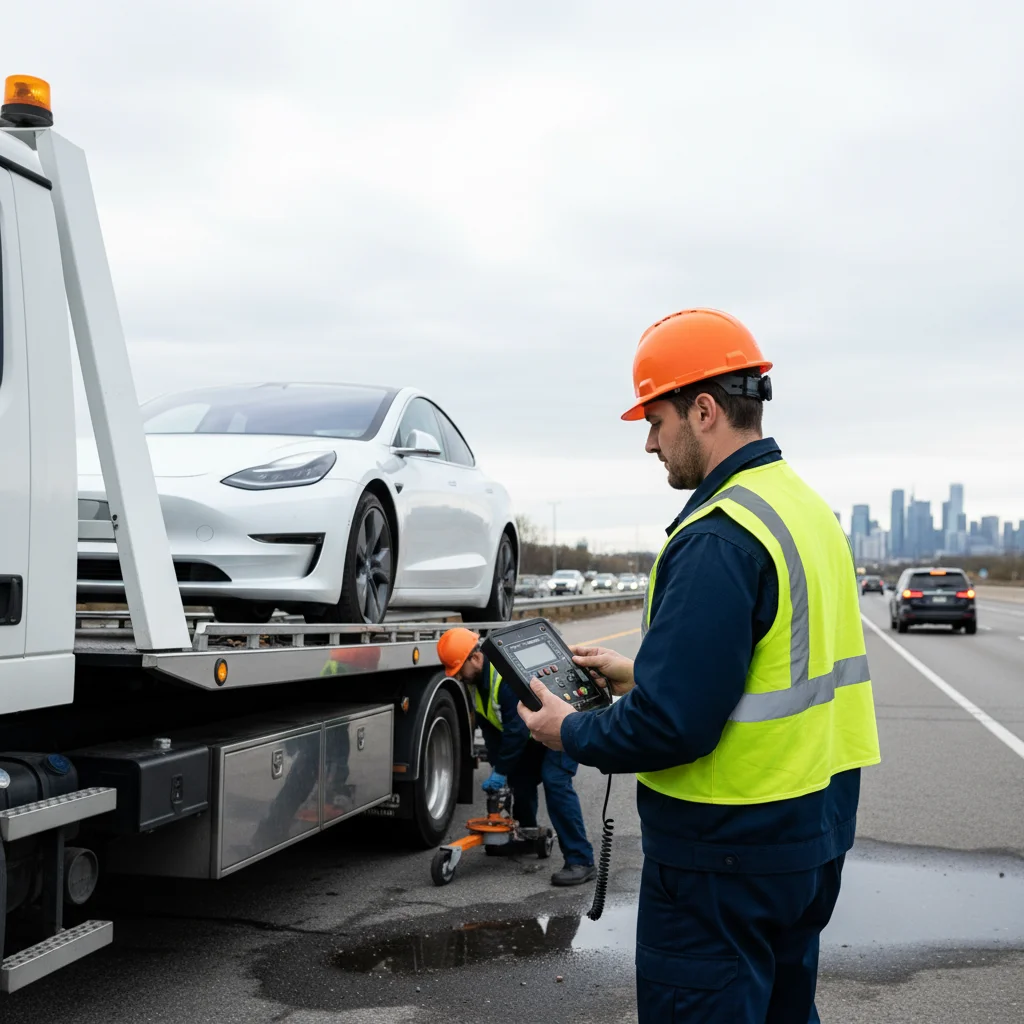
Every electric vehicle, whether a Tesla, Rivian, Lucid, Ford, Hyundai, Kia, BMW, or VW, must be towed on a flatbed with all four wheels off the ground. There are no exceptions. The reason is mechanical, and it is the same on the 405 through Sepulveda Pass, on PCH through Malibu, and on the 110 in downtown.
Quick Tow LA does not publish a brand price for an EV flatbed. No operator with a rate card has signed yet. The cost conversation is qualitative, focused on why the equipment matters and what an EV-specific job looks like, not what the brand charges.
Why you cannot wheel-lift an EV
In a gasoline car with an automatic transmission, the driveshaft and transmission let the wheels spin freely when you shift to neutral. A wheel-lift raises two wheels; the other two roll on the road with no internal drivetrain drag.
An EV does not work that way.
The drive motors in every modern EV are permanently connected to the wheels through a single-speed reduction gearbox. When the wheels roll, the motor spins. There is no clutch, no neutral, nothing to disconnect the motor from the wheels.
When a motor spins without the car’s computer managing it, two bad things happen:
- The motor generates electricity. That regenerated voltage has nowhere to go because the inverter is not awake to manage it. The voltage can damage the motor windings, the inverter, and the battery management system.
- The gearbox dry-runs without proper cooling. The drive motor has no standalone oil pump; cooling depends on the main traction loop being active. Dry-running at speed for miles damages the gearbox internals.
Either repair runs into the thousands of dollars, often five figures, and is not covered under any manufacturer warranty because the damage came from an improper tow, not a defect.
Do not do it. Always flatbed.
Do tow dollies or tow bars work on EVs
Some towing companies try to work around it with a wheel dolly, putting both drive wheels on a small rolling platform. That approach works only as long as the dolly stays in perfect alignment and moves at low speed. Any significant mileage still damages the drivetrain. A wheel-lift truck is designed for conventional drivetrains, not EVs.
Tow bars, where the EV’s front or rear hitch is attached to the back of a motorhome for example, never work on EVs. The wheels are on the ground, the motors still spin, and the damage still happens.
The only safe method is a flatbed with all four wheels off the ground.
What is transport mode and why every EV tow needs it
Most EVs have a parking pawl built into the drive unit. When the car is in Park, a small steel pin locks a gear inside the drivetrain, preventing the car from rolling. Great for parking on hills, a problem for loading onto a flatbed.
Before the car can roll onto the flatbed deck, the parking pawl must disengage.
Tesla transport mode (current steps):
- Press the brake pedal.
- Put the vehicle in Neutral.
- Hold the brake for at least 5 seconds until the “Transport Mode” notification appears.
- The car rolls freely for up to 15 minutes of transport at under 30 mph.
Instructions vary slightly by software version; check the in-car manual or the owner’s manual.
Rivian, Lucid, Mustang Mach-E, and most modern EVs have similar procedures with model-specific menu paths. A driver who knows common EV models can walk through this. For new or unusual EVs, the owner’s manual is the authority.
If the 12V battery is dead, transport mode may not engage. Procedures exist for this: most EVs have an external 12V jump terminal behind a cover in the frunk or engine bay. A portable jump pack can wake the electronics long enough to set transport mode, then the car loads normally.
What a proper EV flatbed load looks like
A proper EV flatbed load follows these steps:
- The driver confirms the vehicle is an EV and asks about battery state (dead, low, normal).
- If needed, a 12V jump wakes the electronics.
- The owner or driver engages transport mode per the specific procedure for that vehicle.
- The flatbed deck tilts to ground level, and the approach ramp deploys.
- The winch cable attaches to the vehicle’s tow point. Every EV has one, usually a threaded hook that screws into the front or rear bumper.
- The vehicle is winched onto the flatbed deck at slow speed.
- All four wheels are secured with soft-strap wheel nets, never chains, never frame hooks.
- The driver takes photos of the load point, strap positions, and vehicle condition.
- Transport mode can be exited once the car is fully loaded and secured.
Loading time runs 10 to 15 minutes for a straightforward EV load, 20 to 30 for a complicated scenario such as a dead 12V, a tight location, or a damaged car.
What can go wrong during an EV tow in LA
A few LA-specific scenarios worth thinking through:
Scenario 1: Dead 12V battery, vehicle will not shift to neutral. Fix: portable jump pack on the 12V terminals. Every reputable EV tow driver carries one.
Scenario 2: Car is locked, no key fob available. Most EVs have manual key access (hidden slot for a physical key). For Teslas specifically, the phone key can unlock; failing that, the front door handle has a manual release. Tell dispatch the scenario so they can unlock remotely through the owner’s app if applicable.
Scenario 3: Damaged wheel or suspension prevents normal rolling. Fix: wheel-net tow dolly under the damaged wheel; winch onto flatbed at very low speed; careful rigging. Takes longer but is safely possible.
Scenario 4: Vehicle partially submerged. Do not start transport mode or any electrical wakeup. Water in battery compartments is a fire risk for days. Move the vehicle by dead-lift winch only, keep it outdoors away from structures, and notify the owner about deferred electrical inspection before any shop work.
What to tell the dispatcher when your EV needs a tow
When you call for a tow on an EV:
- “It is an EV.” First sentence. Nothing else matters until they know.
- Year, make, model (Tesla Model 3, Rivian R1S, etc.)
- Battery state (dead, low, normal, if you can tell)
- Location and destination
- Any damage to wheel, suspension, or body
A good dispatcher routes the right low-clearance flatbed, assigns a driver who knows EV procedures, and confirms the equipment on the phone.
What should you expect on the bill
Operators price each job for the vehicle and the route, not by the city. An EV flatbed runs slightly slower than a standard wheel-lift because of the loading procedure, but the equipment is the same flatbed everyone else uses. Some operators try to layer an “EV surcharge” on top of standard flatbed rates. That is not a meaningful additional service in most cases. Ask the operator to walk through exactly what the line item covers.
If your EV just needs a charge to drive away under its own power, mobile charging options exist in LA County that bring a charge to the car before the flatbed gets dispatched.
Bottom line
No EV should ever be towed with wheels on the ground. Flatbed, soft straps, transport mode engaged. Any other method damages the vehicle in ways the warranty does not cover. In LA County, every operator we dispatch confirms the EV before the truck rolls, brings a low-clearance flatbed, and secures all four wheels with soft straps.
EV flatbed tows run across LA County, from the 405 in Westwood down to the South Bay, out to Long Beach (which runs its own impound program), into the San Gabriel Valley, and up the 5/14 split toward Santa Clarita and the Antelope Valley. Call (213) 410-1414 and tell dispatch what you are driving.
Related reading
For a broader look at how LA tow costs are built, see how much a tow costs in Los Angeles. For longer hauls like an EV headed out of state, see long-distance tow from Los Angeles.
Frequently asked questions
Can you tow a Tesla with a wheel-lift truck?
No. Tesla explicitly states that no Tesla should ever be towed with any wheels on the ground. The drive motors are permanently connected to the wheels, and rolling them without the car’s electronics managing the system can damage the motor and inverter, an expensive repair not covered by warranty.
What does an EV flatbed cost in Los Angeles?
Operators price each job for the vehicle and the route, not by the city. An EV flatbed is the same equipment as a standard flatbed, with a slightly slower loading procedure. Ask the operator for a single flat-rate written number before dispatch. Companies that charge an “EV surcharge” on top of standard flatbed rates are usually padding the bill.
What is transport mode on an electric vehicle?
Transport mode disengages the parking pawl so the car can roll freely onto a flatbed. On a Tesla, you hold the brake, shift to neutral, and wait for the transport mode notification. Most EVs have a similar procedure through the touchscreen or settings menu.
What do I do if my EV’s 12V battery is dead and it will not shift to transport mode?
Most EVs have an external 12V jump terminal behind a cover in the frunk or under the hood. A portable jump pack can wake the electronics long enough to engage transport mode. Every reputable EV tow driver carries one.