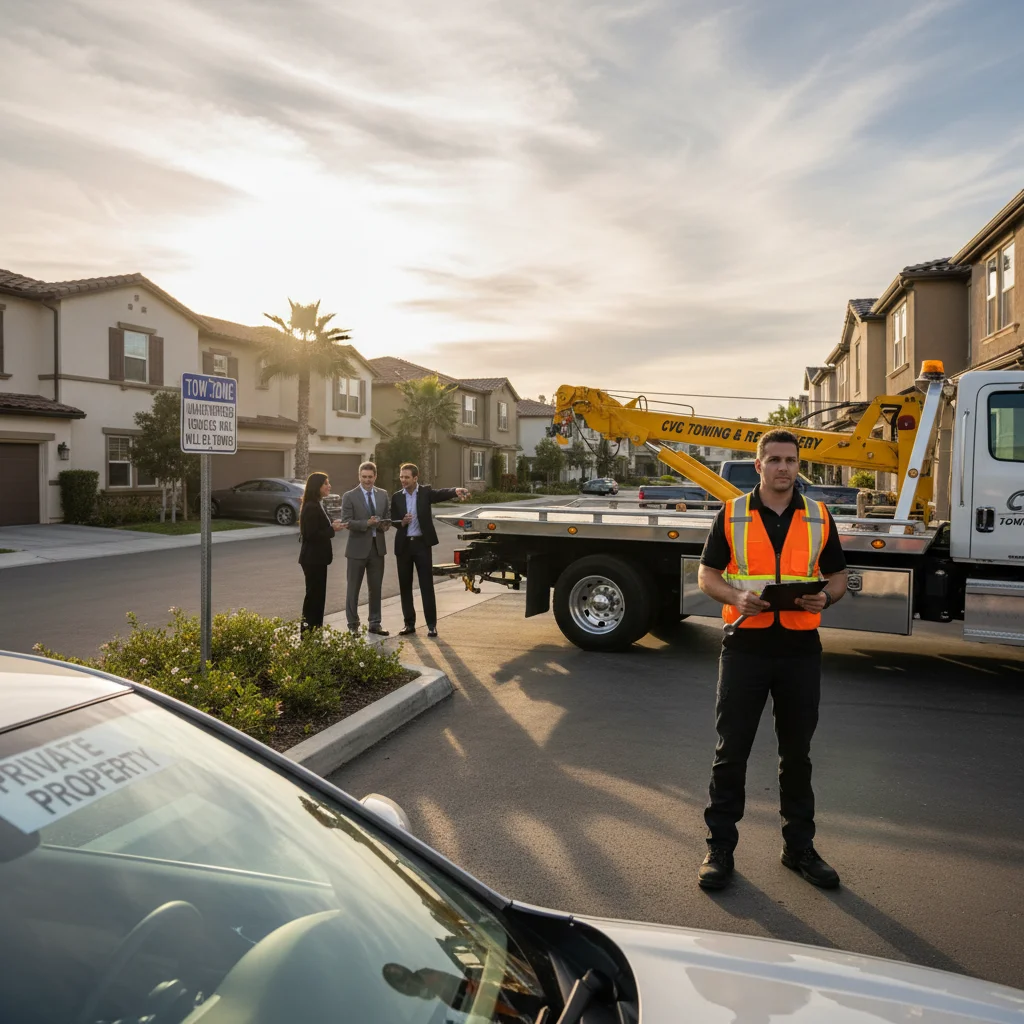
Your car is gone from the carport at your Koreatown apartment or the lot behind a DTLA office, and the only clue is a sign you probably never read closely. California Vehicle Code 22658 is the law that decides whether that sign, and that tow, held up. It applies the same in Long Beach as it does in Reseda, and most drivers only learn what it says after the fact.
This is general information about a public statute, not legal advice. For a specific dispute, talk to a California attorney.
Why this matters more in LA than most places
Los Angeles County is dense multifamily housing: apartment stacks in Koreatown, condo garages downtown, shared retail lots in the Valley, HOA visitor spots from the Westside to the San Gabriel Valley. A huge share of parking here isn’t a driveway you own, it’s a shared lot governed by a sign you drove past without reading. That’s exactly the setup CVC 22658 was written for, and it’s why private-lot tows are a routine complaint in this county, not a rare one.
What the sign has to say, word for word
CVC 22658(a)(1) sets the bar. It’s short enough to quote in full:
There is displayed, in plain view at all entrances to the property, a sign not less than 17 inches by 22 inches in size, with lettering not less than one inch in height, prohibiting public parking and indicating that vehicles will be removed at the owner’s expense, and containing the telephone number of the local traffic law enforcement agency and the name and telephone number of each towing company that is a party to a written general towing authorization agreement with the owner or person in lawful possession of the property.
Four things a compliant sign in an LA lot has to carry:
- A statement that public parking is prohibited.
- A statement that vehicles will be removed at the owner’s expense.
- The phone number of the local traffic law enforcement agency, inside the city of LA, that’s LAPD; other cities and unincorporated county areas point to their own department or the Sheriff.
- The name and phone number of the tow company under written general towing agreement with the property.
Size: not less than 17 by 22 inches, roughly a large tabloid sheet. Lettering: not less than one inch tall. Placement: in plain view at every vehicle entrance to the lot, not just the one closest to the leasing office.
What people assume is required and isn’t
A lot of sign vendors and property managers treat the following as law. None of it is in the statute:
- A phone number staffed 24 hours a day, the law requires a number, not round-the-clock staffing.
- Posted enforcement hours.
- A specific mounting height off the ground.
- Sign lighting for night visibility.
- A separate sign for every subsection of a large lot.
- The statute number printed on the sign itself.
- A minimum number of days the sign must be up before a tow.
None of those are bad practice. A well-lit, legible sign with clear hours cuts down on disputes. But they’re convention, not the statute, and a property can’t be told its tow was invalid because a sign lacked something CVC 22658 never asked for.
One real nuance: signage is only one of four grounds CVC 22658(a) allows for a private tow. A 96-hour-old parking violation notice, an inoperable vehicle 24+ hours after law enforcement was told about it, and a lot attached to a single-family home are the other three. Signage is the one almost every apartment complex, HOA, and shopping-center lot in LA actually relies on.
Where LA signs and tows actually go wrong
No law enforcement number on the sign
The most common defect. The sign lists the tow company clearly and skips the enforcement-agency phone number the statute names outright.
The tow company on the sign isn’t who towed you
A building switches vendors and never updates the signage. Months later a resident disputes a tow and finds the number on the sign doesn’t reach the company that actually hooked the car. The statute ties the sign to whichever company holds a written general towing agreement with that property, current tense.
Undersized sign or lettering
Anything under 17 by 22 inches, or lettering under an inch, doesn’t meet the statute on its face. Worth measuring, not eyeballing, especially on older buildings in Historic Filipinotown or the Valley where signage predates a management change.
Faded, blocked, or vandalism-covered
The law says “in plain view.” A sun-faded phone number or a sticker-covered panel in a downtown parking structure is a real argument the sign wasn’t legible at all.
A second entrance with no sign
Big apartment complexes and shopping centers in LA often have more than one vehicle entrance, a main gate and an alley cut, a garage ramp and a surface lot. One compliant sign at the front doesn’t cover a car that entered through the back.
If you were towed from a private lot in LA
This is where LA’s system trips people up: the tools for a city tow (LAPD, LADOT) and a private-lot tow are different, and mixing them up wastes time.
- Find the sign first. The posted tow company’s name and number is who has your car and who authorized the removal. Call them directly.
- The OPGLA VIIC database at opglaviic.com doesn’t cover this. That lookup tool, and the City’s 17 Official Police Garages, only handle tows LAPD or LADOT ordered, a car towed from your own apartment lot by a private operator never enters that system.
- LAPD non-emergency or 311 can still help if you can’t reach anyone on the sign or suspect the tow wasn’t authorized. They can confirm whether it was a police-ordered removal versus a private one, which tells you which process you’re actually in.
- Check the sign yourself before you argue the tow. If it’s missing the enforcement-agency number, undersized, faded, or names a company that isn’t who towed you, you have a real basis to dispute the charge.
- If you got back before the car left, CVC 22658 lets you demand immediate release for no more than half the posted tow charge, say so on the spot.
- A tow company must notify local law enforcement within one hour of being authorized to remove your vehicle. If a dispute drags on, that hour-notification requirement is worth asking about.
Auditing signage as an LA property manager or HOA board
Drive every entrance. Main gate, alley cut, garage ramp, read the sign from the driver’s seat without stopping.
Measure it. 17 by 22 inches minimum, one-inch lettering minimum.
Confirm all four elements, especially the enforcement-agency phone number, which is the one that goes missing most.
Verify the tow company listed is your current vendor and that the number actually connects.
Fix deficient signs before towing again. A tow made on a non-compliant sign exposes the property, not just the tow company. Violating CVC 22658 can carry a fine up to $2,500 and up to three months in county jail, plus civil liability to the vehicle owner for four times the charges involved.
Photograph every sign after it goes up, dated, showing placement and legibility. That photo is your record if a tow gets disputed later.
Frequently asked questions
Does CVC 22658 apply the same way across LA County? Yes. It’s a state statute, so it applies identically in the City of LA, Long Beach, Burbank, Pasadena, and unincorporated county areas. What differs by city is which agency’s phone number the sign has to list.
My apartment building has one sign at the main gate. Is that enough? Only if there’s one vehicle entrance. Any additional entrance, a garage ramp, an alley cut, needs its own compliant sign.
Can a private lot tow me without any sign at all? Only under the other three grounds CVC 22658 allows: a parking-violation notice 96+ hours old, an inoperable vehicle 24+ hours after law enforcement was notified, or a lot attached to a single-family home. For nearly every apartment, HOA, or retail lot, signage is the ground being used.
Who do I call if I can’t find my car and there’s no sign in sight? Call LAPD non-emergency or 311. If it was a city-ordered tow, they can point you to the OPGLA VIIC lookup. If it was a private lot, they can help you confirm that and get you toward the right tow company.
Is the tow company allowed to charge whatever it wants? No. A charge is considered excessive under CVC 22658 if it’s more than the greater of the local contract rate or the operator’s CHP-approved rate.
Need a hand sorting out a tow
If you’re trying to figure out who towed your car from a private lot anywhere in LA County, or you manage a property and want your signage checked before your next dispute, call our dispatch line at (213) 410-1414. We’ll help you figure out whether you’re dealing with a city tow or a private one, which changes everything about what to do next.
Related reading: Find your towed car in Los Angeles · What it costs to get your car out of impound in LA · What towing actually costs in Los Angeles