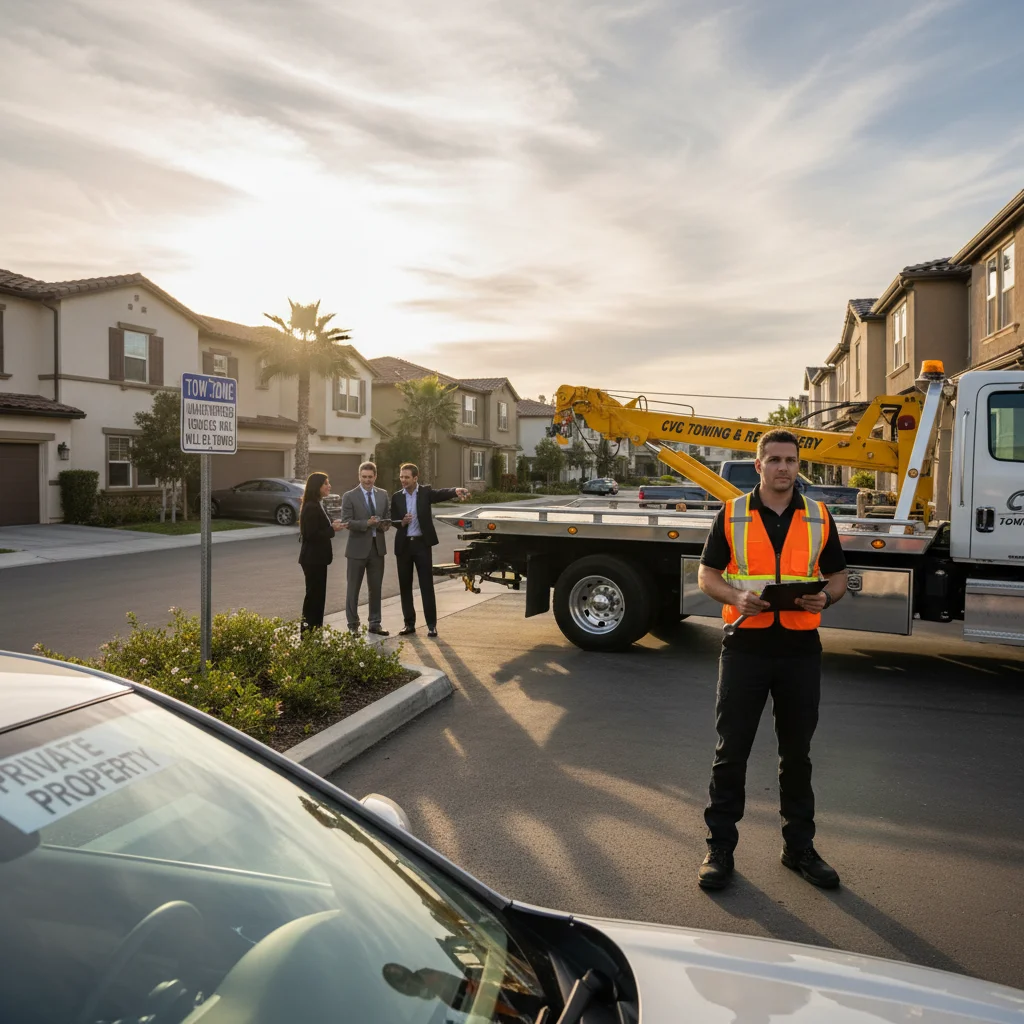
Two different things get called “getting towed” in LA, and they carry different rights. One is a truck you called for a breakdown on the 405 or the 10, that’s a quote you agreed to. The other is a lot tow, a boot, or a police impound you did not ask for. This page is about the second kind: what California law requires the tow company to do, and what you can push back on if they didn’t. It’s general information, not legal advice, and it’s not a deadline calculator for your specific notice.
Quick Tow LA is a referral line, not a tow yard and not an Official Police Garage. Call (213) 410-1414 for a consensual move you’re requesting. We can’t reach into a police impound and pull your car out, and we don’t run a storage lot. For that, you need the agency or garage that actually holds the vehicle.
Private-property tows: the rules under CVC 22658
If you parked in a lot or apartment complex and came back to an empty space, California Vehicle Code 22658 is the statute that governs it, and it’s specific:
- Signage is mandatory. A sign at least 17 by 22 inches, with letters at least one inch tall, has to be posted at each entrance, stating that unauthorized vehicles will be towed at the owner’s expense, and listing the towing company’s name and phone number. No sign, no valid tow.
- The property owner or agent must notify local law enforcement within one hour of authorizing the tow. That’s a check you can ask about later if something feels off.
- If you get back before the truck leaves the lot, the driver has to release your car, for no more than half the posted tow charge. This is the rule most people don’t know exists. You don’t owe the full tow fee just because a hook was already under your bumper. If the car hasn’t left the property yet, you can demand the half-charge release on the spot.
- The charge can’t be “excessive.” CVC 22658 ties this to whatever is greater: the local government’s contract rate for that area, or the rate CHP has approved for that specific towing operator. If a lot tow company hands you a bill well above either number, that’s the exact language to cite when you dispute it.
None of this covers a tow you requested for a breakdown, that’s a private quote between you and whichever operator answers the call.
If LAPD or LADOT towed it: find the car first
For a City of Los Angeles tow, start with the OPGLA VIIC database at opglaviic.com, search by license plate or VIN and it tells you which Official Police Garage has your car. LADOT also takes calls at 311 if you’d rather talk to a person. There are 17 Official Police Garages contracted to handle LAPD and LADOT tows across the city, and OPG business hours run 7 a.m. to 7 p.m., in person only.
To get the car released, an LAPD Area auto detective has to authorize it through a CHP 180 form plus LAPD Form 15.23.07. Practically, that means you go to the LAPD Area station that impounded the vehicle first, get the release paperwork, then bring it to the OPG and pay. Bring a valid driver’s license or government photo ID, current registration or proof of ownership, and be prepared to show you’re the registered owner, the legal owner, or an agent for one of them. If you don’t hold a valid license, someone who does needs to be there to drive the car away. All tow and storage charges have to be paid before the garage releases the vehicle, there’s no partial-payment hold.
As of January 1, 2026, the City of LA’s published OPG rate schedule includes a first-hour tow at $220 (or $215 paying cash/check), daily storage at $68/day ($66 cash/check), and a separate $115 Vehicle Release Fee charged on every redemption. There’s a $77 EV surcharge and a $150 boot fee if the car was booted over five or more unpaid citations. These rates reset every January under a Board of Police Commissioners exhibit, so treat this figure as current for 2026 and re-check before you quote it next year. These City of LA numbers do not apply outside the city, Long Beach, Burbank, and Pasadena each run their own impound programs with their own fee schedules, so if your car landed in one of those cities, ask that city’s lot directly rather than assuming LA’s numbers.
The 30-day impound, and the hearing that comes with it
If the driver was unlicensed, or driving on a suspended or revoked license, California law (CVC 14602.6) requires the vehicle to be impounded for 30 days, this one isn’t discretionary once the officer makes that stop. The agency has to notify the registered owner by certified mail within two working days; if they miss that window, the impound caps out at 15 days instead of 30. Either way, the owner has to be offered a hearing.
That hearing is CVC 22852, the poststorage hearing, and it exists to challenge whether the storage itself was valid, not to argue the underlying ticket. Follow the exact deadline and process printed on your own impound notice; the statute sets the right to a hearing, but the clock on your specific notice is what controls your case.
If the tow looks predatory, the LAPD unit that actually polices this
Los Angeles has a specific city unit that oversees what OPGs are allowed to charge and investigates so-called “bandit” tows, companies that hook a car without proper authority or bill outside what the rate schedule allows. That’s the LAPD Commission Investigation Division, OPG Section, and the number is (213) 996-1270. If a lot tow bill doesn’t match the half-charge rule, if a company towed without proper signage, or if something about the tow smells like a bandit operation rather than a legitimate OPG job, this is the office that takes the complaint.
Steps to dispute a wrongful or overpriced tow
- Get the paperwork before you argue. Ask for an itemized invoice. California law requires it, and you can’t dispute a number you don’t have in writing.
- Check the sign, if it was a private lot. Photograph the posted sign (or the absence of one) before you leave, if you can safely go back. No sign matching the size and content rule is a real defect in the tow.
- If the truck is still on the property, invoke the half-charge release under CVC 22658 immediately, don’t pay the full posted rate on the spot.
- If it’s already at the yard, compare the bill to the published rate. For a City of LA OPG, that’s the January 2026 schedule above. For a private lot tow, the cap is the greater of the local contract rate or the operator’s CHP-approved rate.
- Escalate a predatory or bandit tow to the LAPD OPG Section at (213) 996-1270. Keep every receipt, the tow slip, and photos.
- If the impound is tied to a license issue, request your CVC 22852 poststorage hearing by the deadline printed on your notice, not from memory.
Frequently asked questions
How do I find my car if it was towed in the City of LA? Search the plate or VIN at opglaviic.com, the OPGLA VIIC database LADOT links to. You can also call 311.
What if I get back to the lot before the tow truck leaves? Under CVC 22658, the driver must release your car immediately for no more than half the posted tow charge. You don’t have to pay the full fee.
What counts as an “excessive” tow charge in California? Anything above the greater of the local government’s contract rate for that area, or the CHP-approved rate for that specific tow operator. That’s the language CVC 22658 uses, and it’s the standard to cite in a dispute.
Who do I call about a predatory or “bandit” tow in Los Angeles? The LAPD Commission Investigation Division, OPG Section, at (213) 996-1270. They oversee OPG charges and investigate improper tows.
Does the City of LA’s OPG fee schedule apply everywhere in LA County? No. It only applies inside the City of LA. Long Beach, Burbank, and Pasadena each set their own rates, check with that city’s lot directly.
Related: how to get a car back from impound, illegal private property tow, towing in Los Angeles.
Official sources: CVC 22658, CVC 14602.6, CVC 22852, LAPD OPG/Valet Section (lapdonline.org).
Need a quoted move you’re requesting in LA County? Call (213) 410-1414. Dispatch takes calls 24/7, and the operator who accepts the job quotes it.