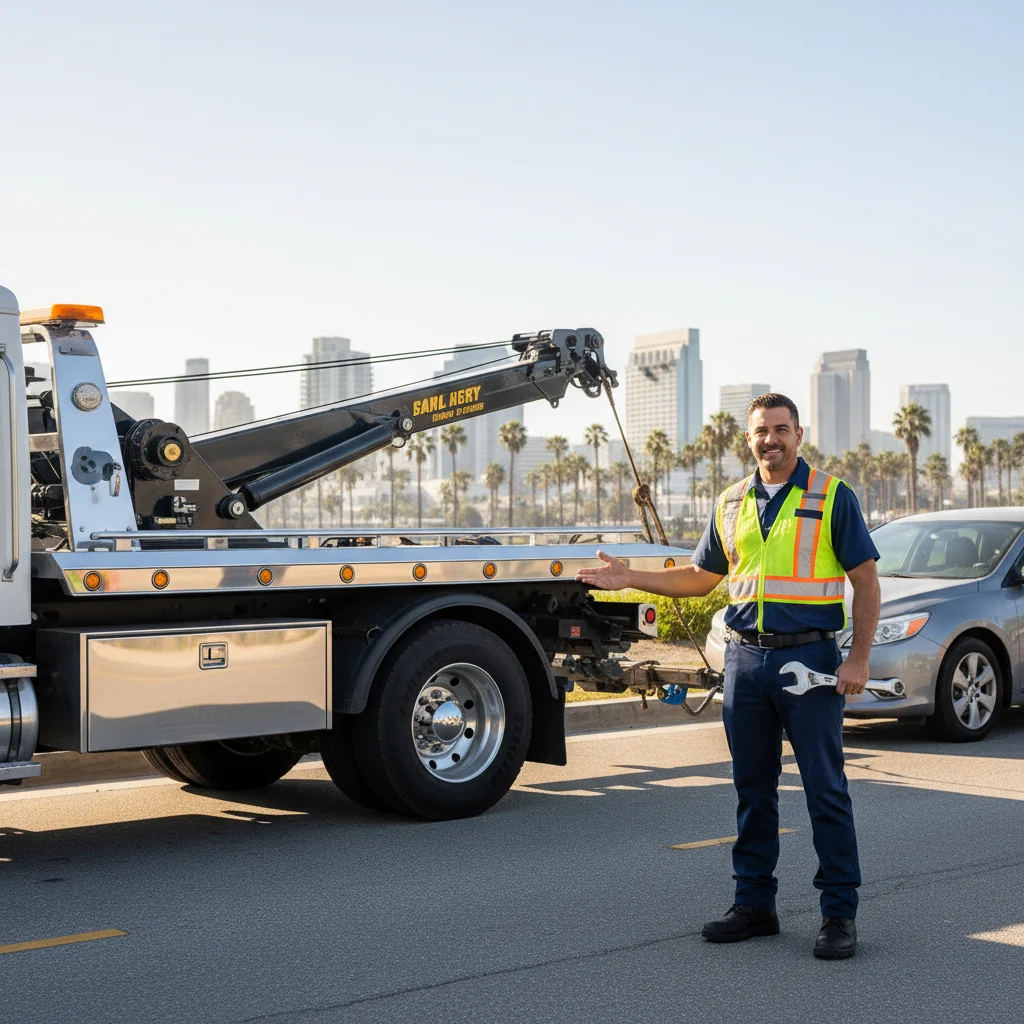
There’s no one number for a tow in Los Angeles. What you pay depends on which of three systems your tow falls under: a roadside operator you called yourself, a City of LA impound lot, or a CHP tow off a freeway. Each one prices differently, and mixing them up is how people search “how much does a tow cost” and land on a page that doesn’t match their situation.
This page walks through all three, with the actual published City of LA rates, what the cities around LA charge instead, and what pushes a number up on a real call. Quick Tow LA does not set or publish a flat rate. No operator has signed a rate card yet, so any dollar figure here is either a city’s published fee or a range built from what drives price, not a brand quote.
The three systems, and why they don’t share a price
A roadside tow you called for. You break down on the 405 through Sepulveda Pass, or your car won’t start in a driveway in Van Nuys. You call for a tow, and the operator who takes the job quotes that vehicle and that route. This is a consensual tow. The price is between you and the operator, and it should be a total, given before anyone rolls.
A City of LA impound. LAPD or LADOT has your car, usually from an Official Police Garage (OPG). There are 17 OPGs across the city, and the fees they charge are published by the Board of Police Commissioners and reset every January 1st.
A CHP freeway tow. If you stall or crash on a freeway CHP patrols, an officer calls the next truck on a rotation list under a Tow Service Agreement. That operator’s rate is CHP-approved for that specific company, not a single statewide number, and CHP can reject a rate it finds excessive.
Know which one you’re dealing with before you ask “how much.” The answer lives in a different place for each.
City of LA OPG rates, as of January 1, 2026
These are the published rates for the 17 Official Police Garages that handle LAPD and LADOT tows inside the City of LA. They reset every January, so treat this table as current only for now and re-check before quoting it back later.
| Charge | Credit-card rate | Cash/check rate |
|---|---|---|
| Tow, first hour | $220.00 | $215.00 |
| Each additional half hour | $109.00 | $106.00 |
| Daily storage | $68.00/day | $66.00/day |
| Mileage, per mile | $12.00 | $12.00 |
| EV surcharge | $77.00 | $75.00 |
| Vehicle release fee | $115.00 | $115.00 |
A car towed and released the same day, in the City of LA, is realistically looking at the first-hour tow charge plus the $115 release fee before anything else. Every extra day the car sits adds the daily storage rate. An EV adds the surcharge on top. Those numbers were $195 and $60/day as recently as January 2025, so if you’re comparing to something you remember from last year, that’s why it moved.
If you don’t know which OPG has your car, don’t guess and don’t drive around Los Angeles looking for it. The OPGLA VIIC database at opglaviic.com searches by plate or VIN and tells you the lot. LADOT also takes the question at 311. OPGs are open 7 a.m. to 7 p.m., in person only, and every charge has to be paid before the car is released.
Why City of LA rates don’t apply in Long Beach, Burbank, or Pasadena
Los Angeles County isn’t one jurisdiction for towing. Each city with its own impound program sets its own numbers, and they aren’t close to each other.
Long Beach runs its own city Vehicle Storage Facility. Light vehicle tow is $255/hour, with a $83/day standard storage rate and a $61 release fee. Heavier trucks and after-hours release run higher.
Burbank contracts its tow program out; published rates there run $308/hour for a standard tow with $88/day storage.
Pasadena handles release through its city Parking Office, and the release fee alone is $159 for an impounded vehicle.
If your car was towed off a street in Long Beach or Burbank, the City of LA’s $220 first-hour figure means nothing to your bill. Confirm which city actually has your car before you plan around a number.
What actually moves a roadside quote
For a tow you called yourself, no law sets the price the way an OPG schedule does. The operator prices the job. What changes the number, in practice:
- Distance. A short pull off a residential street in the Valley costs less than a run down the Grapevine on the 5, or a long haul up the 14 into the Antelope Valley. More miles, more time on the truck, more cost.
- Vehicle class and equipment. A standard sedan is the baseline. A heavy-duty truck, a lowered car, or an EV can need a different truck or extra handling, and that changes what the operator quotes. EV battery weight and required flatbed transport are real cost drivers, not padding.
- Where the car is and how it’s positioned. A driveway pickup is simple. A car stuck on the shoulder of the 10 or 110 during rush hour, or off PCH in the canyons, takes more time and more risk, and operators price for that.
- Time of day. Overnight, weekend, and holiday calls often carry a different rate than a weekday afternoon pickup. Ask whether that’s already in the total you’re hearing.
- Storage, if the car has to sit. If the operator drops your car at a yard instead of your destination, storage is billed separately from the tow. Ask what that clock looks like before you agree to a drop-off location.
None of this is Quick Tow LA setting a number. It’s what determines the number any operator gives you, so you can ask sharper questions and recognize a quote that doesn’t add up.
Private-property tows and CVC 22658
If your car gets towed from a lot you parked in, without a police hold involved, California Vehicle Code 22658 governs it. The lot has to post a sign at every entrance, at least 17 by 22 inches, with the enforcement agency’s phone number and the tow company’s name and contact. The company authorizing the tow has to notify local law enforcement within one hour. If you get back to your car before it’s actually left the lot, the driver has to release it back to you, though they can still charge up to half the posted tow rate for that.
CVC 22658 also caps what a private-property tow can legally charge: it can’t exceed the greater of the local contract rate or that operator’s CHP-approved rate. That’s the phrase to know if a bill looks padded. It’s a real ceiling, not a suggestion.
CHP freeway tows work differently
If CHP clears your car off a freeway, the truck that shows up is the next one on that area’s rotation list under a Tow Service Agreement with CHP. There’s no single statewide CHP rate. Each operator on the rotation submits its own rate, and CHP can reject one it considers too high. That’s the “CHP-approved rate” the private-property statute above references. You generally don’t get to pick the operator on a freeway rotation tow the way you do calling for roadside help.
How to avoid being overcharged
- Get the total before the truck leaves, not after. Ask what’s included: hook, mileage, after-hours, and whether storage starts that day.
- Ask which lot the car is going to, and why. If it’s not your choice, ask if there’s another option.
- If it’s an OPG tow, check opglaviic.com before you drive to a lot. Confirming the right OPG before you show up saves a wasted trip.
- If a private-property bill looks high, ask for the operator’s CHP-approved rate. Under CVC 22658, that’s the ceiling.
- Keep every receipt. The vehicle release fee, storage days, and mileage should each show up as a line item, not a single vague total.
Frequently asked questions
How much does a tow cost in Los Angeles?
It depends which system applies. A roadside tow you called for is the operator’s quote for that vehicle and route. A City of LA OPG impound follows the published schedule: $220 for the first hour plus a $115 release fee, as of January 1, 2026, with $68/day storage if the car sits. A CHP freeway tow uses that operator’s CHP-approved rate. There’s no single county-wide number.
What does it cost to get a car out of a City of LA impound lot?
As of January 1, 2026, the first hour of towing is $220 (credit card) or $215 (cash/check), storage is $68/day, and the vehicle release fee is $115. An EV carries a $77 surcharge. Mileage is $12/mile. These reset every January, so confirm the current schedule before you go.
Do Long Beach, Burbank, and Pasadena charge the same as the City of LA?
No. Each runs its own program. Long Beach’s light tow rate is $255/hour with $83/day storage. Burbank runs $308/hour with $88/day storage. Pasadena’s release fee alone is $159. Confirm which city actually holds your car before assuming the LA figures apply.
Can a private-property tow company in LA charge whatever they want?
No. CVC 22658 caps a private-property tow charge at the greater of the local contract rate or that operator’s CHP-approved rate. The lot also has to post required signage, and the tow company has to notify police within an hour of authorizing the tow.
Does Quick Tow LA have a set price for a tow?
No. Quick Tow LA connects you with a local, licensed operator who quotes the job. Ask for a full total, including mileage and any after-hours charge, before the truck leaves. Call dispatch at (213) 410-1414 any time.
Need a tow in LA County and want a real quote instead of guessing at a rate schedule? Call (213) 410-1414. Dispatch connects you with a licensed local operator who prices your vehicle and route directly.