Who you call depends on exactly where the car is sitting. If it’s on the public street, parked across the mouth of your driveway, that’s a police matter: report it to LAPD and ask for a parking enforcement response, or call 311. If the car is on your own driveway or your private lot, LAPD generally won’t come move it for you, and you don’t get to move it yourself either. You arrange the tow through a licensed company under California Vehicle Code 22658. Those are two different processes with two different phone calls, and mixing them up is the single biggest reason people waste an afternoon on this.
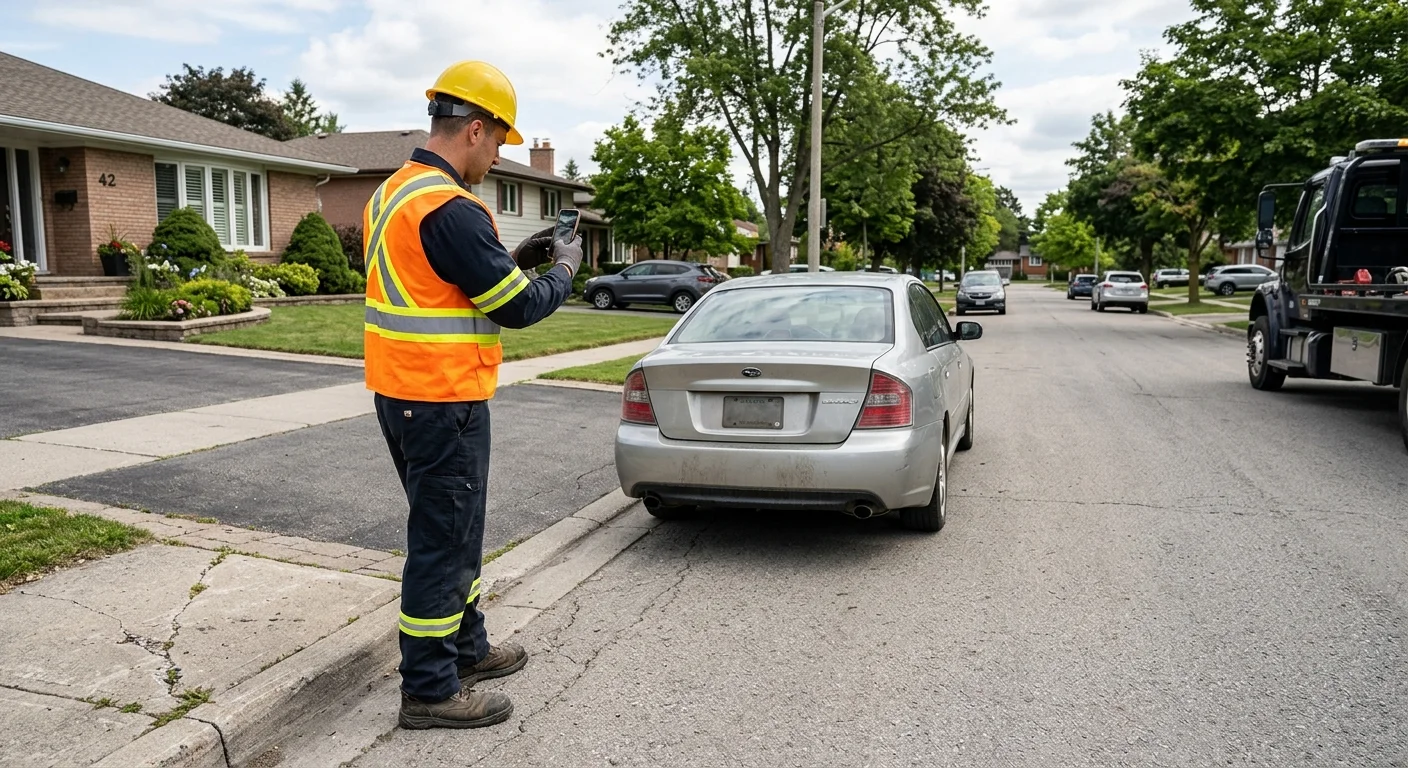
This is common from Eagle Rock to the South Bay: a driveway apron in a tight Silver Lake block, a shared alley in Koreatown, a Valley cul-de-sac where someone’s guest parked wrong. The fix is the same everywhere in LA County. Here’s the process, step by step.
Step one: figure out which law applies
California Vehicle Code 22500(e) makes it illegal to stop or park in front of a driveway, public or private, whether the block is full or partial. But the removal authority splits depending on where the car sits:
- On the public street, blocking your driveway from the outside: CVC 22651(d) lets a peace officer or an authorized city agent have the vehicle towed when it’s blocking a driveway and can’t reasonably be moved to another spot on the street. This is LAPD’s call to make, not yours.
- On your own driveway or private lot: CVC 22658 governs it. This is the private-property towing statute, and it puts the decision in your hands as the property owner, with rules you have to follow first.
Get this wrong and you either wait on a police response that was never going to come, or you call a tow company for a car that’s technically on the street and outside their authority to remove without LAPD’s say-so.
If the car is blocking you from the public street
Call LAPD’s non-emergency line or 311 and report a vehicle blocking a driveway. Give the address, the cross streets, and a plate number if you have it. An officer or parking enforcement unit responds, confirms the block, and if the driver can’t be found or won’t move it, they can have it towed under CVC 22651(d). You don’t pick the tow company in this case and you don’t pay for it; the driver does.
This can take time, especially in denser parts of the city where officers are juggling a full call sheet. It’s genuinely frustrating watching a car sit there while you wait. Resist the urge to solve it yourself, more on that below.
If the same car has been parked in that spot, not necessarily blocking you every hour, but camped on the block for days, a separate rule kicks in. Los Angeles Municipal Code 80.73.2 bars a vehicle from standing on a city street or alley for 72 consecutive hours. A traffic officer has to actually observe the vehicle over that window before it qualifies, so this isn’t an instant fix, but it’s worth mentioning when you call 311, especially if the car has been an ongoing nuisance rather than a one-time block.
If the car is on your own property
This is the case where you act, not LAPD. CVC 22658 lets a property owner have an unauthorized vehicle towed from private property, but it comes with real obligations:
- Check if it’s occupied. If someone’s in the car, ask them to move it first. Give them a reasonable window, most tow operators treat 15 minutes as reasonable, before you proceed.
- Confirm it’s actually your property. The driveway itself, not the public street in front of it. If you’re not sure where the line falls, this is worth confirming before a tow company shows up and finds the car sitting half on the sidewalk.
- Sign the authorization. CVC 22658 requires written authorization from the property owner or an authorized agent before a tow can happen. A legitimate operator brings that paperwork and walks you through it on-site.
- Notify law enforcement. Under CVC 22658, whoever authorizes a private-property tow has to notify local law enforcement within one hour of authorizing it. A reliable tow company handles this as part of the job, but it’s your name on the authorization, so confirm it’s getting done.
- Know the half-charge rule. If the vehicle’s owner shows up before the car is actually in transit, they can demand it back for no more than half the posted tow charge. This protects the other driver from getting stuck with a full bill over a five-minute mistake, and it’s worth knowing before someone shows up angry in your driveway.
Single-family homes generally don’t need a posted “no parking” sign before towing an unauthorized vehicle off the property, that requirement is aimed at commercial lots and multi-unit buildings with more ambiguous parking situations, not a homeowner’s private driveway.
Who pays
The vehicle’s owner pays the tow and storage fees, not you. You’re the one authorizing the tow because it’s your property, but California law doesn’t make the property owner cover the cost of someone else’s illegally parked car. The tow company holds the vehicle until the owner retrieves it and settles up directly with the yard.
The one place this flips is if the tow itself wasn’t done right, wrong property line, no real block, a commercial lot towed without proper signage. Get that wrong and you can end up owning the bill, or worse, liable for a disputed tow. This is exactly why the steps above matter and why the operator’s paperwork isn’t a formality.
What not to do
- Don’t move the car yourself. Pushing, rolling, or nudging someone else’s vehicle out of your way can damage it, hurt you, and make you the liable party.
- Don’t key it, block it in, or confront the driver. All of that turns a parking problem into a legal one, for you.
- Don’t wait it out hoping it moves. Especially on a workday when you need to get out, that driveway access matters and the law gives you a path to get it back.
- Don’t call a tow company that skips the paperwork. A legitimate operator asks for proof you’re the property owner and gets the CVC 22658 authorization signed before hooking up. If a company offers to skip that, that’s a red flag, not a shortcut.
If LAPD ends up towing it
Occasionally a car blocking a driveway from the street gets towed to one of the city’s 17 Official Police Garages rather than released on the spot. If that happens and you’re trying to help the other driver locate their car, the fastest tool is the OPGLA VIIC database at opglaviic.com, searchable by plate or VIN; LADOT also points people to 311. As of January 1, 2026, City of LA OPG rates run $220 for the first hour of tow plus $68 a day in storage, with a flat $115 vehicle release fee on top, all paid at the yard between 7 a.m. and 7 p.m. Those rates only apply inside the City of LA; Long Beach, Burbank, and Pasadena each run their own impound programs with different fees.
Frequently asked questions
Can I tow a car blocking my LA driveway myself? No. Even though it’s your property, you can’t hook up and move the car yourself. You authorize a licensed tow company under CVC 22658, and they handle the removal and the paperwork.
Who do I call if a car is blocking my driveway from the street? LAPD’s non-emergency line or 311. That’s a public-street block, and only an officer or authorized agent can have it towed under CVC 22651(d).
Do I need a posted sign to have a car towed off my driveway? For a single-family home, generally no. Sign requirements are aimed at commercial and multi-unit properties, not a private residential driveway.
Will I have to pay for the tow? No. The vehicle’s owner pays the towing and storage fees, provided the tow was done correctly and you followed the CVC 22658 steps.
What if the owner shows up while the tow truck is there? If the vehicle isn’t in transit yet, they can demand it back for no more than half the posted tow charge under CVC 22658.
If a car is sitting on your Los Angeles County driveway right now and the driver’s nowhere to be found, call Quick Tow LA at (213) 410-1414 and we’ll connect you with a local operator who knows the CVC 22658 process.