Your car is gone from a Koreatown curb, a WeHo alley, or an apartment stall in Van Nuys. A city or police tow and a private-lot tow send you to different yards, different desks, and different clocks. Sort who ordered the truck in the first hour, before storage starts stacking.
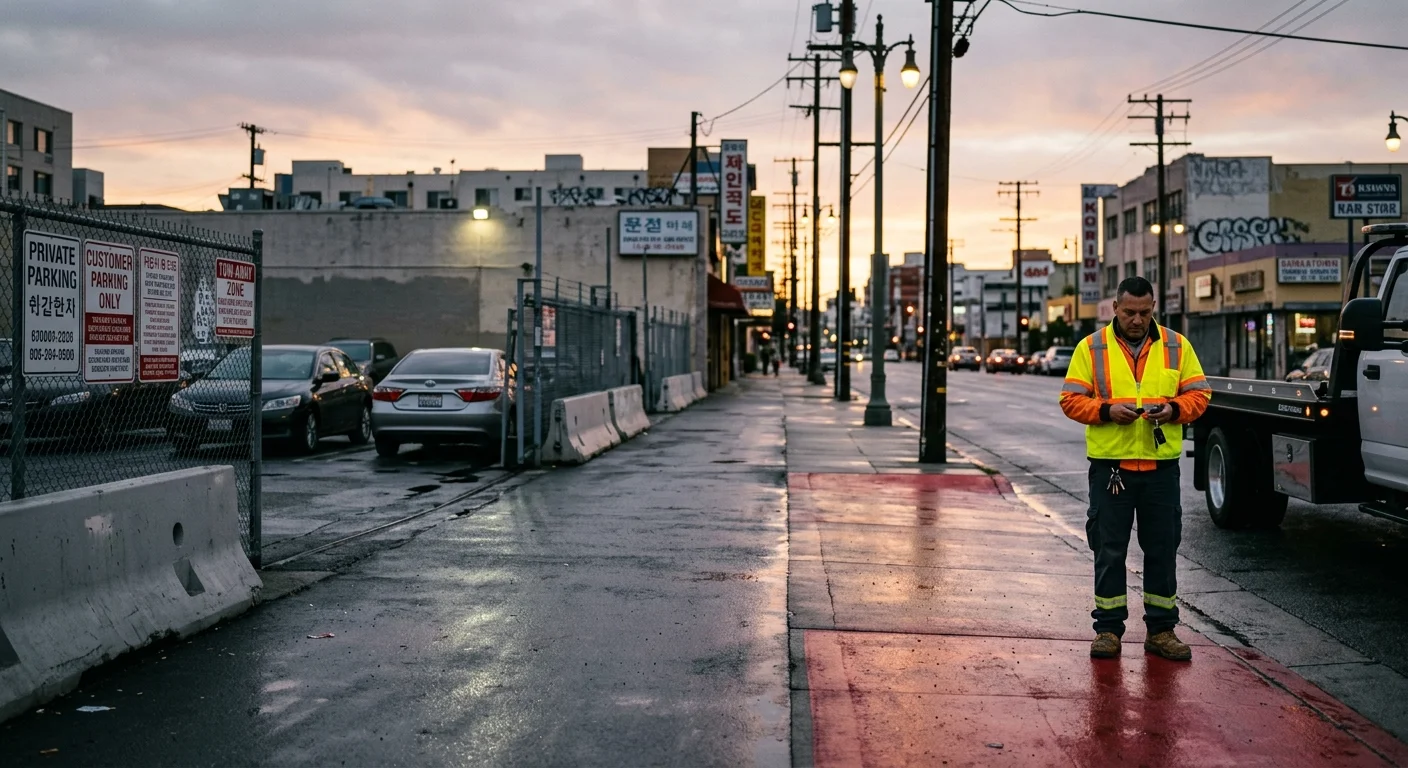
How to tell who ordered the tow in the first hour
Stand where the car was. The ground tells you more than a guess. A red curb, a hydrant, a street-sweeping sign, or a posted 72-hour rule points to a city or police path. A signed apartment gate, a “customer only” stall, or a reserved HOA space points to a lot owner who called a contracted truck. That split is the whole job in the first hour: LAPD tow vs private property tow is not a feeling. It is a location.
Look at the paint and the signs before you leave. Photograph the stall, the curb color, every entrance sign, and the nearest cross street. A DTLA loading zone and a Studio City carport do not run the same play. If you were on a City of Los Angeles street, the next stop is usually an Official Police Garage after LAPD or LADOT authorized the pull. If you were inside a gated lot in Koreatown or a strip-center stall in Pacoima, the truck almost always belongs to the property’s contract operator, not the city’s OPG list.
Theft still happens. Broken glass, a missing catalytic converter, or a different car in the space is not proof of a tow. Ask the desk, the attendant, or a neighbor if they saw a truck. Then search. For a City of LA police or parking tow, start at the OPGLA VIIC public database at opglaviic.com with the plate or VIN. LADOT also points people to 311. For a lot tow, the company name and yard are supposed to be on the entrance sign. Call that number with the plate. If the sign is missing or unreadable, note that now. It matters later when you read your towing rights in Los Angeles.
People type “who towed my car los angeles” because the two systems do not talk the same way. A city tow is logged into the OPG tool when it is a City of LA Official Police Garage job. A private-lot tow is a private-property removal. The lot’s authorizing party has to notify local law enforcement within one hour under California Vehicle Code 22658. That notice is not the same as an OPG listing. Do not wait for a city database to catch a apartment-lot job.
One more mix-up: a boot is not a tow. In the City of LA, five or more delinquent parking citations can get a boot. The boot fee is $150.00 as of the LADOT schedule we verified. You typically have 72 hours after a boot before a tow. If the car is already gone after citations, you are on the city impound path, not a lot-owner path. Search results also float an “80% rule” for towing. That figure is not a published LAPD, LADOT, CHP, or City of LA OPG standard we could confirm. Ignore it. Who called the truck is the fact that changes the yard.
LAPD, CHP, LADOT, and lot-owner paths
Four common callers, four different maps. LAPD and LADOT jobs inside the City of Los Angeles go to the Official Police Garage system. There are 17 designated Official Police Garages handling tow requests from LAPD, LADOT, and other city agencies. Rates for those yards are set by the Board of Police Commissioners and are uniform across the City of LA. They re-set every January 1. As of January 1, 2026, a standard-vehicle tow is $220.00 the first hour on a credit card, or $215.00 if you pay another way, plus a $115.00 vehicle release fee under LAMC 80.77.1, and daily storage of $68.00 / $66.00. Those numbers do not travel with you to Long Beach, Burbank, or a Sherman Oaks apartment lot.
CHP is the freeway path. If you were disabled or in a collision on a CHP-served highway, the California Highway Patrol clears the lane through its Rotation Tow Program. Operators work under a Tow Service Agreement. CHP does not publish one statewide rate. CVC 22658 points at the rate CHP approved for that operator. A 405 shoulder in West LA and a 14 pull in Santa Clarita can land at different rotation yards. Do not walk into an OPG and expect a CHP rotation car to be there.
LADOT is parking enforcement: street sweeping, red zones, the 72-hour rule on city streets and alleys, boots, and citation tows. CVC 22651 lists when a peace officer or authorized agent may remove a vehicle, including hazards, blocking a driveway or hydrant, a driver under arrest, five or more unpaid citations, 72-plus hours, and registration expired more than six months. That is the city-tow side of city tow vs lot tow LA. A Koreatown red curb and an abandoned heap on an Eastside alley can both be 22651 jobs. They still go through the OPG door, not a shopping-center contract.
The lot-owner path is separate. A property owner, manager, or authorized agent calls a private operator to pull a car from a stall, fire lane, or “permit only” space. That is private property towing, not an Official Police Garage assignment. Quick Tow LA does not run city lots and does not hold those OPG contracts. We connect drivers and property managers with licensed local operators. The homeowner or driver contracts with the operator and pays that operator. The City of LA OPG rate card does not apply on that job.
Outside the City of LA, even “police” does not mean OPG. Long Beach runs its own vehicle storage facility at 3111 E. Willow Street, with its own schedule. Burbank uses a contractor, and you get an impound release from Burbank PD first. Pasadena handles release at the Parking Office. LASD runs no central impound. Each sheriff’s station directs its own tow, and the tow company holds the car. Glendale’s exact release-fee dollar amount could not be confirmed from a primary source, so do not budget a guessed number. Confirm with that city before you pay.
Which yard you are dealing with, and why that matters
The yard is the clock, the hours, and the paperwork. Get the name wrong and you spend the afternoon in the wrong line while storage runs. City of LA OPG yards keep posted business hours of 7:00 a.m. to 7:00 p.m. Release is in person. There is no City-set after-hours “gate fee” line item on the LA OPG schedule. If a yard quotes one, ask them to show it on the official rate sheet. Do not assume a night window exists because a private lot down the street stays open.
A private-lot yard is the operator named on the property sign. Hours, payment rules, and storage are that company’s, subject to state private-property rules, not the OPG board rates. A Hollywood Boulevard garage tow and an LAPD hold in the same ZIP can sit two miles apart and still refuse each other’s paperwork. Bring the plate, the VIN if you have it, and a photo of the sign. Ask for the total as of now, broken into the tow and storage, and ask when the next storage day starts.
Geography is not a courtesy. Coastal lots in San Pedro, inland lots in the San Gabriel Valley, and Valley apartment courts do not share one inventory. A City of LA OPG job stays inside that 17-garage system. A CHP rotation job stays with the rotation operator. A Long Beach city tow goes to the city-run facility, not to an LA OPG. If you live in unincorporated county or a LASD city, call the station that covers that block and ask which company they sent. Do not start at opglaviic.com and stop. That tool is the City of LA OPG finder LADOT links to. It will not magically list a Burbank contractor or a private apartment yard in North Hollywood.
Why the yard matters for money: OPG storage is a published daily rate as of January 1, 2026. Private-lot storage is not that figure. Do not apply $68.00 a day to a lot tow, and do not apply a lot’s board to an OPG hold. Lien-sale processing on the city side follows Civil Code 3074, not a City flat “lien fee.” The LA OPG schedule does not publish a standalone notification fee or after-hours gate fee. If you need the city-side dollar path in full, use the impound walkthrough linked below rather than mixing it with a lot receipt.
If you cannot name the yard after one database search and one sign check, keep moving through how to find a towed car in Los Angeles. Plate first, then VIN, then 311 for city jobs, then the lot number on the sign. Write down who you spoke with. The wrong yard is how a same-day pickup turns into a second storage day.
Release steps that differ by who called the truck
A tow means the car left the space. Impound, in this county, usually means an agency authorized the removal and a hold sits on the car until paperwork and charges clear. That is the practical difference between towed and impounded. A private-lot pull can still feel like an impound at the gate. The release path is not the same.
City of LA OPG release follows LAPD Special Order No. 24 and Manual 4/780.55. An LAPD Area auto detective authorizes release with a CHP 180 and LAPD Form 15.23.07. You generally get the police release from the impounding LAPD Area station, then you pay the OPG. Bring a valid driver’s license or a U.S. government photo ID, current DMV registration and/or proof of legal ownership, and proof you are the registered or legal owner or an agent. If you have no valid license, a licensed person has to be there to drive it out. All OPG tow and storage charges must be paid before release. The $115.00 vehicle release fee is charged to everyone redeeming an impounded vehicle on that schedule.
Citation tows add a stop. If the car went after five or more delinquent citations, LADOT’s process is to clear those fines and get a vehicle release order, then go to the OPG named for that job. Do not show up at the garage with only a license and hope. The garage cannot invent a police release you never picked up.
CHP and other agencies are not that LAPD form stack. Confirm with the rotation yard and the agency that ordered the truck. CVC 14602.6 is the 30-day impound when a driver is unlicensed or driving on a suspended or revoked license. The agency must notify the legal owner by certified mail within two working days. Miss that window and the charge is capped at 15 days. You must be offered a storage hearing under CVC 22852. Early release exists only in the circumstances the statute allows. If that hold is on the car, a same-day “just pay storage” plan will fail.
Private-lot release is the yard on the sign, the documents that operator asks for, and the posted charges. CVC 22658 is the state private-property chapter: posted signs, the one-hour notice to local law enforcement, and a charge treated as excessive if it exceeds the greater of the local contract rate or that operator’s CHP-approved rate. If you return before the vehicle is in transit, you may demand immediate release for no more than half the posted tow charge. We are not reciting the full sign-size rules here. Those live on the rights and 22658 pages. Photograph the signs anyway. A lot in City Heights and a hotel garage near LAX both live under that statute, and both still use their own yards.
You can be towed from private property without a knock on your window. California does not require the operator to find you first. What the statute requires is the posted notice and the authorization rules in 22658, not a courtesy call. If the signs were missing or the process looks wrong, document first, then dispute. Do not argue in the driveway while the car is already hooked if you can close it out under the in-transit rule instead.
When to use the impound pages vs the private-lot pages
Use the city impound pages when an agency ordered the truck. That is LAPD, LADOT, CHP, a city PD in Long Beach or Burbank or Pasadena, or a LASD station. Start with how to get your car back from impound for the release order of operations: which desk, which ID, which fee stack. Use the find-your-car page when you still cannot name the yard. Those two pages are the police and city half of this comparison. They will not teach you how a lot manager’s contractor works.
Use the private-lot pages when the car left a stall, a permit space, a fire lane on private asphalt, or a “customers only” lot. That is the private property towing service path, plus the rights page and the 22658 material. Property managers who need a car moved from a reserved stall are on that path too. Quick Tow LA connects you with licensed operators for that work. We do not impound for LAPD, and we do not run an Official Police Garage.
Do not mix the packets. An OPG will not honor a lot sign as a police release. A private yard will not take a City of LA OPG rate as its invoice. Long Beach’s city facility is not the LA OPG list. A CHP rotation yard is not 311’s first result. If you parked on a City of LA street, start city. If you parked behind a gate, start with the sign. If you were on the freeway, start with CHP and the rotation operator.
Keep the receipts either way. Ask for an itemized bill. Inspect the car before you leave the yard. If a city OPG charge looks off the published board, the LAPD Commission Investigation Division, OPG Section, regulates those garages from 100 West First Street, Room 147. For a private-lot fight, the rights page is the first read, then the agency that took the one-hour notice. Confirm every dollar at the yard that actually has the car. A number copied from a City of LA chart onto a Glendale or Santa Monica job is the wrong number. Those cities’ full fee schedules were not all verified here, and we will not invent them.
When to call us
Call when a lot, driveway, or private stall needs a licensed operator, or when you need a consented tow after the city hold is already cleared. We connect you with local pros. We do not run police garages and we do not pull cars off an OPG hold. Call (213) 410-1414 to reach dispatch.