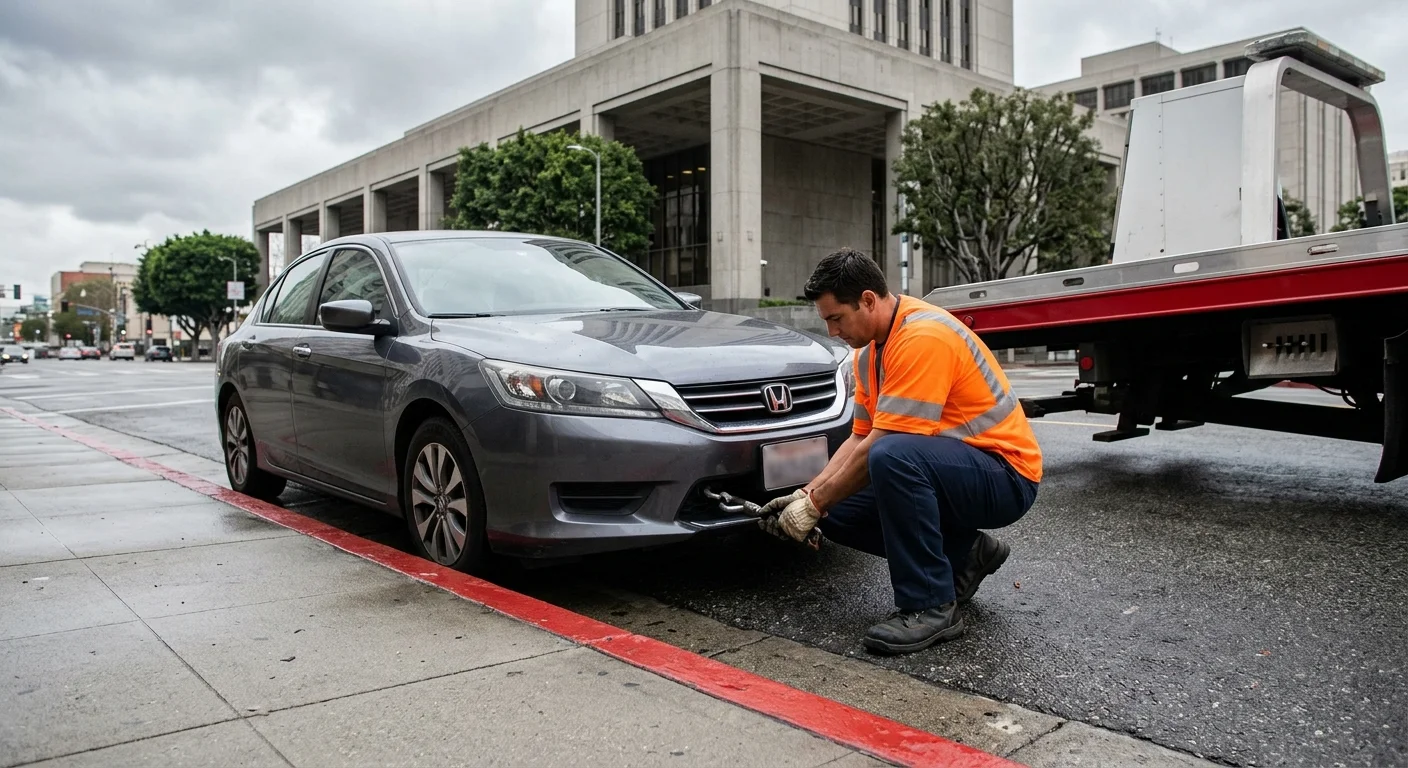
The slip on the windshield, or the empty curb on Vermont, often cites CVC 22651. That is the California Vehicle Code list of when a peace officer or authorized agent may remove a vehicle. It is police-tow authority, not a private-lot rule, and it is not the same as a parking ticket by itself.
What CVC 22651 is, in plain words
CVC 22651 is the state list of situations where a peace officer or authorized agent may take a vehicle off the street, a highway, public land, or an off-street parking facility. In Los Angeles County that officer may be LAPD, LASD, CHP, or a city agency that enforces parking and traffic. The code does not make Quick Tow LA, or any referral brand, the impounding agency. Police lots and Official Police Garages are run by the city or by the contractor that city named.
The approved reading of the section is a catalog, not a single offense. It covers hazards, stolen vehicles, a car blocking a driveway or a hydrant, a driver who has been arrested, five or more unpaid citations, a vehicle left 72 hours or longer, and expired or missing registration, among other grounds written in the statute. Search results that flatten that list into “nine ways you violated 22651” oversell it. 22651 is tow authority. The ticket, if there is one, is usually a different section.
You will also see the string written as 22651 CVC or as a police-tow California Vehicle Code cite on a CHP 180 or a storage notice. Those forms are how the agency records the removal. They are not a private-property tow under CVC 22658. If you need the split in one page, read police tow vs. a private lot tow in Los Angeles.
A 22651 removal in the City of Los Angeles usually goes to one of the 17 Official Police Garages. Those garages handle LAPD, LADOT, and other city tow requests. CHP freeway tows follow the CHP Rotation Tow Program, not the city OPG map. LASD does not run one central impound. Each station points you to the tow company that took the car. Long Beach, Burbank, Pasadena, and Glendale set their own programs. City of LA OPG rates do not follow you into those cities.
The brand that sent you this page connects drivers with local, licensed operators. It does not hold the Motor Carrier Permit, it does not run an OPG, and it does not store police-impounded cars. If the notice in your hand is 22651, start with the agency that ordered the tow, not a roadside dispatch line.
Expired tags, blocking, and other common triggers
The subsection people search most is 22651(o), often typed as 22651 o vc. CVC 22651(o)(1)(A) says a vehicle may be removed when its registration has been expired more than six months before it is found or operated on a highway, public land, or an off-street parking facility. That is the confirmed six-month line. A car with current tags is not in that bucket. A car a few weeks late is not automatically in that bucket either. The expired-registration walkthrough is here: car towed for expired registration in California.
Blocking is on the same list. A peace officer or authorized agent may remove a vehicle that is blocking a driveway or a hydrant. A car sitting in a travel lane, or creating a hazard, is in the hazard language of the same section. CVC 22669, a related but separate section, authorizes an immediate tow of an inoperable vehicle that is a public hazard. Do not mix those two cites on a form. Read the notice.
Five or more unpaid parking citations is another confirmed 22651 ground, and the City of LA layers its own rules on top. LADOT’s boot and tow threshold is five or more delinquent parking citations under CVC 22651.7 and LAMC 80.77.2. The city boot fee is $150.00 as of the 2026-09-19 verification. After a boot, the city typically allows 72 hours before a tow. That boot path is a City of LA parking-enforcement chain. It is not a CHP freeway rotation, and it is not a shopping-center lot tow.
The 72-hour street rule is local and state together. LAMC 80.73.2, read with the Vehicle Code, says a vehicle may not stand on a City of LA street or alley for 72 or more consecutive hours. A traffic officer has to observe it over that period before impound. That is the abandoned-looking sedan on a Valley side street, not a five-minute red-zone stop. Inland cities and LASD contract cities write their own standing-time rules. Confirm the ordinance with that city. Do not assume the City of LA 72-hour clock runs in Santa Clarita, Long Beach, or unincorporated East LA the same way.
A driver who has been arrested is on the 22651 list. The car can come off the street because no licensed person is there to take it. A separate statute, CVC 14602.6, is the 30-day impound when the driver is unlicensed or driving on a suspended or revoked license. That 30-day hold is not a 22651 rule. If the notice cites 14602.6, treat it as its own process, including the storage hearing under CVC 22852.
Stolen vehicles are on the 22651 catalog too. Recovery still goes through the impounding agency and the yard that agency used. The operators we connect you with do not clear a stolen-vehicle hold. Only the police agency that placed it can.
How a 22651 tow differs from a CVC 22658 lot tow
A 22651 tow is an agency tow. A peace officer or authorized agent orders it. The car usually lands at an Official Police Garage in the City of LA, a city yard in Long Beach, a contractor lot in Burbank, or a rotation operator on a CHP freeway. You generally need a police release before the yard will talk about the keys.
A CVC 22658 private-property tow is different. The property owner or the owner’s agent authorizes it. The statute requires a posted sign at each entrance, 17 inches by 22 inches, with lettering at least 1 inch high, showing the enforcement-agency phone and each tow company’s name and contact. The authorizing party must notify local law enforcement within one hour of authorizing the tow. If you get back before the vehicle is in transit, you may demand immediate release for no more than half the posted tow charge. None of that sign-and-half-rate machinery is how 22651 works.
Fees split the same way. In the City of LA, Official Police Garage rates are set by the Board of Police Commissioners under LAMC 80.77.4. As of January 1, 2026, a standard vehicle tow is $220.00 for the first hour on a credit card, or $215.00 cash or check. Daily storage for a standard vehicle is $68.00 credit or $66.00 cash. The vehicle release fee is $115.00 per vehicle under LAMC 80.77.1. Those figures are city-published OPG rates. They are not a Quick Tow LA rate card, and they do not apply in Long Beach, Burbank, Pasadena, or unincorporated county.
Long Beach, as of October 1, 2025, posts its own light-duty tow at $255.00 per hour minimum, daily storage at $83.00 for a standard vehicle, and a $61.00 vehicle release, plus other city line items on that schedule. Burbank’s contractor rates as of August 1, 2025, list a $308.00 per hour tow and $88.00 daily storage for a standard car. Pasadena’s Parking Office posts a $159.00 release for impounded vehicles. Glendale’s release-fee dollar amount is not verified here. The LASD release admin fee amount is not verified here either. Ask that station.
Private-lot storage and police-lot storage also use different hearing paths. CVC 22852 is the poststorage hearing that lets an owner challenge whether the storage was valid. Request that hearing from the impounding agency. Confirm the deadline with that agency. Do not treat a 22658 sign fight and a 22651 storage hearing as the same appointment.
If you want the rights checklist that sits over both tracks, use know your rights when a car is towed in Los Angeles.
What to do in the first hour
Find the car before you argue the cite. In the City of Los Angeles, search the OPGLA VIIC public database at opglaviic.com by plate or VIN. That is the tool LADOT points to. LADOT also directs people to 311. OPG counters are open 7:00 a.m. to 7:00 p.m. Release is in person. The city schedule has no after-hours “gate fee” line item. Do not budget for one that is not on the rate sheet.
For an LAPD impound, an Area auto detective authorizes release on a CHP 180 and LAPD Form 15.23.07. You generally pick up that police release at the impounding LAPD Area station, then you pay the Official Police Garage. Bring a valid driver’s license or a U.S. government photo ID, current DMV registration and/or proof of legal ownership, and proof that you are the registered owner, legal owner, or agent. If you do not have a valid license, a licensed person has to be there to drive the car out. All OPG tow and storage charges have to be paid before release.
If the tow was CHP on a freeway, call the CHP Area that handled the collision or the disablement and ask which rotation operator took the car. CHP does not publish one statewide rate. Operators submit rates under a Tow Service Agreement. If the tow was LASD, call the station, not a city OPG. If it was Long Beach, the city yard is the City of Long Beach Towing Operations and Vehicle Storage Facility. Other cities will name their own lot.
Do not assume the first hour is a free grace period. Storage on the City of LA OPG sheet is a daily charge, and the $115.00 release fee is charged to everyone redeeming an impounded vehicle, as of January 1, 2026. Mileage on that same sheet is $12.00 per mile. An EV surcharge is $77.00 credit or $75.00 cash. Those are OPG figures only.
If you believe the storage was invalid, ask the impounding agency about a CVC 22852 poststorage hearing. CVC 22850.5 lets a local authority charge an administrative release fee to the registered owner or agent to recover removal, impound, and storage costs. There is no fee for an impound hearing unless the owner requested that hearing in writing. Confirm the local fee with that city. Glendale and LASD dollar amounts are not confirmed in our claims file.
A referral dispatch line cannot cut an OPG hold, cannot print an LAPD release, and cannot open a CHP rotation yard after hours. Use it later, if you need a licensed operator once the agency is done with the car.
What we could not confirm and which agency to ask
Several searches that land on “cvc 22651” ask questions this page will not invent. “What is 22651 P?” is a lettered subsection people see on a notice. The only 22651 subsection confirmed for this site is 22651(o)(1)(A), the more-than-six-months expired registration rule. Other letters exist in the statute at leginfo. We are not restating them here without the same verified plain-English line. Read the subsection on the CHP 180 or the storage notice, then ask the impounding agency what ground it used.
CVC 21651(b) is a different section from 22651. People mix the numbers. We did not confirm 21651 as a police-tow authority for this page. Do not treat a 21651 cite as a 22651 tow. Check the exact section on California’s official code site, or ask CHP, LAPD, or the city that wrote the ticket.
We could not confirm a single statewide “maximum days in impound” under 22651. Competitor pages that bolt a 30-day cap onto 22651 are mixing statutes. The 30-day impound we can state is CVC 14602.6, for an unlicensed driver or a suspended or revoked license. After a vehicle has been stored 30 days, CVC 10652 requires the keeper to report it to the Department of Justice, which notifies the owner. That is a reporting trigger, not a 22651 holding period. Lien-sale processing follows Civil Code 3068 and Civil Code 3074. Do not take a dollar amount for a lien from this page. 3074 is a statutory schedule, not a City of LA flat fee we are reprinting here.
DUI-checkpoint tows, handicapped-space tows, unlicensed-dealer tows, and “towed with no warning” rules are often listed next to 22651 on legal-marketing pages. Those specifics are not in our verified claims file, so they are not stated as fact here. Ask the agency that ordered the tow. For City of LA OPG billing disputes, the LAPD Commission Investigation Division, OPG Section, regulates OPG charges. For CHP rotation rates, ask the CHP Area. For LASD, ask the station. For Long Beach, Burbank, Pasadena, or Glendale, ask that city’s parking or police counter.
Santa Monica tow and storage figures were not verified for this site. A Glendale release-fee dollar amount was not verified. An LASD release admin fee amount was not verified. There is no confirmed City of LA OPG after-hours gate fee, notification fee, or standalone “lien fee” on the OPG schedule. If a yard quotes one, ask it to show the line on the city or CHP-approved sheet.
Quick Tow LA does not set those rules, does not run those lots, and does not add a brand price on top. Confirm the current rate with the yard and the impounding agency before you pay.
When to call us
If the car is still on the street, disabled, or about to become a 72-hour or hazard problem, a licensed operator can move it. That is roadside work, not an Official Police Garage release. We connect you with local, licensed tow and roadside operators. We do not retrieve cars from police lots. Call (213) 410-1414 to reach dispatch.