A dead battery on Valley Blvd at 1 a.m. is a different night than a blown tire on the I-10 shoulder south of the Mission District. You still need a tow truck in San Gabriel that can take the call after shops close. Quick Tow LA connects you with local, licensed operators for emergency towing across the city and the west San Gabriel Valley.
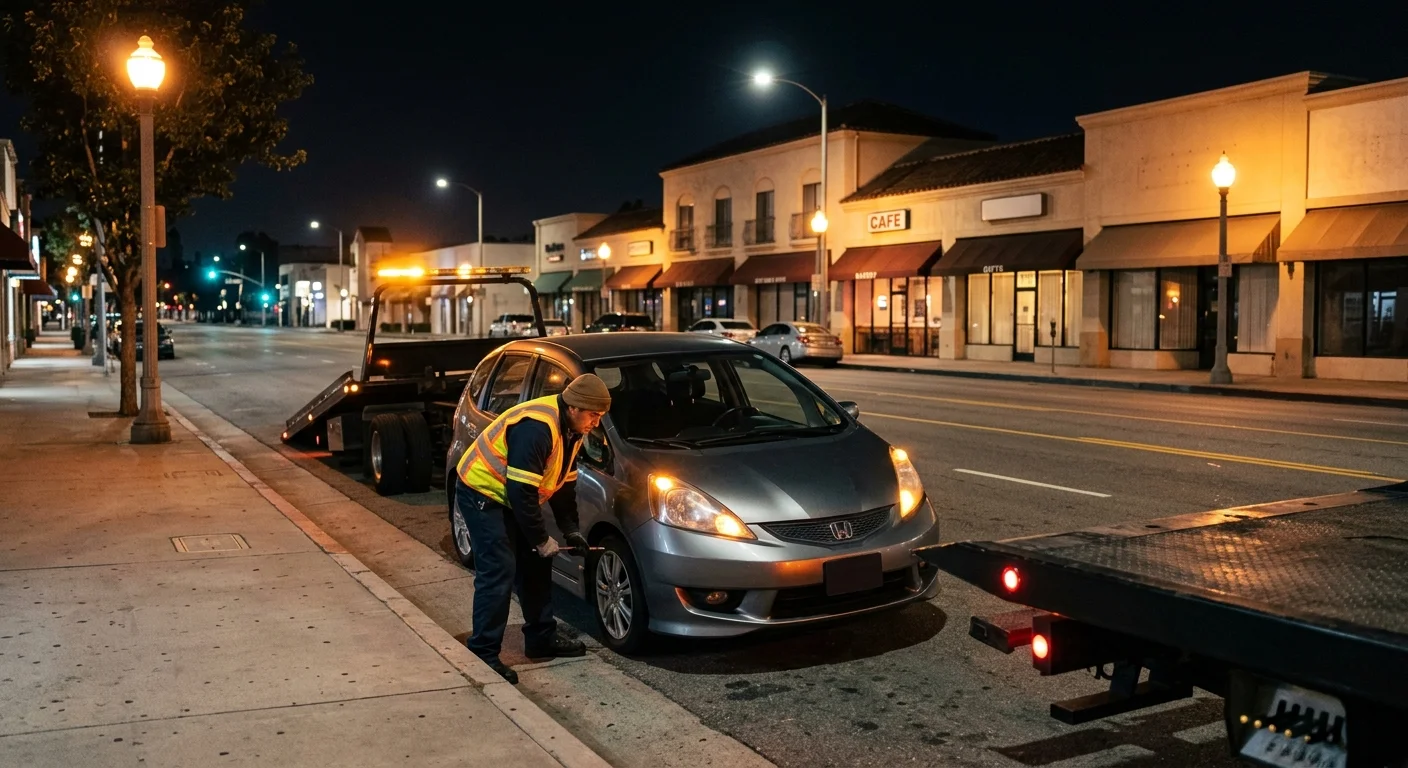
After-hours pickups on Valley Blvd and the 10
Valley Blvd is where San Gabriel stays awake after dark. The restaurant stretch between the Alhambra line and Rosemead Blvd still has cars in the curb lane when the kitchens close. Las Tunas Drive runs quieter and more residential, with plaza lots and the Temple City edge to the northeast. The I-10, the San Bernardino Freeway, hugs the south side of town. That is the night map for 24 hour towing in San Gabriel.
If you are on Valley, give dispatch a cross street they can find. San Gabriel Blvd, Del Mar Avenue, New Avenue, and Mission Drive all cut the boulevard. “I’m by the Mission” helps in the Mission District. “I’m on Valley at Del Mar” is better. The operator we dispatch is working a dense commercial curb: buses, delivery vans, and tight parking bays. A precise pin and the car’s color matter more than a neighborhood nickname.
The 10 is a different pickup. The shoulder is narrow, and late traffic still moves fast. If you are in a travel lane, or anyone is hurt, call 911 first. CHP clears disabled and collision vehicles on the freeways it serves through the Rotation Tow Program. When CHP is already on scene, they assign the truck from that rotation list. You do not pick the company. If you are safely on a city street, you can call us. We connect you with a local operator for a private tow.
West of town you are on the Alhambra line. East, you hit Rosemead. North, San Marino stays dark and residential. South of the 10 you have already left the city of San Gabriel. Tell dispatch which side of the freeway you are on. A driver hunting the wrong frontage road wastes the night.
We do not quote an arrival window. Night traffic on the 10 still stacks, and a wreck two exits west slows everyone. What we can do is take the call, pass a clear location to a licensed operator in the network, and keep the destination straight: a shop on Valley, a driveway off Las Tunas, or a lot the manager named.
For a jump, a spare, or a gallon of fuel that might get you off the curb without a hook, ask about roadside assistance when you call. If the car will not roll, say so. That is a tow, not a boost.
City streets, the freeway, and apartment lots are different calls
Three kinds of night calls come out of San Gabriel, and they are not the same job.
City streets belong to the City of San Gabriel. A stall on Broadway, a lockout on Las Tunas, a crash on Mission Drive: those sit with local police if there is an incident, and with a private operator if you called for your own car. We could not confirm a published San Gabriel Police tow-contractor list, yard address, or after-hours release process from a primary city source. If officers already called a truck, ask them which company has the car and where it is going. Do not assume it is the same operator we would connect you with on a private call.
The freeway belongs to CHP. CHP does not publish one statewide tow rate. Operators on the rotation submit rates under a Tow Service Agreement, and CHP may reject a rate as excessive. California Vehicle Code 22658 refers to the rate approved for that operator by the Department of the California Highway Patrol. We do not have a verified dollar figure for a CHP rotation tow through San Gabriel, so we will not invent one. If CHP towed you, the ticket and the yard on the CHP paperwork are the source of truth.
Apartment and plaza lots are private property. California Vehicle Code 22658 sets the statewide rules. A posted sign at each entrance has to be 17 inches by 22 inches, with lettering at least one inch high, and it has to name the enforcement agency phone plus each tow company’s name and contact. The person who authorizes the tow has to notify local law enforcement within one hour. A charge is excessive if it exceeds the greater of the local contract rate or the operator’s CHP-approved rate. If you get back to the car before it is in transit, you can demand an immediate release for no more than half the posted tow charge.
That last piece matters in San Gabriel’s older courtyard buildings near the Mission and in the tighter complexes toward Las Tunas and the Alhambra line. Low clearance, tandem spots, and ramps that will not take a full-size wrecker are common. Tell dispatch about the garage height and whether the car is already hooked. If a property tow is already rolling, the 22658 in-transit line is the one that counts, not a guess from a neighbor.
NHTSA’s roadside safety guidance is simple and worth following on the 10: hazards on, stay out of the travel lanes, and wait in a safe place if you can get there. Do not stand between the car and moving traffic to watch for the truck.
What to have ready when you phone
Keep the call short and specific. Dispatch is matching you with a local operator, not walking the whole night with you.
Start with the city: San Gabriel, not “the SGV,” and not Alhambra unless you are actually over the line. Then the street and the nearest cross. Valley and San Gabriel Blvd. Las Tunas west of Mission. The westbound 10 shoulder, before Rosemead Blvd. If you are in a garage, give the complex name and the gate code, or a plan for someone to meet the driver at the street.
Then the car: year, make, color, and whether it rolls. A lowered car, an EV, a motorcycle, or a work van changes the truck. If it is an EV, say so. If it is in a stall with a concrete stop and no room to winch, say that too. Emergency towing in San Gabriel at night often fails on that one missing detail, not on the street name.
Then the destination. A shop on Valley Blvd that already knows you. A driveway in the tract north of Las Tunas. “Just get it off the street” if you have not picked a shop yet. Many independent shops along Valley and San Gabriel Blvd will not have a night attendant. Confirm in the morning whether they accept an after-hours drop in their lot. The operator we connect you with can leave the car where you instruct if the site is open to that drop. They cannot invent a key drop the shop never offered.
Have your ID and the registration if you can reach them. For a private tow of your own car, the driver needs to know you are the owner or that you have the right to move it. If this is a property-management call, the person on the phone should be the one who can authorize the tow under 22658, with the signage already posted.
Do not wait in a live lane to make the car easier to find. Put the hazards on, get to the curb or behind a barrier, and stay on the pin you already sent.
If you were looking at coastal after-hours rules, those are a different metro. Our notes on after-hours towing in Long Beach are for that city and its own yard. San Gabriel does not share that process.
Shop drop vs a yard in the SGV
Quick Tow LA does not run a San Gabriel yard, a warehouse, or a storage lot. We are a referral line. You contract with the operator who shows up. That distinction matters at 2 a.m., because “where is my car going” has two different answers.
A shop drop is a private tow you asked for. You name the body shop, the dealer, or the driveway. The driver sent out takes the car there. If the shop is closed, ask whether the lot is open and whether they want the car against a specific wall. Get the shop’s morning number so you are not guessing at sunrise.
A yard is storage after a police, CHP, or private-property tow you did not order. The car is in someone else’s possession. Release rules belong to that agency and that keeper, not to us. The City of Los Angeles Official Police Garage program, with its 17 garages and the public lookup at opglaviic.com, applies inside the City of Los Angeles. San Gabriel is not the City of Los Angeles. Do not show up at an LA Official Police Garage looking for a car taken off Valley Blvd.
We also do not treat Pasadena’s Parking Office schedule as San Gabriel’s. Pasadena publishes its own in-person release fees, as of our September 19, 2026 verification: $159.00 for impounded vehicles and $180.00 for abandoned or abated vehicles, Monday through Friday, 7:30 a.m. to 5:15 p.m., registered owner with a valid license. That is Pasadena. San Marino, Alhambra, Rosemead, and San Gabriel each run their own process. Crossing Las Tunas does not move you onto Pasadena’s list.
For a sense of how public tow bills are built in the City of LA, read what a tow can cost in Los Angeles. Those dollar figures, as of January 1, 2026, are Board of Police Commissioners rates for Official Police Garages. They are not a San Gabriel rate card, and they are not our rate card. We do not publish a brand price. The operator quotes the private-tow price for your trip before they hook the car.
If the destination is a long way out of the west SGV, say so on the first call. A drop in San Gabriel or Alhambra is a local trip. A drop across the county is a different conversation with the same operator.
What we could not confirm about San Gabriel city process
This is the part most 24 hour towing San Gabriel Valley pages skip, and it is the part that actually helps you.
We could not confirm a City of San Gabriel tow fee, daily storage fee, after-hours release fee, or vehicle-release fee from a primary city schedule. Our approved claims file covers City of Los Angeles Official Police Garage rates (as of January 1, 2026), Long Beach’s city-run lot (schedule effective October 1, 2025), Burbank’s contractor rates (as of August 1, 2025), and Pasadena’s Parking Office release fees. San Gabriel is not on that list. A number that sounds right for the valley is not a number we will print.
We could not confirm which company holds a city or police contract in San Gabriel, where that yard sits, or what hours it releases cars. Secondary listings online are not good enough. If officers towed the car, ask them for the company name and the lot address. If a property manager towed it, they have to have named the tow company on the 22658 sign, and they have to have notified local law enforcement within one hour of authorizing the tow.
We could not confirm a Los Angeles County Sheriff release-admin fee either. LASD does not run a central impound. Each station directs its own tow, and the tow company holds the vehicle. San Gabriel has its own police department, so a city-street impound here is not automatically an LASD tow. Do not mix those systems.
CHP rotation authority on the 10 is real. The exact rate-setting mechanics beyond “rates are set through the CHP Tow Service Agreement” are not something we will dress up as a local price sheet.
If you need the official answer, go to the source that actually sets it. For a freeway tow, start with CHP and the paperwork on the car. For a city-street impound, start with the City of San Gabriel and the police department that authorized the removal. For a private-property tow, start with the sign at the entrance and the Vehicle Code rules already cited above. Confirm the current charge with the yard before you pay. That is the correct move.
Call any time, day or night, for a private pickup. You call. We connect you with a licensed, insured operator. The city, CHP, and property yards keep their own books.
When to call us
Call when the car will not move, the shoulder is a bad place to wait, or a lot tow is already in motion and you need a private operator instead of guessing at a yard. A spare and a jack on Las Tunas at noon is one thing. A dead car on Valley after midnight, or a stall on the 10, is a job for a professional towing operator. Call (213) 410-1414 to reach dispatch.