A tow in Los Angeles County is not one rulebook. State law sets the floor. Then the City of LA, Long Beach, Burbank, Pasadena, Sheriff’s stations, and CHP each run their own process on top of it. If you searched towing regulations california, you need the stack that applies to your street, not a statewide average.
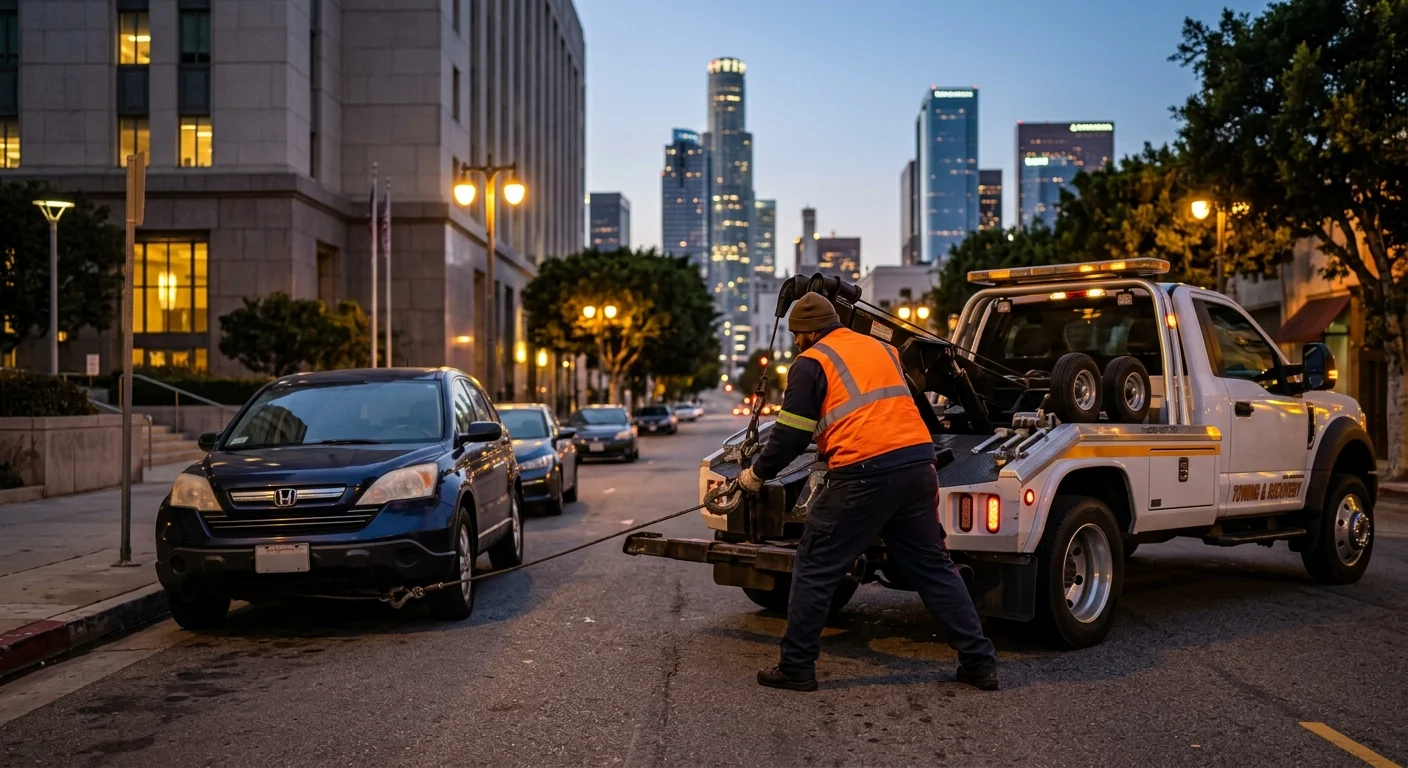
Who writes the rules that affect a tow in LA County
California towing laws start in Sacramento. The Legislature writes the Vehicle Code and pieces of the Civil Code that apply in every county, including Los Angeles. CVC 22651 lists when a peace officer or authorized agent may remove a vehicle. CVC 22658 governs many private-property tows. CVC 14602.6 covers the 30-day impound when a driver is unlicensed or driving on a suspended or revoked license. Civil Code 3068 covers the garage keeper’s lien once a yard has the car. Those statutes are the floor. They are not the whole map.
Who regulates towing in California depends on where the truck hooked you. On CHP-served freeways, the California Highway Patrol runs a Rotation Tow Program under a Tow Service Agreement. CHP does not publish one uniform statewide rate. Operators submit rates. CHP may reject a rate as excessive. CVC 22658 points to the rate approved for that towing operator by the Department of the California Highway Patrol.
Inside the City of Los Angeles, a second stack takes over. The Board of Police Commissioners sets Official Police Garage rates each year under LAMC 80.77.4. Seventeen designated Official Police Garages handle tow requests from LAPD, LADOT, and other agencies. LAPD Commission Investigation Division, OPG Section, at 100 West First Street, Room 147, regulates OPG charges and investigates predatory bandit tows.
Cross a city line and the stack changes again. Long Beach runs its own Vehicle Storage Facility. Burbank uses a city contractor. Pasadena’s Parking Office handles release fees. LA County Sheriff’s stations do not run one central impound. Each station directs its own tow, and the tow company holds the vehicle. Antelope Valley, Santa Clarita, the Malibu canyons, and unincorporated pockets of the South Bay often sit in that Sheriff pattern even when the next block is City of LA.
Towing rules in Los Angeles are local on purpose. A published City of LA OPG figure does not bind Long Beach or a Valley contract city. Treat every yard as its own program until you confirm the agency that ordered the tow. Quick Tow LA is not a regulator. We connect LA County drivers with local, licensed operators. We do not write the code, and we do not hold a Motor Carrier Permit of our own.
People hunting for “new towing laws in California” often want a 2025 or 2026 overhaul. This page could not confirm a single statewide package of that kind. What did change on a published schedule is the City of LA OPG rate reset as of January 1, 2026, and Long Beach’s city-lot schedule effective October 1, 2025. For the live text, go to the Legislature site, not a recap.
Private lot tows vs police and city tows
If your car left a supermarket lot, an apartment garage, or a strip-mall stall in North Hollywood, Koreatown, or San Pedro, you are usually in the private-property lane. CVC 22658 requires a posted sign at each entrance, 17 inches by 22 inches, with lettering at least one inch high. The sign has to carry the enforcement agency phone and each tow company’s name and contact. The party who authorizes the tow must notify local law enforcement within one hour of authorizing it. If you get back before the vehicle is in transit, you may demand immediate release for no more than half the posted tow charge. A charge is excessive if it exceeds the greater of the local contract rate or the operator’s CHP-approved rate.
That is the confirmed core for this page. Other Vehicle Code sections also touch private lots. We could not confirm those extra clauses against this site’s claims file, so we are not restating them here. Read the live statute, then our longer CVC 22658 private property towing guide. Lot owners who need a removal handled by a licensed operator can start on private property towing. Sign size and lettering are spelled out again on private property towing sign requirements in California.
Police and city tows run on a different list. CVC 22651 covers hazards, stolen vehicles, blocked driveways and hydrants, an arrested driver, five or more unpaid citations, 72-plus hours on a street, and expired or missing registration. CVC 22651(o)(1)(A) lets an officer remove a vehicle when registration has been expired more than six months before it is found or operated on a highway, public land, or off-street parking facility.
City of LA parking enforcement adds its own chain. Five or more delinquent parking citations can lead to a boot, then a tow, under CVC 22651.7 and LAMC 80.77.2. The City boot fee is $150.00 on the verified LADOT schedule. After a boot you typically have 72 hours before a tow. Fines are due within 48 hours or the car is subject to tow. LAMC 80.73.2 plus the Vehicle Code also bar a vehicle from standing on a City street or alley for 72 or more consecutive hours. A Traffic Officer has to observe it over that period before impound. CVC 22669 authorizes an immediate tow of an inoperable public-hazard vehicle.
CHP freeway rotation is a third path. A collision on the 405, a stall on the 10, or a disabled car on a CHP highway is not an OPG street tow and it is not a shopping-center hook. The rotation list and the Tow Service Agreement control who gets the call.
If a hook looks unlawful, start with know your rights when your car is towed in Los Angeles and illegal private property tows in California. Get the yard name, the agency, and the plate. Then read the matching code. Do not treat a curb argument as the hearing.
What fee rules cover, and what they do not
Fee rules in California towing laws cover some dollars and leave a lot of others to the yard in front of you. There is no single statewide tow price. CHP does not publish one uniform rotation rate.
Inside the City of Los Angeles, Official Police Garage rates are public. They reset every January 1 by the Board of Police Commissioners. As of January 1, 2026, a standard vehicle tow is $220.00 for the first hour on a credit card, or $215.00 if you pay by cash or check, under Civil Code 1748.1(a). Each additional half hour is $109.00 credit / $106.00 cash. Daily storage for a standard vehicle is $68.00 / $66.00. Motorcycle storage is $18.00 either way. Mileage is $12.00 per mile. An EV surcharge is $77.00 / $75.00. An upright heavy-duty tow is $400.00 / $390.00 for the first hour. Everyone redeeming an impounded vehicle also pays a Vehicle Release Fee of $115.00 per vehicle under LAMC 80.77.1. Those 2026 figures are up from the January 1, 2025 schedule, when the standard first-hour tow was $195.00 / $190.00 and daily storage was $60.00 / $59.00.
Those OPG numbers do not travel. Long Beach’s city-run lot, schedule effective October 1, 2025, lists a light tow at $255.00 per hour minimum, medium $348.00, heavy $463.00, with daily storage of $50.00 for a motorcycle, $83.00 for a standard vehicle 20 feet or under, and $102.00 for 21 feet and over. Long Beach also lists a $61.00 vehicle release, a $127.00 after-hours release, a $46.00 impounding-agency admin fee, and a $31.00 impound notification fee. Burbank’s contractor schedule as of August 1, 2025 lists a $308.00 per hour tow for a standard car, light truck, or motorcycle, $88.00 daily storage, $36.00 motorcycle storage, and a $154.00 after-hours release. Pasadena’s Parking Office lists $159.00 to release an impounded vehicle and $180.00 for abandoned or abated vehicles.
What the fee rules do not cover matters as much as what they do. Glendale’s dollar release fee could not be confirmed from a primary source, so we are not publishing one. The LASD release admin fee amount could not be confirmed. No primary Santa Monica tow or storage schedule turned up for this page. The City of LA OPG schedule has no standalone after-hours gate fee, notification fee, or lien fee line item. Lien-sale processing follows Civil Code 3074. We are not publishing a specific lien dollar amount from that schedule. Quick Tow LA does not publish a brand rate card. You contract with the operator we connect you with. For the statewide structure question, use how California regulates towing fees.
Where to read the current code instead of a blog summary
A blog is a map. It is not the code.
Read CVC 22658 on the California Legislature site. Read neighboring sections from the same Vehicle Code chapter when your facts do not match a private lot. For freeway rotation, start at chp.ca.gov and the Tow Service Agreement language CHP publishes. For a City of LA police garage tow, use the OPGLA VIIC database at opglaviic.com and the rate exhibit the Board of Police Commissioners posts. LADOT also points people to 311. City of LA OPG release is in person, 7:00 a.m. to 7:00 p.m. There is no City-set after-hours gate fee on that OPG schedule.
If a yard is moving toward a sale after long storage, start with DMV’s lien-sale and abandoned-vehicle handbook. CVC 10652 requires the keeper to report a vehicle to the Department of Justice after 30 days in storage. That report is the trigger before a lien sale, not the sale procedure itself.
Trailer length and towing a trailer behind a fifth wheel are a different question. Those searches land on highway combination and equipment rules. They are not the same as private-lot or impound towing. We could not confirm a maximum combination length or hitch rule against this site’s claims file, so we are not inventing one. Ask CHP and read the current Vehicle Code before you build a rig.
Statutes move when the Legislature amends them. A summary dated last year can be wrong this year. If a number or a waiting rule is not on the live code page or on the city rate sheet, treat it as unconfirmed.
If your car already left, which local page to use next
Once the truck is gone, stop arguing the curb. Identify the agency.
City of LA: search opglaviic.com by plate or VIN. That is the tool LADOT links. Then get the police release from the impounding LAPD Area station. An LAPD Area auto detective authorizes release via CHP 180 and LAPD Form 15.23.07. Bring a valid driver’s license or US government photo ID, current DMV registration and/or proof of legal ownership, and proof you are the registered or legal owner or their agent. If you have no valid license, a licensed person has to be there to drive it away. Pay all OPG tow and storage charges before release. Step-by-step, use find your towed car in Los Angeles and how to get your car back from impound. Dollar math for a City lot is on cost to get a car out of impound in Los Angeles.
Long Beach: locate the vehicle at findmytowedcar.org. The city lot is at 3111 E. Willow Street. Hours on the city page are Monday through Friday 8 to 5, Saturday 8 to 4, closed Sunday and holidays.
Burbank: get an impound release from Burbank PD first, then pay the yard.
Pasadena: in person only at the Parking Office, registered owner with a valid driver’s license, all fees including outstanding citations. Hours on the city page are Monday through Friday 7:30 a.m. to 5:15 p.m.
LASD: the station that ordered the tow directs you. The registered or legal owner goes in person with proof of ownership and a valid license, or a licensed agent. A storage notice is mailed within 48 hours, excluding weekends and holidays. The admin fee amount is not verified here.
CVC 22852 lets the owner request a poststorage hearing to challenge the validity of the storage. CVC 22850.5 lets a local authority impose an administrative release fee on the registered owner or agent, with no fee for an impound hearing unless the owner requested it in writing. CVC 14602.6’s 30-day impound requires the agency to notify the legal owner by certified mail within two working days. Failure to do that caps the charge at 15 days. Early release is allowed in defined circumstances in that section. Read the statute for those circumstances. Do not guess them from a blog.
If the car sat long enough that a yard is talking sale, Civil Code 3068 is the possession lien for storage. Pair that with the DMV handbook linked above, not with a round number from another city.
When to call us
When a car is disabled on an LA street, blocking a driveway, or sitting in a stall you need cleared, you want a licensed operator on the hook, not a DIY pull. We connect you with local, licensed tow and roadside operators. Call (213) 410-1414 to reach dispatch.