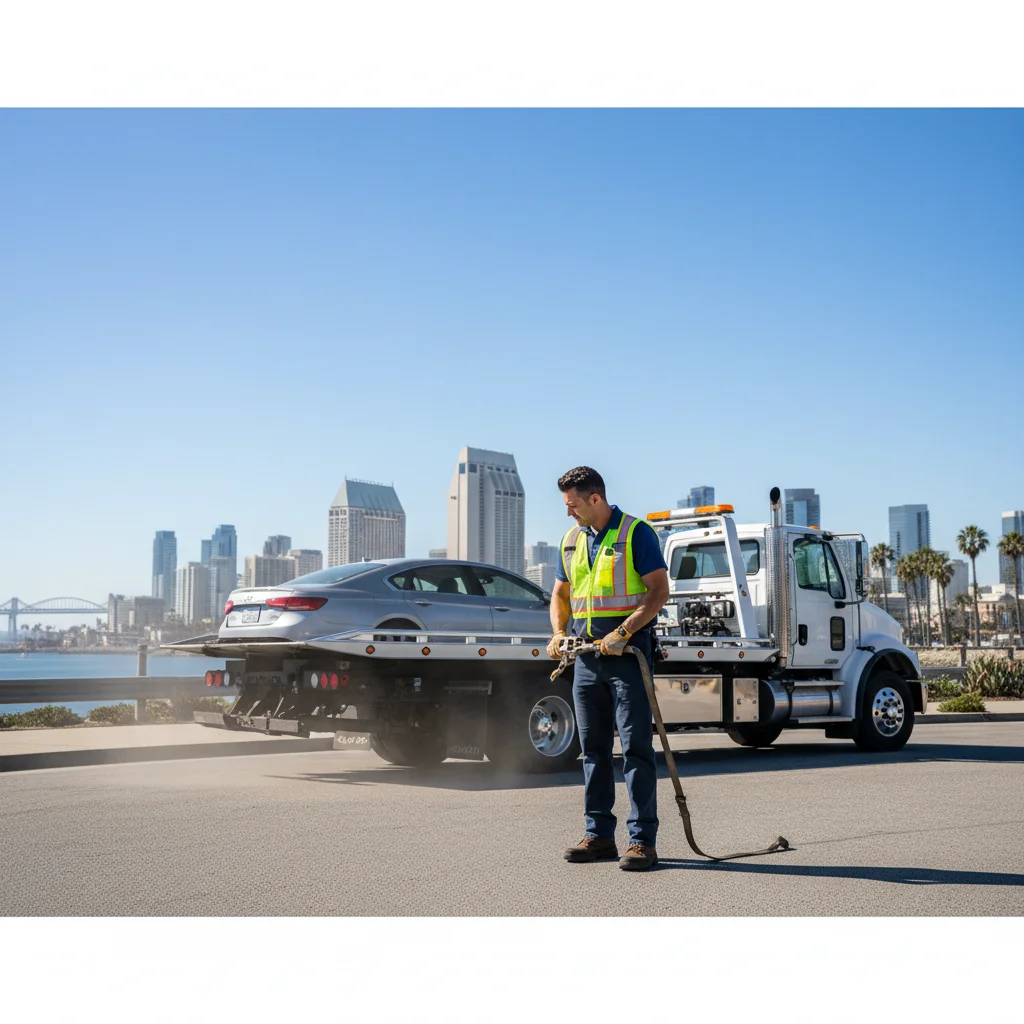
Yes and no. If LAPD or a property owner had your car towed against your will, the rate is capped by law. If you called a tow yourself because you broke down on the 405, that’s a private deal between you and the company, and no statute sets the price. Two different systems, two different answers, and most of the confusion in Los Angeles comes from mixing them up.
Regulated means someone else ordered the tow
Start here, because it settles almost every question that follows.
A consensual tow is one you asked for. Dead battery in a Sepulveda Pass backup, flat with no spare on the 101, fender-bender on the 10. You called, you picked the company, you agreed to the price before the truck rolled. That’s a private transaction. California doesn’t set a ceiling on it. The market does.
A nonconsensual tow is one that happened to you. LAPD or LADOT had your car removed for a parking violation, a hazard, a suspended license, or an accident on a CHP-patrolled freeway. A property owner had it hooked from a no-parking lot. Nobody asked your permission first. These are the tows California actually regulates, and Los Angeles has more machinery around them than most cities in the state.
Under California Vehicle Code 22658, the law governing private-property tows, a charge is “excessive” if it runs above the local contract rate or the towing operator’s CHP-approved rate, whichever is higher. That single phrase, CHP-approved rate, is the anchor for every private-property and freeway tow bill in the state. It’s also why there’s no one statewide dollar figure: each operator files rates with the California Highway Patrol through the CHP Rotation Tow Program, and CHP can reject a rate it judges excessive, but it doesn’t publish one number everyone charges.
Inside the City of LA, there’s an actual published schedule
Where LA pulls ahead of a lot of California cities is the Official Police Garage system. When LAPD or LADOT has a vehicle towed within city limits, it goes to one of 17 Official Police Garages (OPGs), and those garages charge off a rate card the Board of Police Commissioners sets every January under LAMC 80.77.4. It isn’t a guideline. It’s the ceiling.
As of January 1, 2026, the City of LA OPG schedule runs:
- Standard vehicle tow, first hour: $220 (credit card) / $215 (cash or check)
- Each additional half hour: $109 / $106
- Daily storage: $68/day / $66/day
- Vehicle release fee: $115 per vehicle, charged to everyone redeeming an impounded car
- Boot fee: $150, applied at 5 or more unpaid citations
- EV surcharge: $77 / $75
- Mileage: $12/mile
Those two-column prices exist because California Civil Code 1748.1(a) requires a discount for paying by cash or check instead of credit card. Either way, an OPG can’t charge you more than that card. It’s set annually and it went up from the January 2025 schedule ($195 first hour, $60/day storage), so if you find an older number online, it’s stale.
If your car went missing off an LA street, don’t guess which yard has it. Run your plate or VIN through the OPGLA VIIC database at opglaviic.com, the same locator LADOT links people to. LADOT also answers at 311. OPGs are open 7 a.m. to 7 p.m., in person only, and every dollar owed has to be paid before they’ll release the vehicle.
Outside the city line, the number resets
The OPG schedule is a City of LA program. Cross into a neighboring city and a different authority, a different contractor, and a different price sheet takes over, all still operating under the same state framework (CVC 22850.5 lets a local authority adopt its own impound release fee).
A few examples, each running its own program:
- Long Beach contracts its own city-run storage facility. A light tow starts at $255/hour, daily storage on a standard vehicle is $83, and the release fee is $61 ($127 after hours).
- Burbank uses a private contractor billing $308/hour for a standard tow, $88/day storage, $154 for an after-hours release.
- Pasadena runs releases through its Parking Office: $159 for an impounded vehicle, $180 for an abandoned or abated one, in person only.
None of those figures apply inside LA city limits, and the LA OPG numbers don’t apply once you’re in Long Beach, Burbank, or Pasadena. If you’re trying to figure out what you owe, the first question isn’t “what’s the rate,” it’s “whose yard is my car in.”
The minimum cost for a tow you call yourself
There’s no legal floor on a consensual tow. But there’s a practical one.
Most legitimate LA-area companies build their price around a hook fee, a flat charge to send a truck and connect to your car before mileage even starts. That covers dispatch, the driver’s time, and the truck itself. Across the state that base typically starts somewhere in the $75 to $100 range before mileage, and a short local tow, a few miles off the 110 or out of a Gateway Cities neighborhood, generally lands within a predictable band once mileage and vehicle type are added.
A quote that comes in well under that isn’t a deal, it’s bait. The mileage, a fuel surcharge, “difficult access,” or after-hours labor gets tacked on once the truck’s already hooked to your car, and the number on the invoice looks nothing like the number you were quoted on the phone.
Red flags that mean you’re being overcharged
- No number before the truck shows up. A real quote happens before dispatch, not after the car’s already loaded.
- A teaser base that grows. $40 on the phone, $200 on the invoice once mileage and “labor” appear.
- Cash only, no itemized receipt. You’re entitled to a written statement of charges on any tow. A company that won’t give you one is a company you can’t dispute.
- A bill above the posted cap on an OPG tow. Compare it to the current LA OPG schedule. Above the cap is contestable, and LAPD’s Commission Investigation Division, OPG Section fields exactly these complaints.
- A daily storage rate that doesn’t match the yard’s posted schedule. If your car is at an LA OPG, storage is $68/day flat. A lot inventing its own number is overcharging.
Tow type, who sets the price, your rights
| Tow type | Who sets the price | LA-area figure | Your rights |
|---|---|---|---|
| Consensual (you call it) | Open market, the company you hire | Flat rate, quoted before dispatch | Get the number first; choose any company |
| LAPD/LADOT impound, City of LA | Board of Police Commissioners, LAMC 80.77.4 | $220 first hour + $68/day + $115 release (as of Jan 1, 2026) | Itemized bill, retrieve belongings, release on proof of ownership + payment |
| Private-property tow (any city) | CHP-approved rate, CVC 22658 | Capped at the operator’s filed CHP rate | Posted signage required; owner returning pre-tow pays at most half the posted charge |
| Neighboring city impound (Long Beach, Burbank, Pasadena) | That city’s own program | Varies by city, see above | Set by local ordinance; ask the specific yard for its schedule |
Frequently asked questions
Are towing fees regulated in California? Partly. Nonconsensual tows, meaning police-directed, impound, and private-property tows, are capped: either by a public agency’s published schedule (like LA’s OPG rates) or by CVC 22658’s excessive-charge standard tied to the operator’s CHP-approved rate. A tow you call yourself is a private transaction with no state-set ceiling.
What is the minimum cost for a tow in Los Angeles? No legal minimum exists, but the practical floor is the hook fee most companies charge to send a truck and connect to your car, generally in the $75 to $100 range before mileage. A quote well under that usually hides add-ons that surface on the final bill.
How much does an LA impound tow cost? Inside the City of LA, an Official Police Garage charges $220 for the first hour, $68 a day in storage, and a $115 release fee as of January 1, 2026. Those rates reset every January under LAMC 80.77.4, so always check the current schedule before you budget for it.
Can a tow company overcharge me in LA? Not legally. On an OPG tow, the Board of Police Commissioners’ schedule is the ceiling. On a private-property tow anywhere in the state, CVC 22658 caps the charge at the operator’s CHP-approved rate. On a consensual tow you arranged, there’s no ceiling, so your protection is a flat quote before dispatch and an itemized receipt after.
Does the LA OPG rate apply in Long Beach or Burbank? No. Each city runs its own impound program with its own contractor and its own price sheet. Long Beach, Burbank, and Pasadena all publish different figures than the City of LA. Confirm which jurisdiction towed your car before you assume a rate.
Get a flat-rate quote first
The simplest defense against an unreasonable fee is a number before the truck rolls. Call Quick Tow LA at (213) 410-1414 to get connected with a local operator who quotes flat before dispatch. For more on getting a car back from an LA impound, see our towing service in Los Angeles page.