Your car has stopped, and the person answering speaks mostly Spanish. Knowing a few direct phrases can help you request a tow, explain the problem, and confirm where your car is going.
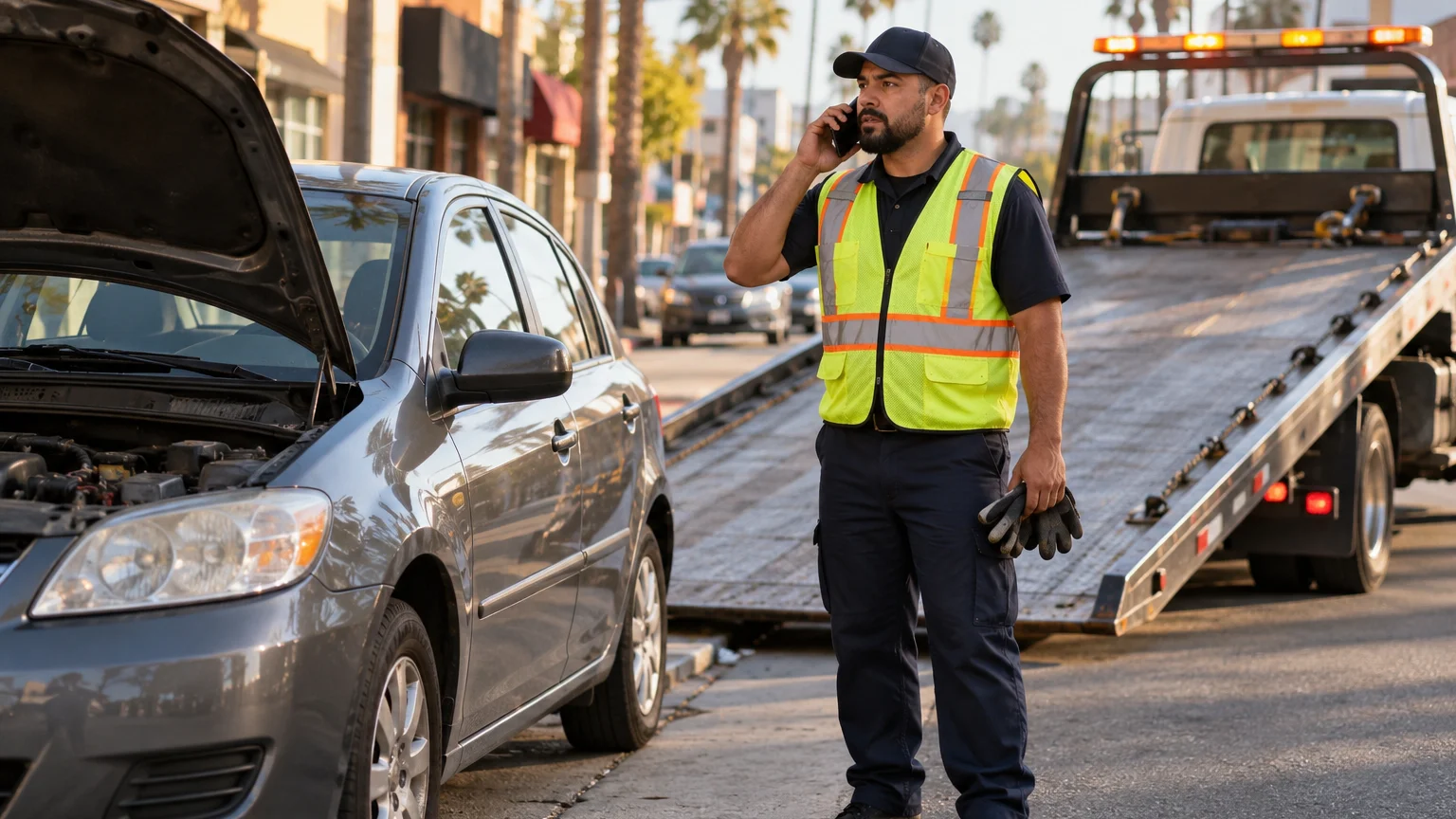
The words LA drivers use when asking for a tow
The most useful word is grúa, pronounced roughly “GROO-ah.” In a roadside conversation, grúa means tow truck. It can also mean a crane elsewhere, but your situation supplies the context.
To say “I need a tow truck,” use:
Necesito una grúa.
That’s enough to begin the call. You can add para mi carro, meaning “for my car”:
Necesito una grúa para mi carro.
If you searched for “how to say tow truck in Spanish,” that’s the practical Los Angeles answer. Camión de remolque is understandable, but it sounds less natural in everyday Southern California conversation. Remolque usually refers to towing, a tow, or a trailer, depending on context.
The spelling matters too. In English, “tow truck” is two words. In Spanish, grúa carries an accent over the u. The plural is grúas. Someone searching for gruas cerca de mi usually means “tow trucks near me,” correctly written as:
Grúas cerca de mí.
Los Angeles Spanish varies between families and neighborhoods. You may hear carro, auto, or vehículo. Carro is common and clear in Mexican-American Spanish. For “truck,” people may say camión, camioneta, or the informal troca. Those words describe different vehicles, so grúa remains the clearest roadside term.
Don’t assume the dispatcher speaks Spanish. You can ask:
¿Hay alguien que hable español? “Is there someone who speaks Spanish?”
If you’re arranging emergency towing, start with your location and immediate safety concerns.
How to describe your location and vehicle
A useful location description has three parts: the road, the direction, and a visible landmark. Los Angeles streets repeat across communities, so naming the city or neighborhood also helps.
Start with:
Mi ubicación es… “My location is…”
Estoy en Los Angeles, cerca de… “I’m in Los Angeles, near…”
On a freeway, state the freeway number and direction:
Estoy en la autopista 405, rumbo al norte. “I’m on the 405 freeway, heading north.”
Estoy cerca de la salida de… “I’m near the exit for…”
That structure works on the 110 through central Los Angeles, the 101 in the San Fernando Valley, or the 405 through the Sepulveda Pass. On Pacific Coast Highway near Malibu, mention the closest cross street or recognizable public landmark. In the Antelope Valley or canyon areas, send a phone map pin when street signs aren’t nearby.
You can say:
Le puedo mandar mi ubicación por mensaje. “I can send you my location by text.”
Next, describe the car:
Es un Honda Civic gris. “It’s a gray Honda Civic.”
Mi carro está en el estacionamiento. “My car is in the parking lot.”
Mi carro está en el acotamiento. “My car is on the shoulder.”
Give the make, model, color, and visible condition. Mention low clearance, damaged wheels, or blocked access. Don’t guess technical details. A plain description helps the operator decide what equipment the job requires.
If someone else owns the car, say so. If you’re unsure what type of towing to request, our guide to getting a car towed in Los Angeles explains the information an operator may need.
What to say about a crash, flat tire, or dead battery
Describe what happened before asking for a specific service. A car that won’t start may need roadside help rather than a tow. A damaged or unsafe vehicle may need a towing operator.
For a breakdown, say:
Mi carro se descompuso. “My car broke down.”
El carro no arranca. “The car won’t start.”
For a flat tire, use the regional phrase llanta ponchada:
Tengo una llanta ponchada. “I have a flat tire.”
No tengo llanta de repuesto. “I don’t have a spare tire.”
For a dead battery, say:
La batería está descargada. “The battery is dead.”
Necesito ayuda para arrancar el carro. “I need help starting the car.”
For an empty fuel tank:
Me quedé sin gasolina. “I ran out of gas.”
These problems may fit roadside assistance. Tell dispatch whether the car is in a driveway, parking structure, street lane, or freeway shoulder. Parking garages can have low ceilings and tight turns. That detail matters more than trying to name the towing method yourself.
After a crash, keep the explanation simple:
Tuve un choque. “I was in a crash.”
El carro no se puede manejar. “The car can’t be driven.”
Una rueda está dañada. “One wheel is damaged.”
Don’t say the car is safe to drive unless you know it is. Follow instructions from police, fire personnel, or other responders at the scene.
A short call might sound like this:
Conductor: Necesito una grúa. Mi carro no arranca. Dispatch: ¿Cuál es su ubicación? Conductor: Estoy en Koreatown, cerca de Wilshire y Western. Es un carro gris.
That exchange provides the service, problem, neighborhood, cross streets, and vehicle color without a long explanation.
How to confirm the destination and total quote
Before the operator is sent, repeat the destination. Don’t rely on a similar street name or an incomplete address.
Use:
Quiero llevar el carro a esta dirección. “I want to take the car to this address.”
¿Puede confirmar el destino? “Can you confirm the destination?”
¿El carro va al taller o a otro lugar? “Is the car going to the repair shop or somewhere else?”
If the vehicle must travel from Long Beach to the San Fernando Valley, say both locations clearly. If it’s only moving between nearby streets in East Los Angeles, give the full destination anyway.
Ask for the complete quote before agreeing:
¿Cuál es el precio total? “What is the total price?”
¿Qué incluye el precio? “What does the price include?”
¿Hay algún cargo adicional? “Is there any additional charge?”
Quick Tow LA doesn’t publish a brand rate card. The driver contracts with and pays the operator. Pricing can depend on the specific job, so confirm the amount and included work directly with that operator. Our guide to Los Angeles towing costs explains which details to gather when comparing a quote.
You can also ask:
¿Cómo puedo pagar? “How can I pay?”
¿Me puede mandar la cotización por mensaje? “Can you send me the quote by text?”
A written message gives you something clear to review. Check the pickup point, destination, vehicle, requested service, and quoted total. If any detail differs, correct it before dispatch.
California generally requires every party’s consent before recording a confidential call. Don’t secretly record the conversation. Requesting the quote by text is the simpler option.
When to call emergency services instead
A tow request isn’t the first call when someone is injured or traffic faces an immediate danger. When contacting emergency services, tell the operator your direction of travel and the nearest exit.
NHTSA roadside guidance can help drivers prepare for roadside emergencies. Follow directions from emergency personnel at the scene.
Useful phrases include:
Hay una persona herida. “Someone is injured.”
El carro está bloqueando el tráfico. “The car is blocking traffic.”
Veo humo. “I see smoke.”
Estamos en peligro. “We’re in danger.”
If there’s no immediate emergency, provide the towing dispatcher with your exact location. A disabled car beside the 101 in Hollywood presents different access issues than one inside a South Bay parking lot. Give the lane position, shoulder, cross street, or parking level.
Freeway tows may also involve the California Highway Patrol. CHP uses a rotation program to clear disabled and crashed vehicles from highways it serves. It doesn’t publish one uniform statewide towing rate. If CHP has already requested a tow, ask where the vehicle will be taken before arranging another operator.
Keep the calls separate. Emergency services handle immediate danger. A towing operator handles vehicle movement after the scene is safe and the vehicle can be released.
When to call us
Call when your car can’t be driven safely, roadside help won’t solve the problem, or you need an operator to move it. Quick Tow LA connects Los Angeles County drivers with local, licensed towing and roadside operators. Call (213) 410-1414 to reach dispatch.