A shredded rear tire on the 405 at Sepulveda, or a slow leak in a Koreatown garage, still comes down to the same fork. You either get a spare or a plug on the spot, or the car leaves on a truck. If you typed tire repair roadside assistance near me, you want a pro at the curb who can make that call, not a guess in a live lane.
Quick Tow LA connects Los Angeles County drivers with local roadside and tow operators. The brand does not own a fleet and does not do the work itself. The pros we send handle roadside tire calls and tows.
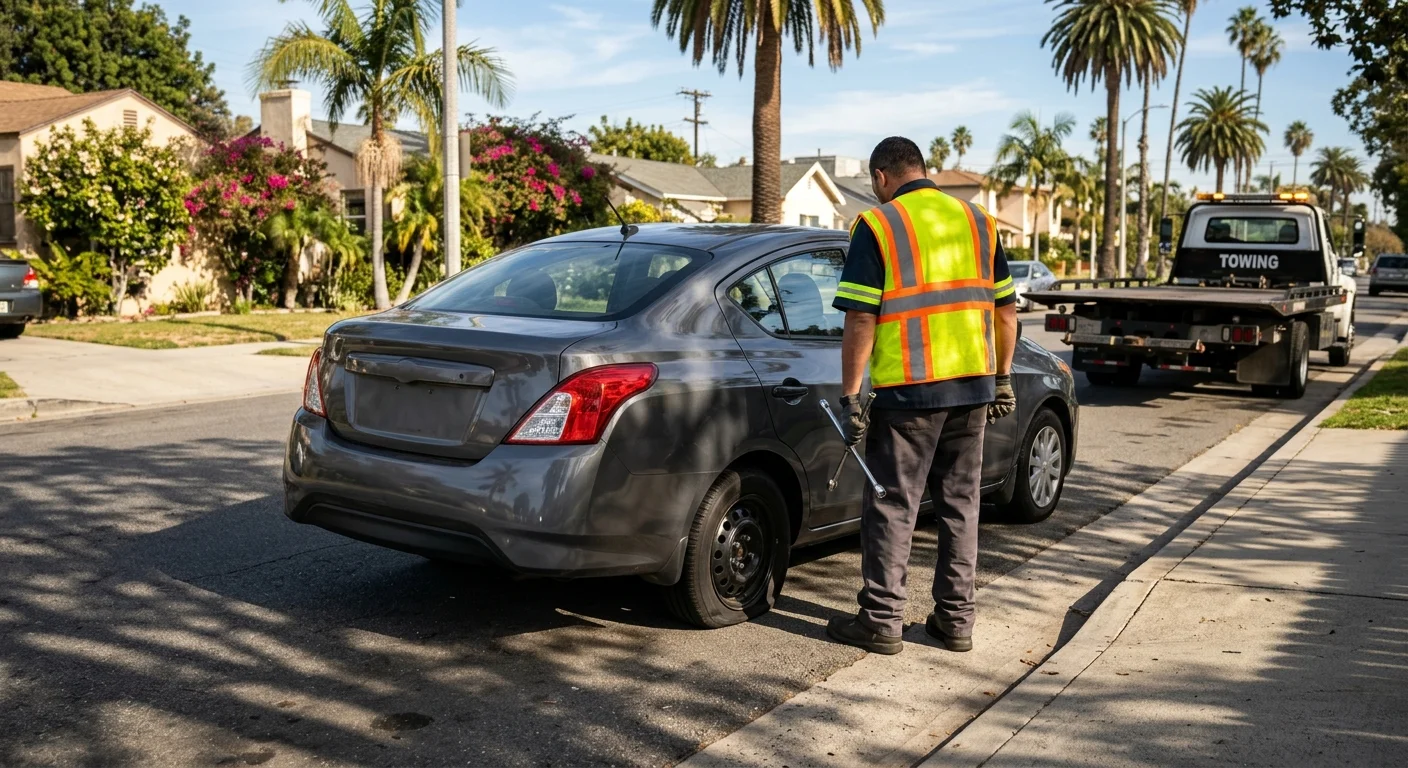
When a spare or plug is enough
A roadside tire change is enough when three things line up. The car sits where a jack can go down without putting anyone in a lane. You have a usable spare, or a small tread puncture a pro will treat as a short-term plug. The wheel, the studs, and the sidewall still look sound.
Many newer cars in Los Angeles come with an inflator kit and no spare. Compacts in buildings from Westlake to North Hollywood often hide a donut that was never aired up. If the spare is missing, flat, or too small for a freeway run, say so on the first call. Dispatch is matching the job to an operator, not stalling you.
A plug from the outside can get you off a side street. It is a short roll to a shop, not a finished repair. A proper inside patch happens with the tire off the wheel. Do not treat a plugged tire as ready for a night run to Santa Clarita or a trip on the 10. Sidewall cuts, a tire off the bead, or a wheel that folded on a trench on Olympic or a steel plate on the 110 are not plug jobs. If a TPMS light sat on for days and the tire ran hot, the casing may already be cooked.
If you can roll into a well-lit lot on a surface street, do that before anyone kneels with a jack. A quiet block in Mid-City or a grocery lot in the Valley beats a bike lane on Sunset. Wait on the curb side, out of traffic.
Cost is the next question. Quick Tow LA does not publish a brand price for a tire call or a tow. Confirm the charge with the operator before work starts. Some drivers ask whether a parts store will air a tire or patch a leak. Walmart and AutoZone air and leak-repair policies were not confirmed for this page, and they change by store. Call that shop before you limp there. A shredded tire, a bent wheel, or a car that cannot roll safely should not be driven across town to find out.
Freeway shoulders, PCH, and tight garage stalls
Location decides the job in this county more than the puncture does.
On the 405, the usual story is debris. Shredded truck casings, metal, and construction scrap sit in the slow lane from LAX through Westwood. You feel the thump, the car pulls, and you need a gap that may not exist. Move right only if you can do it without cutting across live lanes late. Then get yourself and passengers out of the travel lanes. NHTSA roadside guidance is to get to a safe place away from traffic when you can. On a thin shoulder, that may mean standing behind a barrier, not behind the trunk.
The 110 ramps downtown and through South Los Angeles often have no usable shoulder. A jack on that grade, with buses on your hip, is a bad idea even with a perfect spare. Same for the 101 through Hollywood and the 5 in the Eastside pinch. If you are on a CHP-served freeway, the Highway Patrol clears disabled vehicles through its Rotation Tow Program. Do not wait in a live lane for a plug kit. Get out of the roadway and call. For shoulder and crash work on those corridors, read freeway recovery in Los Angeles.
Pacific Coast Highway is a different trap. The Malibu and Palisades stretches are narrow, dark at the edges, and lined with parked cars. A spare change with the door in the bike lane puts you in traffic. Pull into a public lot if one is close and legal. If you cannot, say you are on PCH and which canyon, pier, or beach parking you just passed. Cross streets help more than a vague “near the coast”: Topanga, Sunset, Chautauqua.
Downtown and the industrial east side eat tires on nails and screws. Fashion District alleys, produce markets, and housing sites off the 10 drop fasteners that a compact picks up at walking speed. Those are often clean tread punctures. They are still a problem if you are wedged on a one-way with a scooter lane.
Apartment garages are the other Los Angeles specialty. Stacked parking in Koreatown, Hollywood, and the Westside leaves no room for a jack, a spare, or a second vehicle. Low clearance scrapes equipment. A tire change in a stall that barely fits the car is how people get pinned. Tell dispatch it is a garage with a tight stall. The operator may stage in the alley and roll the car out, or they may say the car has to ride.
When the car should ride instead of getting a roadside fix
The car should ride when the scene is unsafe, the tire is not a street repair, or the car cannot be raised.
Skip the jack when you are on a no-shoulder ramp or still in a lane. Skip it on a slope, a soft shoulder, or a storm grate. Skip it if two tires are down or the spare is missing. Skip it if the sidewall is open, the bead is off, or the wheel is bent. If the spare is a donut on an AWD car, ask the operator whether a short roll is sane or whether the car should ride. A low car or an EV that should not sit on a rim often needs to leave on a truck.
Driving on a flat rim on Los Angeles pavement destroys the wheel and can wreck the hub. A few blocks on a donut is one thing. A run from Long Beach to Pasadena on a ruined casing is how a tire job becomes a suspension job.
If a peace officer decides a disabled car is a hazard, it can be removed under California Vehicle Code 22651. Inside the City of Los Angeles, Official Police Garage tows (as of January 1, 2026) charge $220.00 for the first hour of a standard vehicle tow on a credit card, or $215.00 if you pay by cash or check. Daily storage for a standard vehicle is $68.00 on a credit card, or $66.00 by cash or check. Those are City OPG rates. They are not a private roadside quote, and they do not apply outside the city. Getting the car moved by an operator you chose is usually the cleaner path.
Ask for emergency towing when the car cannot roll, the scene is hot, or you need it off a freeway. A flatbed is the right call when a rim is damaged or the car should not take a wheel-lift. You contract and pay the operator. Confirm the rate before the hook goes on.
What to tell dispatch about the tire and the location
A useful call is short and specific. Start with where you are, then the tire, then whether the car can roll.
On a freeway, give direction, the last exit, and whether you are on the shoulder, in a gore, or still in a lane. On a surface street, give the cross street. “Third and Spring” beats “downtown.” On PCH, name the last canyon or pier you saw. In a garage, give the building address, level, stall, clearance, and whether the car can be pushed to the alley. Valley access is not Westside access. South Bay lots are not Eastside alleys. Say which one you are in.
For the tire, say which corner is down. Say whether it was a slow leak, a sudden blowout, or you hit something. Say if you have a spare, an inflator kit only, or nothing. Mention a run-flat if you know you have one. If a warning light is on, or you hear a fender dragging, say that too.
Also say how many people are with you. Say if you are in a work zone, a red curb, or a bus lane. A car sitting in a travel lane on Figueroa at rush hour is a different dispatch than a flat in a Burbank office park after close. If you already tried a plug kit or a portable compressor, say that. A tire that will not hold air after a kit is often a sidewall or a bead problem. Do not keep adding air on a hot casing.
You can call any time, day or night. Give a gate code if there is one. Meet the driver where a truck can actually stop.
How this fits with a jump or a full tow
A flat is not a dead battery, and the two jobs should not share a plan just because both happen at the curb. If the car also will not crank, read jump-start versus a tow and tell dispatch both symptoms. A jump with a destroyed tire still leaves you stranded. A spare swap on a car that will not start still leaves you stranded.
Roadside assistance is the path when the car can stay put and a spare, a plug assessment, or a simple roll-off will finish the stop. A full tow is the path when the car has to leave. Same phone. Same county. Different setup on the truck that shows up.
Do not stack the jobs in your head as one price. The operator prices the work they do. A tire change that turns into a tow because the lugs are seized or the spare is flat is two tasks. Say if you want the car to a shop on Pico, a dealer in Glendale, or a driveway in Torrance. Destination changes equipment.
If you only need the spare on so you can drive to a tire shop in the morning, say that. If you cannot drive at all, say that too. The goal is one clear outcome. You leave the scene safe, and the car is either rolling on a sound tire or riding.
When to call us
Call when the spare is missing, the scene is a freeway or a tight garage, or you do not want to kneel in a live lane with a jack. The operators we connect you with handle the roadside tire work and the tow if the car has to ride. Call (213) 410-1414 to reach dispatch.