The key turns and you get a click, or nothing at all. In Los Angeles that can happen in a Koreatown garage, on a hillside street in Silver Lake, or on the shoulder of the 405. A jump start near you is often enough. A tow is the right call when the car still will not run, or when it is sitting in live traffic.
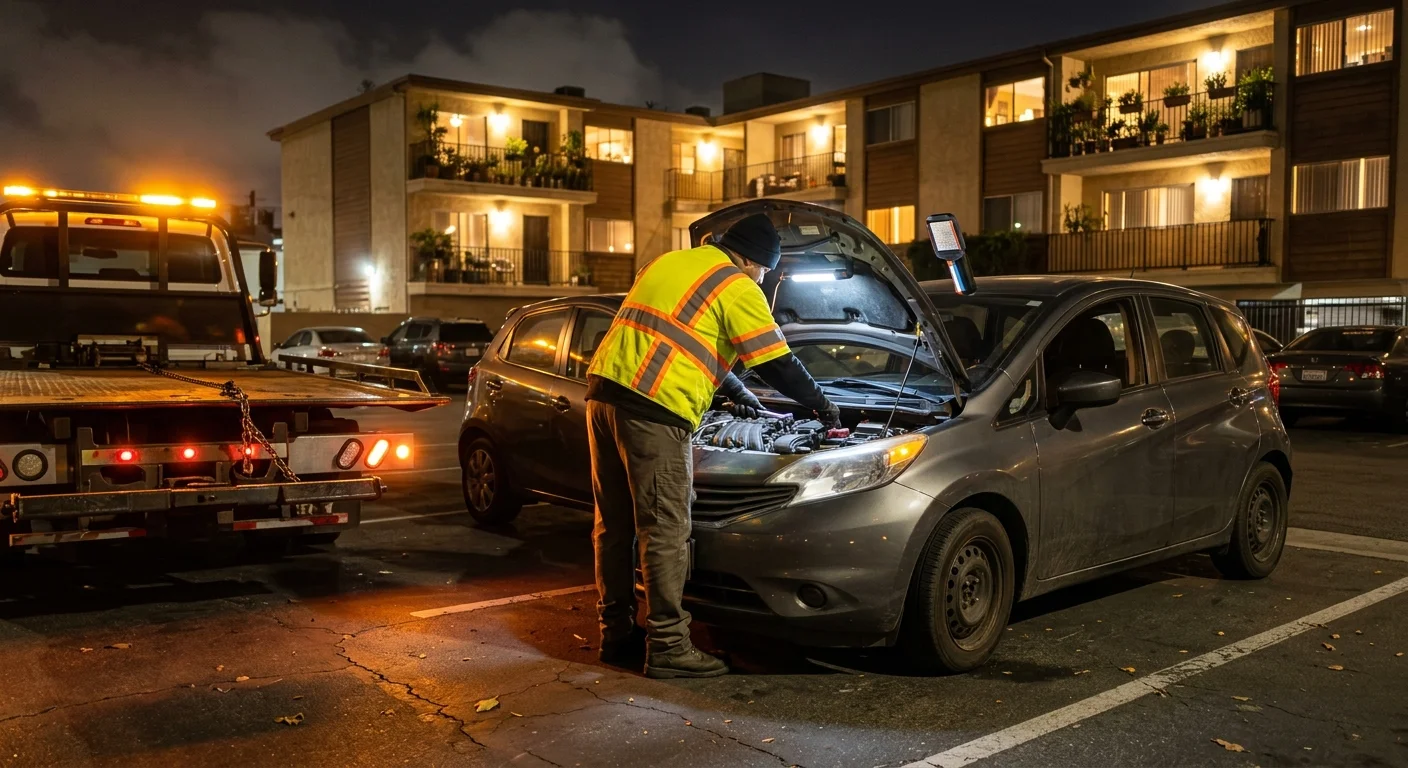
Dead battery vs a car that will not move
A dead battery and a car that will not move are not the same job. Lights that still glow, a single click at the starter, and a car that sat unused after a Dodger night or a shift at LAX often point to a battery that needs a boost. Dash lights that are bright while the engine cranks hard, then never fires, point somewhere else. Fuel, a starter that is already grinding, an immobilizer, or a flooded engine will not get better from jumper cables.
Tell the dispatcher what you hear and see. Dim interior lights and a slow crank are useful. A grinding noise, smoke, or a warning light that was on before the car died are useful too. The operator we send needs that picture so they bring a pack for a jump, or a truck that can load the car.
Los Angeles makes the split sharper because of where the car sits. A compact in a tight stall under a Hollywood apartment is still a battery job if it starts and holds. The same silent car on the 110 downtown, with traffic closing the lane, is a move-it-now job even if the battery is the only fault. Heat in the Valley cooks batteries. Short trips in Mid-City and East Hollywood never give the charging system a long run. Coastal cars from San Pedro up through Santa Monica sit in damp air that is hard on terminals. None of that changes the first test: will it start, and will it stay running.
Do not stand in a travel lane to diagnose it. If you are on a City street, stay on the curb side. If you are on a CHP highway, get yourself and passengers out of live lanes when it is safe to do so. The National Highway Traffic Safety Administration treats a stopped car on a high-speed shoulder as a crash risk, not a DIY workspace. A jump is a battery task. A car that will not move is a towing task. Mix them up and you either pay for a load you did not need, or you sit in traffic with a car that will never catch.
Parking structures, street parking, and freeway shoulders
Where the car died decides the work as much as why it died. Downtown Bunker Hill, South Park, Century City, and the stacked lots off Vine and Cahuenga are tight. Many stalls will not take a full-size wrecker. The pro we connect you with may walk in with a jump pack, start the car in the stall, and have you drive it out. If it will not hold a charge, they still have to get it out of that structure without dragging it across a parkade ramp. Say the level, the stall number, the nearest elevator, and whether a height bar is in the way.
Street parking is a different clock. A dead car on a City of Los Angeles street or alley can run into the 72-hour rule in LAMC 80.73.2 once a traffic officer has observed it over that period. CVC 22669 also lets an officer remove an inoperable car that is a public hazard without waiting. That is not a jump-start fee. It is how a battery problem becomes an impound if you lock it and leave. Koreatown, Boyle Heights, Highland Park, and the flats of the Valley are full of overnight street cars. If it will not start, do not assume it can sit until morning.
Freeway shoulders are the hard case. The 405 through the Sepulveda Pass, the 110 through downtown, the 10 through Mid-City, the 5 on the Eastside, and the 101 through Hollywood are CHP-served highways. The California Highway Patrol clears disabled cars from those roads through its Rotation Tow Program. If you are on that shoulder, get out of live lanes. Put the hazards on if you can do it from a safe spot. Do not stand behind the bumper in traffic. Our freeway crash towing guide covers the highway sequence in more depth. The short version for a dead battery: a jump on a live shoulder is only sane if the operator can work off the travel lanes. If they cannot, the car should be loaded and taken to a lot or a shop, not nursed through the next interchange.
Private lots and apartment garages add house rules. A jump in a Westside subterranean garage is usually allowed. Leaving a dead car in a reserved stall overnight is between you and the building. It is not a City Official Police Garage tow unless an agency authorizes one. Give dispatch the gate code or meet the driver at the driveway. A pack that cannot reach the battery through a locked gate does not help you.
When a jump is enough
A jump is enough when the battery is flat and the rest of the car is willing. You left the lights on at The Grove. The car sat two weeks at a Burbank apartment. It is a cold inland morning in Santa Clarita after a short hop the night before. Interior lights still work. You hear a click or a slow crank. No grinding. No burning smell. No fluid under the car.
In those cases, roadside assistance is the right request. The pros we send handle jumps, lockouts, and tows. For a straightforward dead battery they bring a pack, connect it in the right order, and see if the engine catches. If it starts and stays running, that is the job. Drive it. A short trip around the block in stop-and-go on Wilshire is a weak test. A longer run that lets the charging system work is a better one. If it dies at the next light, you did not fix the charging system. You borrowed a few minutes.
Say the make and model when you call. A 12-volt pack on a gas compact in North Hollywood is a common call. A hybrid or an EV is not the same hookup. Many of those cars still have a 12-volt battery that can go flat, and the access point is not always under the hood the way an older Civic is. Do not guess at the jump points. Tell dispatch what you drive so the operator arrives with the right gear. We do not publish a jump-start price, and we do not own the service trucks. Ask the operator what the boost will cost before they start.
A jump is also enough only if the car can legally and safely leave the spot. A car that starts in a red zone, a bus lane, or a travel lane still has to move. If it will not stay running long enough to reach a legal stall, stop treating it as a jump. Load it. People search for 24 hour jump start service because batteries die at 1 a.m. in apartment lots as often as they die at noon at a studio lot. Call any time, day or night. The line takes the call. Describe the symptoms, not the diagnosis you want.
Skip the stranger with cables in a Costco lot if you do not know the car or the sequence. Modern electronics do not love a reverse hookup. A portable pack in untrained hands has the same risk. Stay with the car if the lot is well lit and you feel safe. If you do not, wait in a lobby or a well-lit doorway and give the operator a clear meeting point.
When the pro should load it instead
Load the car when a jump would only restart a problem, or when the location is the problem. It cranks after a boost and dies before you leave the structure. It never cranks, even with a pack on it. You hear a grinding starter. You smell fuel or burning plastic. The engine was overheating on the 5 before it quit. There is a puddle of coolant or oil. Airbags went off. The car took a hit. Those are not battery-only jobs.
A car that cannot be driven in gear, a CVT that will not engage, or a steering column that will not unlock after a collision belongs on a truck. Emergency towing is the request when the car has to leave the scene and cannot do it on its own power. On a freeway, that is the default more often than a jump. On a hillside street in Echo Park or Mount Washington, a car that will not hold park or that sits at a steep grade is a load, not a boost you hope holds through the next stop sign.
An inoperable car left in a live lane is also a load. CVC 22651 lists when a peace officer may remove a vehicle, including a hazard. You do not need a citation number in your head. You need the car out of traffic. If CHP or LAPD is already on scene, follow their direction. Agency tows in the City of Los Angeles go through the Official Police Garage system, which is a different path from a private roadside call. City OPG rates as of January 1, 2026 start at $220.00 for a standard vehicle tow in the first hour at the credit-card rate, plus storage if it is held. That schedule is for police-ordered tows, not for a private jump. Do not mix the two invoices in your head.
If the car starts and the battery light stays on, treat that as a charging failure. A jump gets you off the block. It does not replace an alternator. If you cannot reach a shop without dying again, have it loaded. Same if you are in a structure with no cell service on the lower levels: walk to a signal, call, and ask for a truck that can recover from that garage, not only a pack.
Rideshare does not replace this decision. An Uber can get you home. It does not jump the battery, and the car stays where you left it. That is fine if the stall is yours and the building allows it. It is a bad plan on a City street heading toward a 72-hour observation, and it is a worse plan on a freeway shoulder.
What a roadside call in LA usually includes
A roadside call in Los Angeles is a conversation, then a dispatched operator, then a choice on scene. You give a location that a local driver can actually find: not only “near the 101,” but the off-ramp, the cross street, the garage name, the level, and the last four of the plate if you have it. You describe the symptoms. You say whether anyone is still with the car. Dispatch matches that to a licensed, insured operator in the network. Quick Tow LA connects you with that operator. You contract with them, and you pay them. We do not hold a Motor Carrier Permit and we do not run a yard.
On scene, a jump is cables or a pack, a start, and a short watch to see if it holds. A lockout is a separate tool set; see car lockout help in Los Angeles. An empty tank is fuel delivery, not a boost. A tow is a hook or a bed and a destination you name: home, a shop, a lot. Ask the destination and the charge before the truck moves. This site does not publish a brand price for a jump or a private tow. No operator with a signed rate card is on file here. City and state published fees that we can cite are police and impound figures, not a battery boost in a Reseda driveway. If someone quotes you a number, that is their rate. Confirm it before they start.
Membership clubs and a local pro are different paths, not a fight. If you already pay AAA or another club, call that number first. Those programs are built for members. If you are not a member, the club is not obligated to roll a truck for you. A local dispatch line can still connect you with a licensed operator tonight. Use the club when you have it. Use a local pro when you do not, or when the club cannot reach the car where it sits.
Walmart is a store, not a county roadside plan. A county-wide rule that every Walmart Auto Care Center in Los Angeles County will jump a dead car in the lot could not be confirmed. Ask that store’s desk, during that store’s hours. If the lot is closed or the desk says no, you still need a mobile operator.
People also ask how much a jump should cost. There is no City of LA published jump-start fee to quote. Do not use Official Police Garage tow figures as a stand-in. Get the operator’s number in dollars before the clamps go on. If the job changes from a jump to a load, get that number too. For a wider view of how local help is organized, see our guide to roadside assistance in Los Angeles.
When to call us
Call when the car will not start and you cannot safely work on it where it sits, or when a jump already failed and the car still has to leave a stall, a street, or a shoulder. The operators we dispatch handle the boost or the load. Call (213) 410-1414 to reach dispatch.