A crash on an LA freeway is not a parking-lot fender bender. Live lanes are still moving at highway speed, the shoulder may be a few feet of concrete, and the first truck that rolls up may not be the one anyone called. Freeway accident towing in Los Angeles starts with getting people out of traffic, then deciding who moves the car and where it goes. A car in sand off PCH is a different job: beach winch-out.
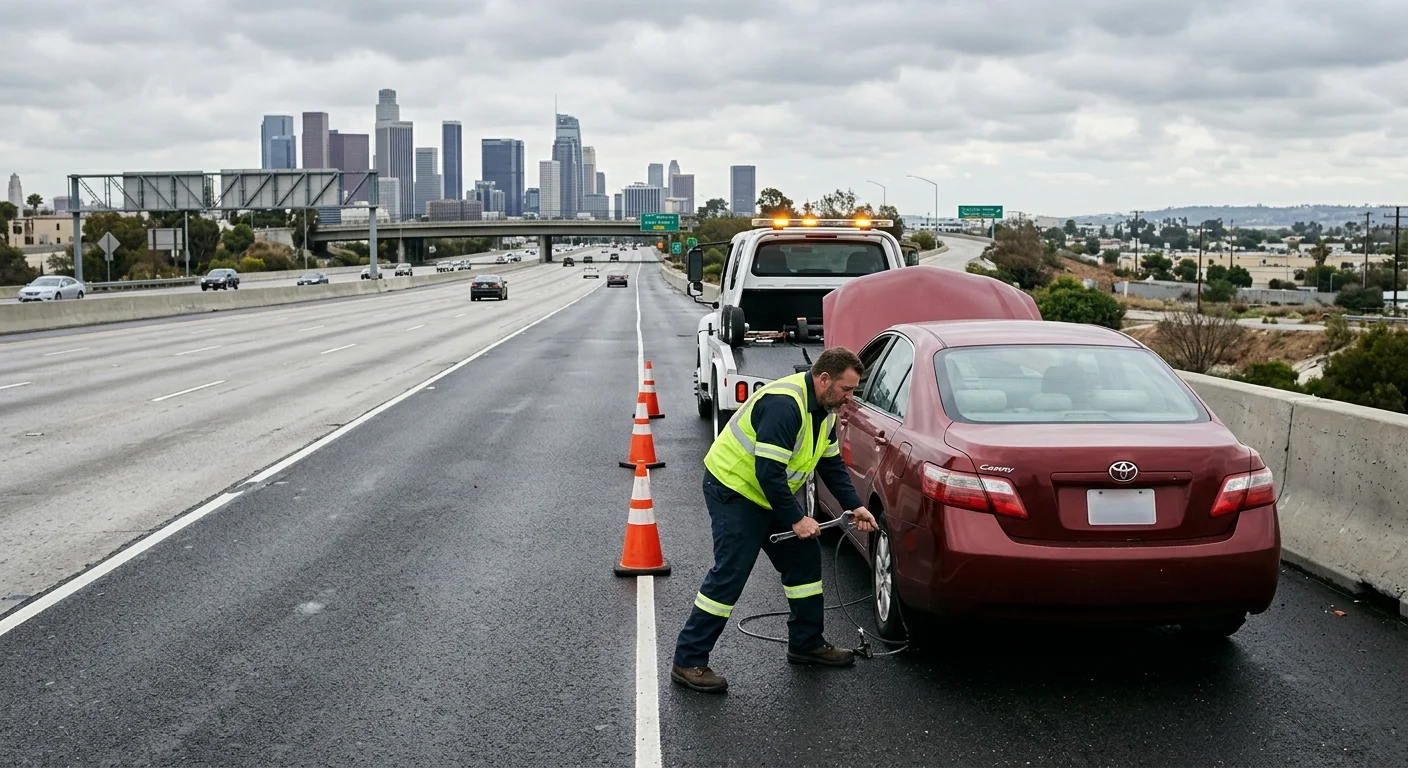
Get out of live lanes on the 405, 110, 10, and 5
If the car still rolls, get it fully out of the travel lanes. Hazard lights on. Wheels pointed away from traffic. Then get people to a place that is not the white line.
The 405 through the Westside and the Sepulveda Pass often gives you a real right shoulder. Use it. Do not sit in the number-one lane at the Getty, Skirball, or Mulholland because the next gap “looks close.” The grade is steep, trucks stack up, and fog sits in that cut. A 405 accident tow starts with the car being all the way right, not half in a lane.
The Harbor 110 is a different problem. Through downtown and South LA the right edge is often a painted stripe against a wall, a column, or a short off-ramp. The 110 at 3rd, 4th, 6th, and Florence does not give you the same room as the 405 at Wilshire. If you cannot get fully out, stay belted in the vehicle if leaving would put you in a live lane. If you can reach a gore point, a blocked lane behind cones, or the far side of a barrier with a walkable path, take people there and keep them off the pavement.
The 10 through downtown, East LA, and the 5/10/60 mix has stacked ramps and short merges. The 5 through the Valley, the 5/101 split, and the 5 south toward Commerce put you next to walls, trucks, and people still doing 65. Same rule on all of them: live lane first, phone second.
Do not stand behind the trunk. Do not walk up the lane to “warn” traffic. Do not climb a K-rail in the dark unless that is the only cover. NHTSA’s roadside safety guidance is blunt about this: get out of the path of moving vehicles, then deal with the car.
Call 911 if anyone is hurt, if the car is in a lane, if fluids are on the pavement, or if you cannot move it. On a CHP-served freeway, that call is how the scene gets a unit and a plan. A photo of the mile marker, the overhead sign, and the nearest exit (Sepulveda, Vermont, Santa Monica Blvd, Los Angeles Street) helps more than “I’m on the 405.”
Who usually runs a freeway scene in LA County
On the mainline freeways, the California Highway Patrol is usually the agency that owns the scene. That is the 405, 110, 10, 5, 101, 210, and the rest of the CHP-served highway system in the county. CHP handles the collision, the lane closure, and the decision to move wreckage so the freeway can reopen.
Once you leave the freeway, the map changes. LAPD handles city streets inside Los Angeles. LASD and city police handle their own cities and unincorporated pockets. A car that ends up against a wall on the 110, then gets pushed onto a downtown surface street, can pass from a CHP scene to a city street in a few hundred feet. Ask the officer in front of you who has the scene. Do not guess from the color of the first light bar you saw.
CHP clears disabled and collision vehicles from the highways it serves through its Rotation Tow Program, under a Tow Service Agreement. Calls go out on an equitable rotation list. That is the published frame. The exact order of that list, who is “next,” and whether you can always refuse a rotation truck could not be confirmed as a single public rule. Ask the officer on scene. Ask if a truck is already assigned. Ask if you may call your own operator.
CHP does not publish one uniform statewide tow rate. Operators submit rates. CHP may reject a rate as excessive. Beyond “rates are set through the CHP Tow Service Agreement,” the finer mechanics are not verified. Do not take a shoulder quote as the official number.
A City of Los Angeles Official Police Garage tow is a different machine. The City has 17 designated Official Police Garages for LAPD, LADOT, and other city-agency requests. Those OPG rates (as of January 1, 2026) apply to that city program. They do not automatically apply to a CHP freeway rotation. If someone cites a city storage board as if it were your freeway bill, stop and ask which agency authorized the tow.
Predatory trucks hunt crash scenes in this county. A truck that arrives before 911 has been called, before CHP is on scene, or before you asked for help is a warning, not a favor. Ask the officer if they requested that truck. If the answer is no, do not sign. Photograph the door lettering and the plate. Then call your own dispatch or wait for the unit that was actually requested.
Winch-out and recovery vs a simple hook-up
A car sitting straight on a wide 405 shoulder, all four tires on pavement, may only need a hook-up or a flatbed load. That is the simple job. Crash towing in Los Angeles is often not that job.
Winch-out and recovery is the work when the car is not sitting where a truck can just back up to it. Over the K-rail on the 110. Nose-down in the 405 median in the Pass. Against the wall on a downtown 10 ramp. Hung on a gore point at the 5/101. Dropped off a short ramp onto the street below. Two cars nested so neither can roll. An EV that cannot be dragged on its drive wheels.
That is accident recovery and winch-out work. The operator needs the right truck, the right straps, and a plan that does not dump the car back into a live lane. A light-duty wheel-lift that was circling the 101 looking for work is not that plan.
Tell dispatch the truth about the position. “Facing the wrong way on the right shoulder of northbound 405 at Skirball” is useful. “In the bushes west of the 110 at 6th” is useful. “I think it will roll” when it will not is how the wrong truck shows up and then sits in the closure.
Do not try to yank it yourself with a strap from a friend’s SUV. You do not have the anchors, the traffic control, or the angle. You also do not want a second collision because someone improvised a pull across a travel lane.
Heavy damage, leaking fluids, a deployed airbag, or a car that will not roll in a straight line all point to a flatbed after the recovery, not a drag. The operator we connect you with loads it. You do not stand in the lane to “help” with the winch. Stay where the officer put you.
If the car is already assigned to a rotation truck, say so when you call anyone else. Two trucks at the same bumper is how arguments start on the 10 at night. One scene, one authorized mover, one destination on the ticket.
Your car, your belongings, and the next stop
Where the truck takes the car is not a mystery you solve tomorrow. It is a sentence you get in writing before the truck leaves the shoulder.
If you requested the tow, name the destination. Home, a shop you already use, a dealer, a lot you can reach by rideshare. If you do not name one, many operators default to their own storage yard. Confirm the yard name, the city, and a phone number on the invoice. “A yard in LA” is not an address.
If CHP called rotation, ask the officer and the driver the same questions. Which company. Which yard. Which city. Is this a private tow you are authorizing, or a rotation move to that operator’s lot. Get the ticket. Photograph it.
If the car was taken as a City of LA police impound, that is the OPG system, not a random freeway yard. Search the OPGLA VIIC public database at opglaviic.com by plate or VIN. That tool is what LADOT points people to. Release from an OPG is in person, generally 7:00 a.m. to 7:00 p.m. You still need the police release from the impounding LAPD Area station, plus ID and proof of ownership, before the garage will hand over keys.
A freeway rotation tow and a city OPG impound are easy to mix up when you are shaken. They are not the same bill and not the same building.
Pull what you can from the car before it is loaded, if the officer says it is safe: wallet, phone, keys, medication, child seats, work bag, laptop. Once it is on a truck, getting back into the cabin is the driver’s call, not yours. California rules on what a yard can hold onto are their own subject. Read whether a tow company can keep your belongings before you leave a purse in the back seat and assume it will be there Friday.
Who pays is not a slogan. Quick Tow LA does not publish a brand price. CHP does not publish one statewide crash-tow number. Your insurer may cover all of it, part of it, or none of it, depending on the policy, fault, and deductibles. Confirm that with the insurer. Do not sign a blank ticket because someone on the shoulder said “insurance will handle it” and “the shop is already picked.” That is how cars leave the 5 and show up at a yard you never chose.
If you only learned the car was gone after you got a ride, start with the agency that had the scene. Then the ticket. Then the yard on that ticket. For a city police tow, use the OPG locator. For a private or rotation tow, you are looking for the company name on the invoice, not a rumor from a second truck.
How to request a tow once the scene is clear
Once CHP or the local unit says the car can move, you have a narrow job: get an authorized operator, a destination, and a paper trail.
Ask the officer, out loud, who is calling the truck. You. Them. Rotation. Insurance. If rotation is already rolling, you may not need a second call. If nobody has called, you can. That is often you, not “whoever shows up first.”
When you call, give the freeway, direction, nearest exit or overpass, and how the car is sitting. Northbound 405 at Sepulveda. Southbound 110 at Florence. Eastbound 10 at Los Angeles Street. Westbound 101 at Cahuenga. Say if it needs a winch-out. Say if it is an EV. Say if it will not roll.
Call any time, day or night, at (213) 410-1414. Quick Tow LA connects you with local, licensed operators. You contract with the operator. The brand does not run the truck, the yard, or the recovery itself. For a car still in a closure, that call is emergency towing, not a later-day appointment.
Do not sign a blank invoice, a blank work order, or a destination you did not agree to. If the driver will not take the car where you asked, that is a stop sign. If the truck has no company name on it, that is a stop sign. If the story is “CHP sent me” and the officer says they did not, that is a stop sign.
Take photos of the truck, the plate, the door lettering, and the signed ticket. Keep your copy. If the scene already feels wrong, read your towing rights in Los Angeles before you argue on the shoulder. The safer move is to refuse the load and wait for an operator you can name.
Insurance can send its own truck. That only helps if you confirm the dispatch while you are still there. A truck that claims it “already spoke to State Farm” is not proof. Call the number on your card. Match the company name.
Then get people off the freeway. The car can wait at a shop. You should not wait in a live lane for a second argument about a winch.
When to call us
If the car is still on an LA freeway, in a median, against a wall, or too damaged to roll, you need a recovery operator, not a friend with a strap. Call (213) 410-1414 to reach dispatch. Tell them the freeway, the direction, and whether this is a simple load or a winch-out, and they will connect you with a licensed pro who can take the car where you name.