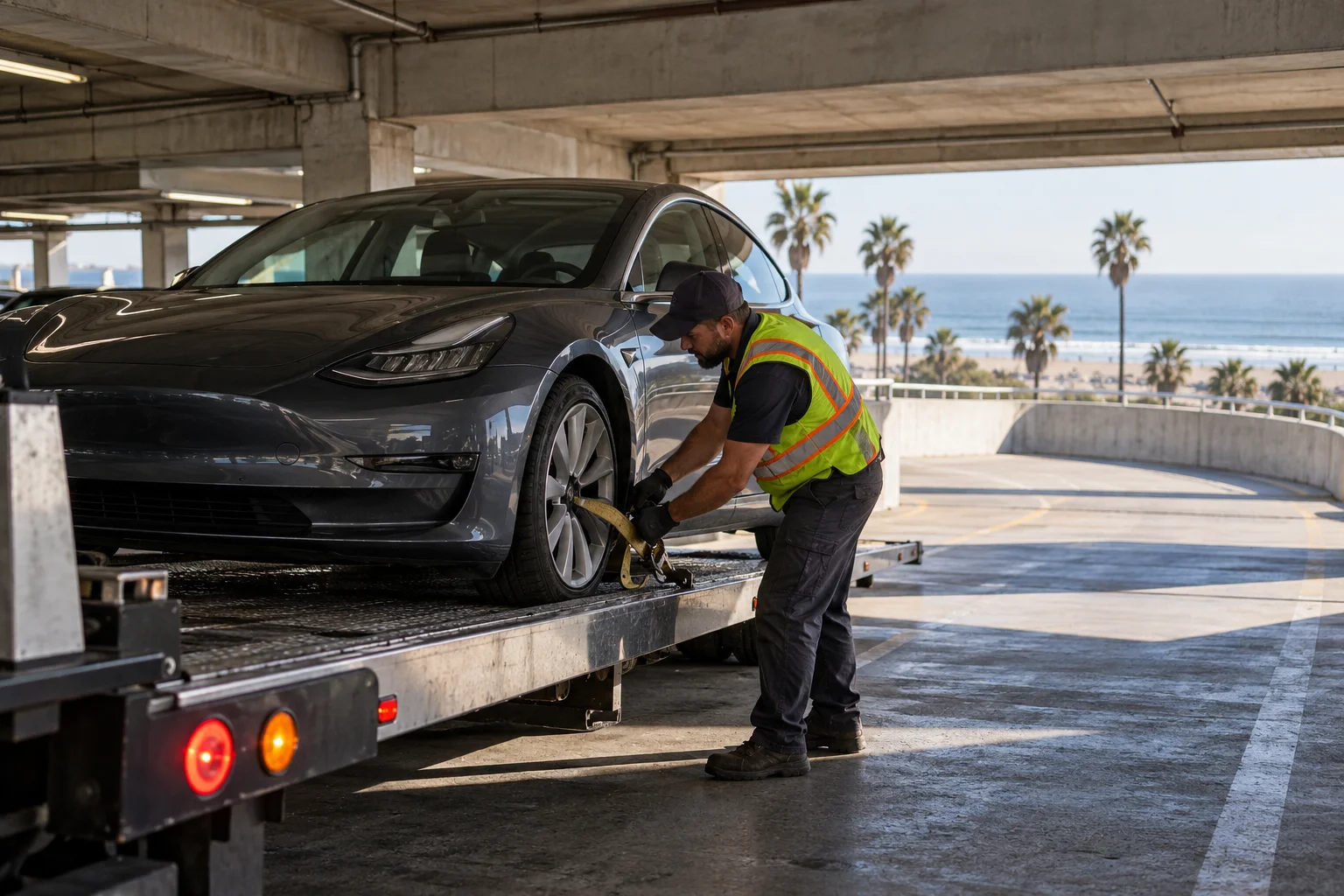
A disabled car inside a Santa Monica garage may need more than a standard flatbed pickup. The operator must first understand the clearance, ramps, gates, and space around the vehicle. In some cases, the flatbed can wait outside while the car reaches an accessible loading point.
Why garage clearance changes the pickup plan
A flatbed needs enough room to enter, turn, position, and load. A garage entrance may look wide enough while the interior creates a different problem. Low ceilings, overhead pipes, sharp ramp transitions, and tight corners can limit access.
This matters in structures around Downtown Santa Monica, Ocean Avenue, Wilshire Boulevard, Lincoln Boulevard, and the beach district. The exact problem depends on the building. An open street-level entrance isn’t proof that a full-size towing setup can reach an upper or underground level.
Check every posted clearance sign you can see. Report the lowest number, not only the entrance clearance. Some structures have separate limits near ramps, exit lanes, or upper levels. Don’t guess if a sign is missing or unreadable. Tell dispatch that the clearance couldn’t be confirmed.
The vehicle’s position matters too. A car facing a wall presents a different problem than one facing the drive aisle. A locked steering wheel, engaged parking brake, damaged suspension, or blocked wheel can further change the recovery plan.
A local operator must decide what setup fits the site. A smaller recovery arrangement may be needed to move the vehicle into an accessible area before flatbed loading. That method can’t be promised without reviewing the vehicle and structure.
Our flatbed towing service connects Santa Monica drivers with local, licensed operators. For a general explanation of loading and transport, read how flatbed towing works in Los Angeles.
What to report about ramps, gates, and stall access
Good access details help dispatch match the problem with an operator. Start with the garage name or street address. Add the entrance street, parking level, stall number, and nearest elevator or stairwell marker. A map pin can help when a property has several entrances.
Then describe the full path to the vehicle. Mention each ramp, gate, turn, and overhead restriction. Say whether the entrance is level or sloped. Note sharp transitions where a low car might scrape. Report whether the driving aisle ends near the vehicle or continues past it.
Gate access deserves special attention. Tell dispatch whether the gate opens with a ticket, resident remote, key card, code, or property staff. Don’t assume the tow operator can enter through a resident-only gate. If management controls access, contact the property before dispatch when possible.
Photos can explain the site better than a short description. Useful images include:
- The posted clearance at the entrance
- The tightest interior turn
- The ramp directly before the vehicle
- The space in front of and behind the car
- Each damaged wheel or low body panel
- The exit area where a flatbed might wait
Also report whether the car can roll, steer, and shift into neutral. Don’t try to force those functions. The correct process depends on the vehicle and its condition.
For a classic, exotic, or very low vehicle, mention modifications and ground clearance concerns before the operator arrives. Our exotic and classic vehicle towing page explains why those details affect equipment selection and loading.
When a flatbed can wait outside the structure
A flatbed may not need to enter the garage. If the interior can’t accommodate it, the operator may consider moving the vehicle to a suitable loading area outside. That decision belongs to the operator after checking access, vehicle condition, and property restrictions.
The outside location needs careful planning. A garage exit on Ocean Avenue creates a different setup than an exit into a quieter internal driveway. Wilshire Boulevard and Lincoln Boulevard can also leave little room for staging near moving traffic. Don’t choose a loading point simply because it’s close.
Tell dispatch what sits beyond the exit. Describe the curb, driveway, travel lane, loading zone, alley, or parking area. Mention gates that close automatically. Note whether another vehicle blocks the path. If property staff have identified an approved staging area, share that information too.
Never push or tow the car through the structure with another personal vehicle. Tight ramps provide little room to correct a bad angle. A disabled car may also have steering, braking, drivetrain, or wheel problems that aren’t obvious from the driver’s seat.
The operator may use a smaller recovery setup, repositioning equipment, or another method suited to the structure. Quick Tow LA can’t promise one technique before the operator evaluates the site. The goal is to reach an accessible loading point without guessing about the garage or vehicle.
If the car can still move under its own power, don’t drive it outside unless doing so is safe for the vehicle. Warning lights, collision damage, fluid loss, tire damage, or unusual noises can indicate that further driving isn’t appropriate.
EVs, AWD cars, and low-clearance vehicles
Vehicle type changes the information dispatch needs. An electric vehicle, all-wheel-drive car, or low-clearance model may require specific handling. Share the year, make, model, drivetrain, and current condition before the operator is sent.
For an EV, report the battery state if the display is available. Say whether the vehicle powers on, shifts into neutral, rolls, or has collision damage. Mention a locked charge cable or charging-space barrier. Don’t try to disconnect damaged electrical components.
Our guide to EV and Tesla flatbed towing covers the vehicle details operators need. The vehicle manufacturer’s towing instructions remain important because procedures differ by model.
For AWD and four-wheel-drive vehicles, don’t assume two wheels can roll while two remain on the ground. The drivetrain configuration and vehicle condition affect transport. Read the AWD and 4x4 towing guide for a focused explanation.
Low-clearance cars add another layer. A steep garage ramp may already leave little space beneath a bumper, splitter, battery enclosure, or exhaust component. Loading angles outside the structure can create a second clearance issue. Photograph the lowest body area and any existing damage before recovery begins.
Modified suspension, oversized wheels, underbody panels, and nonstandard bodywork should be disclosed. The same applies to a missing tow eye or inaccessible wheel. These details help the operator assess the job before reaching the garage.
Don’t crawl beneath a disabled vehicle to inspect it. Describe what you can see from a normal standing position. Let the dispatched operator inspect areas that require equipment or training.
How beach traffic affects the destination choice
The garage exit is only the first part of the tow. Before dispatch, choose a destination that makes sense for the vehicle and the route. That might be a repair facility, dealership, home, or another location you’re authorized to use.
Santa Monica’s beach district can make this decision more complicated. A destination across town may require travel through busy corridors near Ocean Avenue, Lincoln Boulevard, Wilshire Boulevard, or the I-10 connection. Traffic conditions can change while the recovery is underway, so don’t build the plan around an assumed travel time.
Confirm that the destination can receive the vehicle. Ask about access, operating hours, key drop procedures, and where the operator should unload. Those details must come directly from the destination. Quick Tow LA can’t confirm another business’s current policies.
If the vehicle needs model-specific service, consider that before selecting the nearest shop. An EV, AWD vehicle, exotic car, or modified vehicle may need a destination prepared for that model or problem. Tell dispatch if the selected location has narrow access, underground parking, or another gate.
A breakdown on a CHP-served highway differs from a car disabled inside a garage. The California Highway Patrol uses its Rotation Tow Program to clear disabled or collision vehicles from highways it serves. It doesn’t publish one uniform statewide towing rate.
For broader guidance when a breakdown places you near traffic, NHTSA maintains a roadside safety resource. Inside a garage, follow property instructions and avoid blocking active ramps while waiting for the operator.
When to call us
Call when the car can’t move safely, the flatbed may not fit, or the garage requires a controlled recovery plan. We’ll connect you with a local, licensed towing operator who can review the access and vehicle details. Call (213) 410-1414 to reach dispatch.