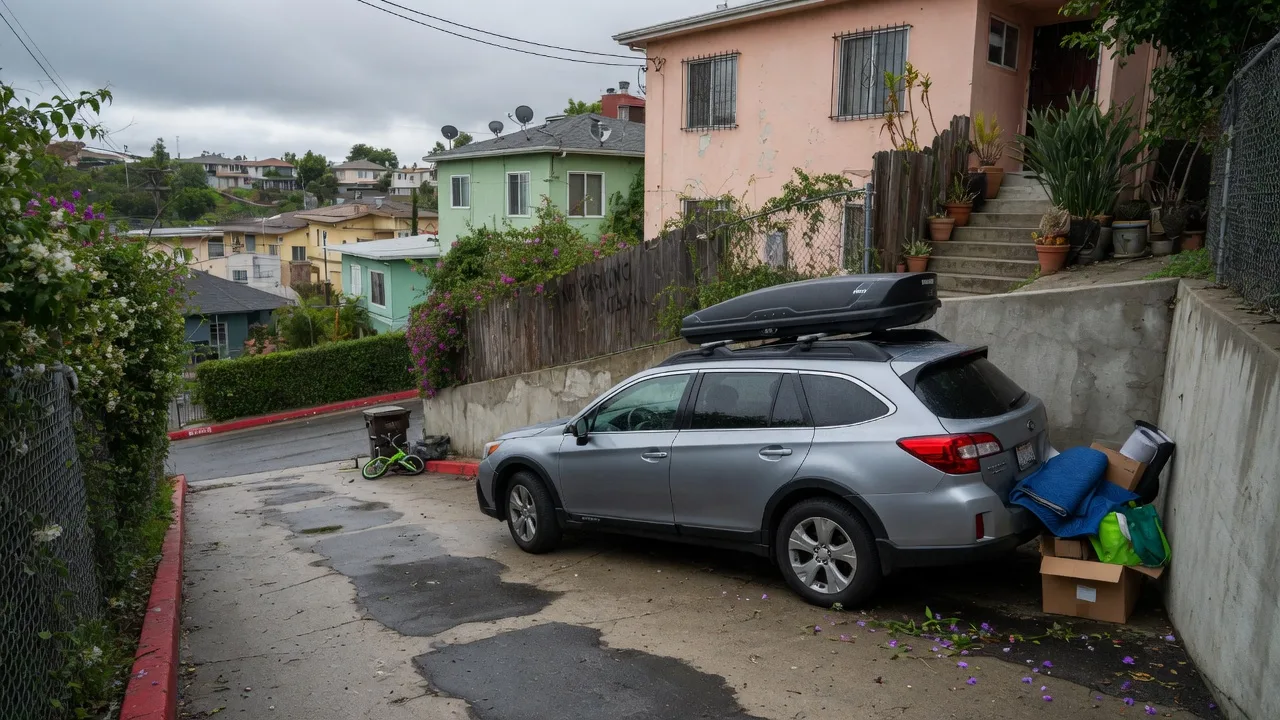
A Subaru in an Echo Park driveway, a BMW xDrive on the 405, a Tacoma left in 4-High in the Angeles forest: those drivetrains do not like two tires rolling while two hang. AWD and 4x4 towing in Los Angeles is a flatbed job, or a wheel-lift with dollies under the rolling axle. It is not the same problem as an EV motor, and it is not a short-hop exception.
Why two rolling tires bind an AWD drivetrain
A front-wheel-drive Civic can often ride a wheel-lift with the drive wheels up and the rears rolling free. A rear-wheel-drive Mustang can do the reverse. All-wheel-drive and part-time 4x4 do not have that free end.
The center differential, viscous coupling, or transfer case still connects the axles. When two wheels turn on the pavement and two do not, that box takes the speed difference. Transfer cases and couplings are not built for a tow-speed mismatch with the engine off. The damage often shows up later as a grind, a shudder, or a shop bill that dwarfs the tow.
This is not the EV problem. An electric drivetrain can generate voltage in a spinning motor. We keep that on why Teslas and EVs must go on flatbeds. An AWD gas Subaru can still wreck a transfer case with no electric motor in the picture. An AWD Tesla has both problems. Tell dispatch both facts: AWD, and electric.
How flatbed towing works is the equipment page. This page is the drivetrain decision: ask for a bed, or ask whether dollies will be under the trailing axle, before anyone hooks.
We do not publish a brand price for a flatbed versus a wheel-lift. No operator with a signed rate card is on file. Do not use Official Police Garage figures as a stand-in. City OPG rates as of January 1, 2026 start at $220.00 for a standard vehicle tow in the first hour at the credit-card rate. That schedule is for police-ordered tows.
What to say on the phone in LA
Say AWD, 4WD, or 4x4 in the first sentence. Say the make and model. Subaru Outback, Audi quattro, BMW xDrive, Mercedes 4MATIC, Honda CR-V AWD, Toyota RAV4 AWD, Tacoma 4WD, Wrangler, F-150 4x4: those words change the truck.
Say if the transfer case is in 4-High, 4-Low, or Auto. A truck left in 4-Low in the Angeles Crest or on a dirt spur off the 2 is a different recovery from a Forester in a Silver Lake stall. If you do not know the setting, say that. Do not crawl under it in a travel lane to find out.
Say the space. A Koreatown tandem stall may not take a long deck. The operator may still need a bed, and may need to winch to a spot where the deck can sit. A hillside street in Echo Park or Mount Washington adds grade. A wheel-lift with no dollies is still the wrong answer on AWD, even if it is the only truck that fits the aisle. Then the operator stages the right equipment, or uses dollies. That is their call on that car, in that spot.
If you are on a CHP-served highway, the California Highway Patrol rotation program may send the wrecker. Tell the officer it is AWD. You still want four wheels off the ground, or dollies under the rolling pair.
Tight lots, canyons, and short hops are not exceptions
“It’s only five miles to the shop on La Brea” is not a reason to drag an Outback on two tires. The transfer case does not care that the hop is short.
Lowered AWD cars add a second problem. Airbags, coilovers, and lip kits hang lower than stock. A yoke that has to slide under the tires can catch the valance first. A tilting deck lets the operator winch from behind.
Canyon roads off PCH, Topanga, and the 2 are long enough that a bad method has more miles to work. If the car is already in sand or a ditch, it may need a winch-out first, then a bed.
Part-time 4x4 trucks sometimes have a true 2WD mode. Even then, confirm the setting. If you cannot get it into 2WD, treat it as a bed job. We will not invent a manufacturer exception list. Check the owner’s manual for that VIN if you have it. The operator still decides the hookup they will put their name on.
Dollies, beds, and what we will not invent
A flatbed carries all four wheels off the pavement. That is the default ask for AWD in Los Angeles.
A wheel-lift with dollies under the trailing axle also keeps those tires from turning. Whether dollies come out is the operator’s call. You can ask. You cannot assume they are on the truck.
Hook-and-chain on a bumper is the old method. Do not accept it on a modern AWD car.
A published dollar premium for flatbed versus wheel-lift in Los Angeles County could not be confirmed in our claims file. Drivetrain repair after a bad tow is usually far more expensive than the difference on the method. Get both numbers from the operator if both methods are actually safe for that car. If they are not, skip the cheaper hookup.
Quick Tow LA connects you with a licensed operator. We do not own the beds. You contract with the operator, and you pay them.
When to call us
Call when the car is AWD or 4x4 and it has to leave a stall, a street, a canyon, or a shoulder. Ask for a flatbed, or ask how they will keep the driveline from spinning. Call (213) 410-1414 to reach dispatch.