The gauge hit empty on the 405, or on a quiet street in San Gabriel after a missed exit. Fuel delivery in Los Angeles is often a can to the tank, not a load. It is a different job from a jump, and a different job from sitting on a CHP shoulder until a rotation truck takes the car.
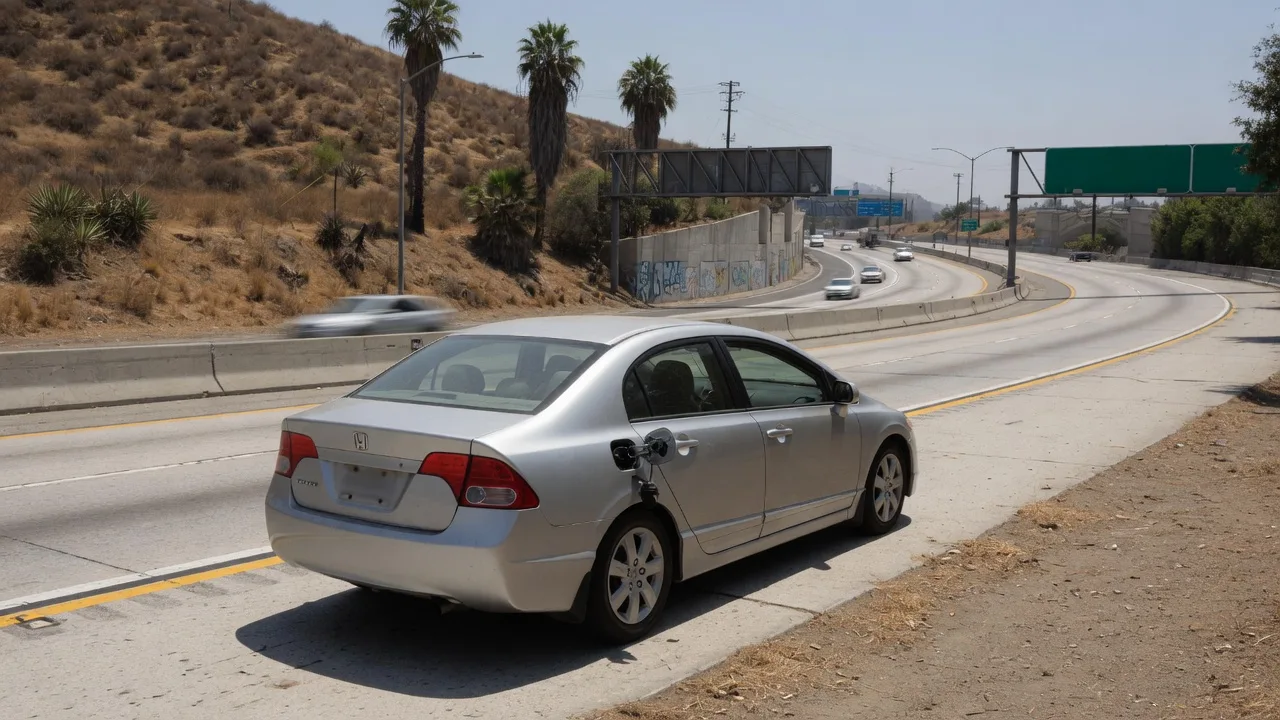
Empty tank vs a car that will not move
An empty tank and a car that will not move are not the same job. A sputtering engine, a long downhill coast, and a gauge that has been on E since the last light in Van Nuys often point to fuel. A car that cranks with a full-looking gauge, or that died with a check-engine light and a puddle, points somewhere else.
Tell the dispatcher what you drive and what you need. Regular, premium, or diesel. A gas Civic in Highland Park is a common call. A diesel truck in Vernon is not the same can. An EV is not a fuel call. If you drive a Tesla or another EV, stop here and use EV flatbed towing.
The operator we send quotes fuel they can legally bring to that spot. We do not publish a gallon amount, a brand of fuel, or a price. No operator with a signed rate card is on file. City Official Police Garage figures are police-ordered tows, not a can on a San Gabriel curb. Ask the operator what the fuel and the trip will cost before they roll.
If the car still will not run after fuel, it was never only an empty tank. Then you need a jump or a tow. Our jump start vs a tow page covers that split.
Shoulders, structures, and city streets
Where the car died decides whether fuel is even possible.
Freeway shoulders are the hard case. The 405 through the Sepulveda Pass, the 110 through downtown, the 10 through Mid-City, the 5 on the Eastside, and the 101 through Hollywood are CHP-served highways. The California Highway Patrol clears disabled cars from those roads through its Rotation Tow Program. Get yourself and passengers out of live lanes when it is safe. NHTSA roadside safety treats a stopped car on a high-speed shoulder as a crash risk, not a DIY workspace.
A can on a live shoulder is only sane if the operator can work off the travel lanes and the car can restart and merge. If they cannot, the car should be loaded and taken to a lot or a shop, not nursed through the next interchange. If an officer already assigned a rotation truck, that truck has the job.
Street parking is a different clock. An inoperable car on a City of Los Angeles street or alley can run into the 72-hour rule in LAMC 80.73.2 once a traffic officer has observed it over that period. CVC 22669 also lets an officer remove an inoperable car that is a public hazard without waiting. Fuel tonight can keep an empty tank from becoming an impound.
Parking structures add access. Downtown, Century City, and airport lots may not let a service truck in. Say the level, the stall, and the height bar. If the operator cannot reach the filler neck, they cannot pour.
Private lots and apartment garages add house rules. Meet the driver at the driveway if the gate will not open for them.
When fuel delivery is enough
Fuel delivery is enough when the tank is empty, the rest of the car is willing, and you can legally leave. You misread the gauge on a long crawl up the 405. You idled in a Dodger-night backup. You ran a Highland Park errand on fumes. The engine died clean. No grinding. No burning smell. No fluid under the car.
In those cases, roadside assistance is the right request. Say regular, premium, or diesel. Say if the car is a hybrid that still burns gas. Do not guess at a diesel fill for a gas engine.
A short trip around the block is a weak test after a fill. Get to a station and put in a real amount. If it dies at the next light, you did not only need fuel. You needed a diagnosis.
People search for 24 hour fuel delivery because tanks hit empty at 1 a.m. in apartment lots as often as they die at noon on the 10. Call any time. The line takes the call. Describe the symptoms, not the diagnosis you want.
If you already pay a club, call that number first. If you are not a member, a local dispatch line can still connect you with a licensed operator. Roadside with no AAA is that path.
When the pro should load it instead
Load the car when a can would only restart a problem, or when the location is the problem. It takes fuel and still will not fire. You smell fuel on the ground. The engine was overheating before it quit. You are on a freeway shoulder with no safe place to pour. Those are not fuel-only jobs.
A car in a travel lane is a load. CVC 22651 lists when a peace officer may remove a vehicle, including a hazard. You need the car out of traffic. If CHP or LAPD is already on scene, follow their direction. Agency tows in the City of Los Angeles go through the Official Police Garage system. City OPG rates as of January 1, 2026 start at $220.00 for a standard vehicle tow in the first hour at the credit-card rate. That schedule is for police-ordered tows, not for a private can.
Do not walk a gas can along a live shoulder. Do not siphon from a stranger in a Costco lot. Stay with the car if it is safe. If it is not, wait in a well-lit place and give the operator a meeting point.
What a fuel call in LA usually includes
You give a location a local driver can find: the off-ramp, the cross street, the garage name, the level, and the last four of the plate if you have it. You name the fuel. You say whether anyone is still with the car.
Dispatch matches that to a licensed, insured operator in the network. Quick Tow LA connects you with that operator. You contract with them, and you pay them. We do not hold a Motor Carrier Permit and we do not run a yard.
On scene, fuel delivery is a legal amount of the fuel you named, then a start, then a short watch to see if it holds. A lockout is a separate tool set. A tow is a hook or a bed and a destination you name. Ask the charge before they pour. If the job changes from fuel to a load, get that number too.
A county-wide rule that every gas station in Los Angeles County will walk a can to a nearby shoulder could not be confirmed. Ask that station, during that station’s hours. If they say no, you still need a mobile operator.
For a wider view of how local help is organized, see our guide to roadside assistance in Los Angeles.
When to call us
Call when the tank is empty and you cannot safely get fuel where the car sits, or when fuel already failed and the car still has to leave a stall, a street, or a shoulder. Call (213) 410-1414 to reach dispatch.