A lowered Civic scraping a Hollywood garage ramp, an AWD SUV locked on the 405 shoulder, a crumpled bumper after a PCH fender-bender: those cars should ride on a bed, not roll on two tires. A flatbed tow truck carries the whole vehicle on a tilting deck so none of the wheels stay on the pavement. That’s the difference that keeps AWD systems, air suspension, and bodywork from taking a second hit.
Which LA cars usually need a flatbed
Los Angeles isn’t one housing stock. A 1990s Camry in Pacoima and a slammed S2000 in West Hollywood don’t load the same way. The cars that usually need a bed share one trait: rolling them on two wheels is the risk.
All-wheel-drive and four-wheel-drive sit at the top of that list. If two tires stay on the street while the other two hang, the driveline can bind. Transfer cases, viscous couplings, and locked diffs don’t like that. Tell dispatch the drivetrain before a truck is assigned. The dedicated AWD and 4x4 towing page is that drivetrain call. A sedan with AWD badges, a Subaru, a late BMW, a truck left in 4-High: treat them as bed jobs unless the operator says otherwise.
Lowered cars are next. Airbags, coilovers, lip kits, and aftermarket splitters hang lower than stock. A wheel-lift yoke has to slide under the tires. On a dropped Civic in Koreatown or a bagged truck in the Arts District, that yoke can catch the valance first. A tilting deck lets the operator winch from behind, with the approach angle under control.
Wrecks belong on a bed. After a hit on the 10, the 101, or a Silver Lake side street, you may have a bent wheel, a locked parking brake, or a radiator dripping on the asphalt. Two rolling tires assume the chassis still tracks straight. A damaged car often doesn’t. The winch pulls it onto the deck as a dead load.
Plenty of everyday sedans should ride on a bed too. A Prius with a seized parking pawl. A Camry with a frozen caliper in a Glendale driveway. A minivan that won’t shift out of park in a Burbank apartment garage. If it won’t roll, it’s a winch-and-bed job, not a two-wheel drag.
EVs are their own case. Battery packs sit low. Many Teslas and other electrics are AWD. We already covered that on the Tesla and EV flatbed page. This post is the rest of the fleet.
Motorcycles, classics, and low-clearance sports cars follow the same rule: the whole machine leaves the pavement. For a bike, ask for a motorcycle-capable operator. For a classic, say so on the call so the driver brings straps, not chains against chrome.
If you’re not sure, describe the car, not the truck you think you want. Year, make, drivetrain, whether it rolls, and how low it sits. Dispatch can match that to a flatbed towing operator in the network.
Street parking, garage ramps, and canyon pickups
The truck type is only half the job in Los Angeles. The street is the other half.
Downtown subterranean garages are a regular mismatch. Pillars, ticket gates, tight helix ramps, and low beams stop a long rollback from backing to the stall. The operator may winch from a drive aisle, use skates for a short pull, or ask you to meet at the garage entrance. Say the building name and the level. A Bunker Hill stack and a Santa Monica Blvd. surface lot aren’t the same call.
Hollywood and the hills add slope. Apartment ramps off Beachwood, Franklin, and the side streets below the Hollywood Sign often pitch steeper than a residential driveway. A deck that tilts at the street can still leave the car’s nose scraping if the ramp crest is sharp. The driver needs room to stage, wheel chocks, and a clear path for the winch line. If the car is already high-centered on the ramp, say that on the phone.
Canyon and coast roads cut the margin further. Mulholland has little shoulder and fast curves. PCH through Malibu and Pacific Palisades leaves you between a cliff and a travel lane. On those stretches, the first job is getting you and the car out of live traffic. Stand behind a barrier if you can. Put the hazards on. NHTSA roadside safety guidance is simple: get out of the travel lane and stay visible.
Freeway shoulders are a different system. On CHP-served highways, including much of the 405, 5, 10, and 101, the California Highway Patrol clears disabled and collision vehicles through its Rotation Tow Program. That’s a CHP dispatch, not a private call you place. If you’re already on a CHP-served freeway, the rotation operator is who shows up. If you’re in a neighborhood, a garage, or a surface lot, you’re calling a private operator through a line like ours.
Street parking in Koreatown, East Hollywood, and much of the Westside is bumper-to-bumper. A rollback needs a hole long enough to tilt the deck. If cars are stacked at both bumpers, the operator may need a neighbor to move, or they may wait for a legal gap. Don’t try to squeeze a dead car into a smaller space yourself. That’s how rocker panels get folded.
Antelope Valley wind, Santa Clarita grades, and San Gabriel Valley heat don’t change the loading method. They do change how the operator stages the truck. Say the city, the cross street, and whether you’re on a slope. A Lake Hughes dirt pull-off and a Pasadena alley aren’t interchangeable.
How a typical flatbed hookup goes
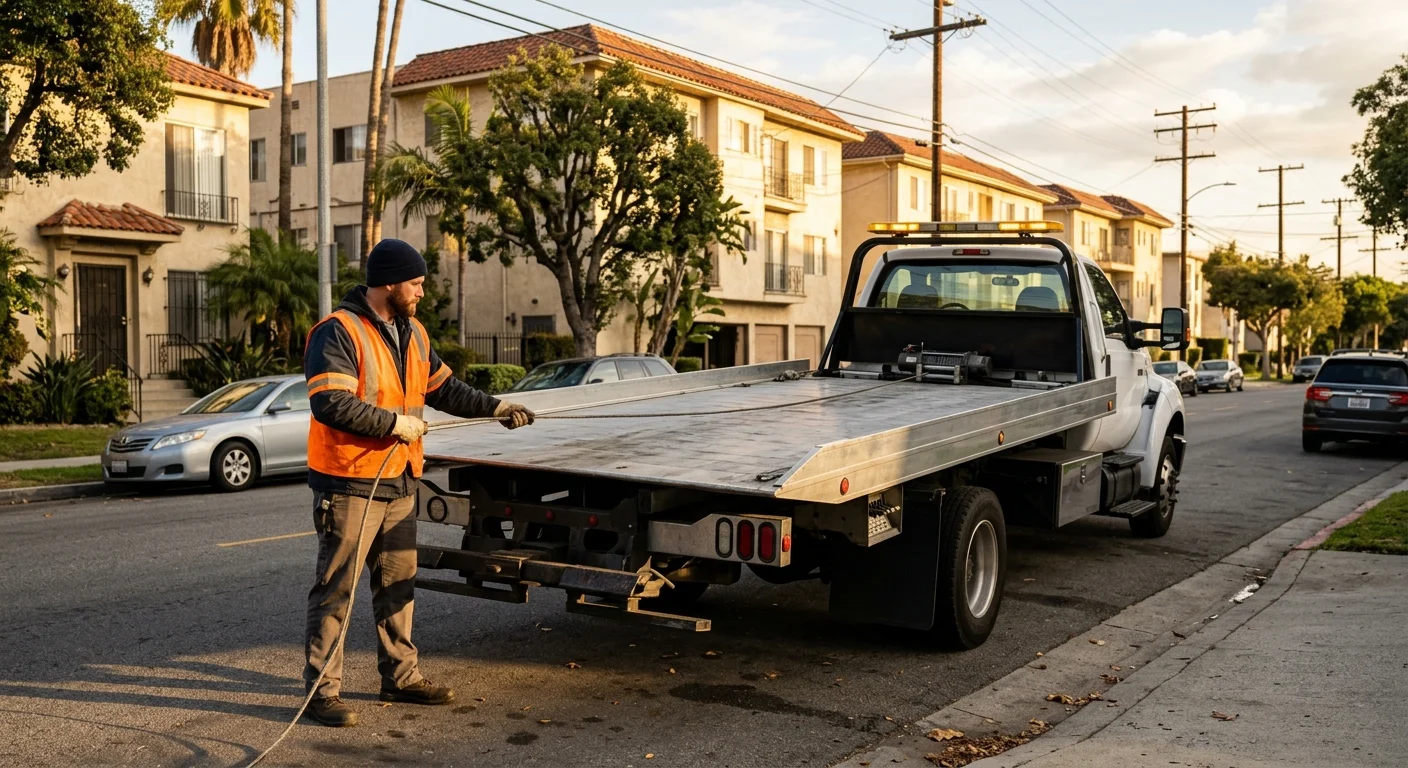
People mix up the names. A cargo flatbed that hauls lumber is a stationary deck. The tow version most drivers mean is a rollback, also called a slide bed. The bed tilts and slides back until the rear edge meets the pavement. The car is then driven or winched onto that deck, strapped, and the bed returns to level for the ride.
A typical private hookup in Los Angeles looks like this.
The driver parks in line with the car, lights on, and checks traffic. They walk the vehicle: drivetrain, leaks, missing wheels, a locked steering column, aftermarket bodywork. If the car still rolls and the parking brake is off, they may idle it onto the deck in a low gear. If it doesn’t roll, the winch cable comes out from the head of the bed. A hook or a strap finds a rated recovery point, never a bumper cover or a plastic valance.
The bed tilts. The winch takes the load. The car creeps up until all four tires sit on steel. The driver stops the winch, raises the bed, and ties the vehicle down at four points, usually at the wheels, with ratchet straps in the deck pockets. Chains against a painted control arm are the old way. Ask for wheel straps on a clean street car.
Once the bed is up and the load is snug, the operator does a walk-around: strap tension, lights, the path out of the space. Then they drive. Your car is cargo now. It shouldn’t bounce, roll, or drag.
That sequence is why a flatbed for a tow truck is the default on cars that can’t, or shouldn’t, roll. The winch does the lifting. The deck does the carrying. Nothing on the car has to act as a trailer.
What the sequence doesn’t include is a published deck height, a winch rating, or a truck this brand owns. Quick Tow LA connects you with local, licensed operators. The driver sent out runs their own equipment. If the stall is too tight for a long bed, they’ll say so and change the plan before they force it.
Hook-and-chain is the old picture of a tow truck: a hook on the bumper and two tires scraping. That method is hard on modern unibody cars. You shouldn’t see it used as the plan for a daily driver on a clean street. If someone describes chains on the frame as the default, ask for a bed.
When a wheel-lift is the wrong tool
A wheel-lift is a different machine. A yoke slides under two tires, lifts that axle, and the other two tires roll down the road. It’s compact. It’s useful in a tight alley. It’s the wrong tool when those rolling tires, or the driveline between them, can’t take the trip.
AWD and 4WD are the clearest miss. The rolling axle is still connected to the rest of the car. Miles of that on the 110 or up the Grapevine is how you turn a disabled car into a transmission job. If the operator can’t confirm a driveline disconnect, ask for the bed.
Locked wheels are next. A parking brake that won’t release, a seized caliper in South Gate, a steering lock with the key lost: a wheel-lift still needs two tires to rotate. If they won’t, the operator is dragging metal. That’s a winch onto a deck.
Damage changes the math. A bent rim after a pothole on Sunset, a control arm tucked in after a curb in Los Feliz, a car that crab-walks: the rolling axle won’t track. On a wheel-lift, that car will fight the yoke the whole way. On a bed, it’s a static load.
Low bodywork is the other miss. The yoke needs a path under the tire. Splitters, side skirts, and dropped springs close that path. Operators can sometimes use skates or extra care. The safer ask is still a rollback.
A wheel-lift can still be the right call. A stock front-drive sedan in a narrow downtown alley, with both rolling tires good, and a short hop to a shop two blocks away, is a classic wheel-lift job. Match the tool to the car. Don’t take whichever truck is closest.
If dispatch offers a wheel-lift and you know the car is AWD, lowered, or won’t roll, say it before they leave the yard. Changing trucks on the curb in Silver Lake wastes the slot and leaves you in the street longer.
What to ask before the truck rolls
The useful questions are about the car and the street, not about buying a rollback bed or what an F-550 can legally tow. Those are dealer questions. You need a load that won’t hurt the car.
Ask what truck is coming. You want to hear flatbed, rollback, or slide bed if the car is AWD, low, wrecked, or dead. If they say wheel-lift, confirm the drivetrain and that two tires can roll.
Ask the operator to confirm they can work the location. “It’s a subterranean garage under a DTLA high-rise” is a different sentence from “I’m on a wide street in the Valley.” Give the gate code, the parking level, and the stall number. On a canyon road, give a mile marker or a named canyon if you have one.
Ask how they’ll load it. Drive-on, winch, wheel straps. If it’s a clean car, ask them not to hook painted control arms. If it’s a wreck, tell them what’s leaking so they know which end to pull.
Ask where it’s going, and say that destination on the first call. A shop in Van Nuys, a driveway in Whittier, a dealer in the South Bay: distance and surface change the job. We don’t publish a brand rate card. Private towing in Los Angeles isn’t one city-set number. CHP doesn’t publish one uniform statewide tow rate either. Operators set their own charges, and CHP may reject a rate as excessive on rotation work. Tow cost in Los Angeles walks through how those jobs get priced, and which public fee schedules apply when the City is the one that took the car. Confirm the operator’s charge before they hook the car, not after.
If the car was already impounded inside the City of Los Angeles, that’s a different system. Official Police Garage rates are set by the Board of Police Commissioners, as of January 1, 2026, and they aren’t a private roadside quote. Don’t mix those two bills.
Have the keys, the registration if you have it, and a way to pay the operator. Stand somewhere the driver can see you. On a 405 shoulder that’s often behind the guardrail, not in the gore point. On a Hollywood side street, that’s the sidewalk, not the travel lane.
When to call us
Call when the car shouldn’t roll, the street is tight, or you’re between a live lane and a slope you can’t push out of. A winch and a bed are operator work. They aren’t a strap from the trunk. Call (213) 410-1414 to reach dispatch.