A dusty sedan has sat on your South L.A. curb for two weeks. Nobody moves it, and the block is down a parking space. Reporting it only works if you call the agency that actually owns that street, lot, or freeway shoulder.
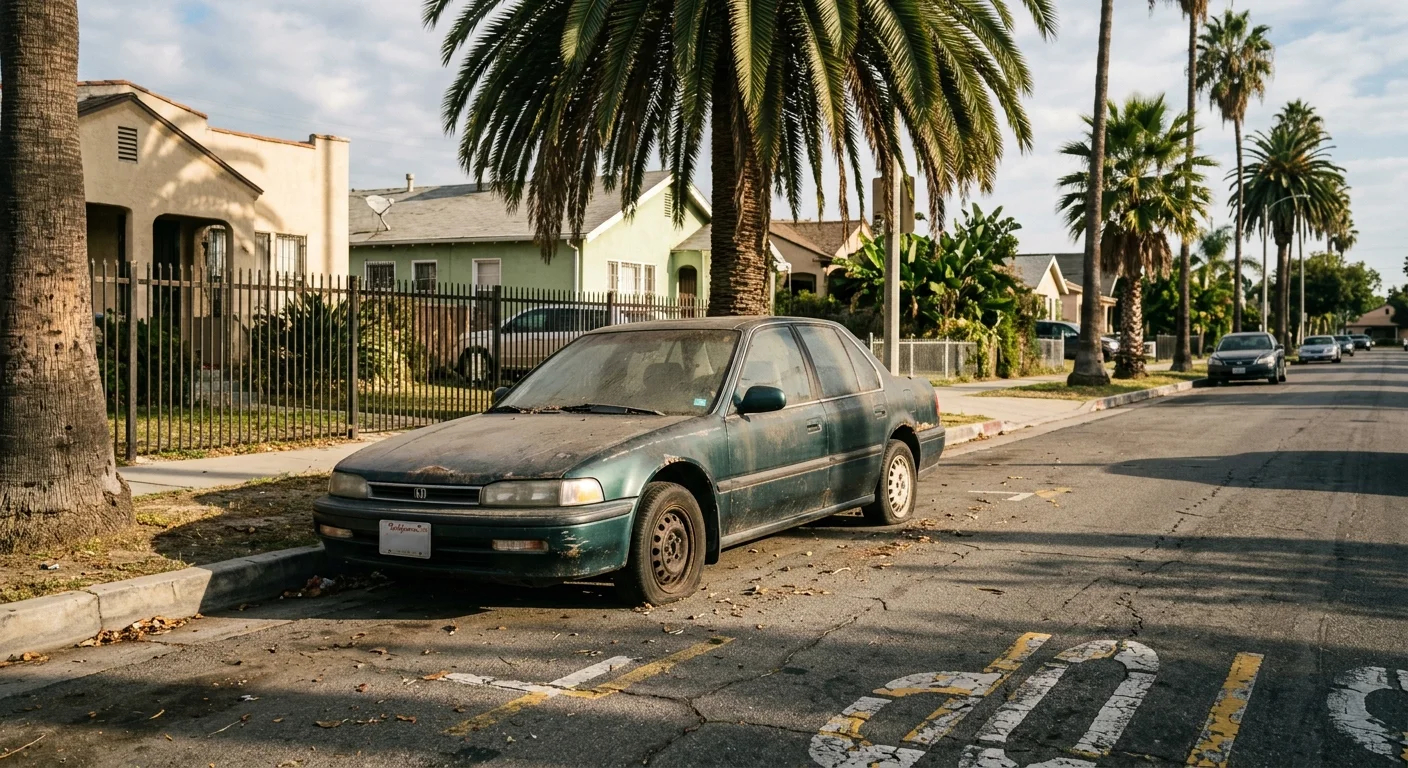
Who to call on a city street vs a private lot
Start with the ground under the tires. A car on a City of Los Angeles street, highway, or alley is a city stored-vehicle problem. A car in an apartment stall in Koreatown, a shopping-center space in Van Nuys, or a driveway in Boyle Heights is a private-property problem. Those two paths do not share a phone tree.
On a City of L.A. curb, abandoned vehicle laws in Los Angeles County set the clock. LAMC 80.73.2 and the California Vehicle Code say a vehicle may not stand on a City street or alley for 72 or more consecutive hours. A Traffic Officer has to observe it over that period before an impound for storage. Filing a complaint does not make the car disappear that afternoon. If the car is inoperable and a public hazard, CVC 22669 lets officers tow it without waiting out that 72-hour watch. Missing wheels, a missing engine, or a body that cannot roll safely is the kind of condition that statute is aimed at.
That 72-hour rule is also the plain answer to how long you can leave a car parked on a City of Los Angeles street. It is not a secret grace period. It is a standing limit, and the officer still has to see that the car did not move.
A rude parking job is not always an abandoned-vehicle case. A car blocking your driveway can be removed under CVC 22651. Five or more unpaid parking citations can lead to a boot, then a tow, under CVC 22651.7 and LAMC 80.77.2. Those are parking-enforcement paths. They are not the same as a neighbor’s junker that has sat on 54th Street since Labor Day.
On a private lot, you do not call 311 to authorize a tow. The property owner or the owner’s agent does. California’s private-property towing rules live in CVC 22658. A posted sign at each entrance has to be 17 inches by 22 inches, with lettering at least 1 inch high, and it has to name the enforcement agency phone plus each tow company’s name and contact. The person who authorizes the tow must notify local law enforcement within one hour of that authorization. If you only live in the building, talk to the manager or HOA. You cannot send a truck off a lot you do not control. When the owner is ready, private property towing is the service path, not a city abandoned-vehicle ticket.
Long Beach, Burbank, Pasadena, Glendale, and the Sheriff’s contract cities are not the City of L.A. parking desk. A car on East Willow in Long Beach is not an LADOT curb. Ask that city which unit takes stored-vehicle reports. Do not assume a Los Angeles 311 ticket covers it.
LAPD, LASD, 311, and CHP paths we can actually name
Inside the City of Los Angeles, the contacts we can name for a stored or abandoned car on a public street are 311 and LADOT. LADOT also points people to its parking line at (866) 561-9742. Ask the operator for a stored or abandoned vehicle report. Some older neighborhood writeups mention a City 1-800 line and an online stored-vehicle form. We could not confirm a current online portal, a live 1-800 number, or a promised callback window against our City of Los Angeles claims file. LADOT and 311 set the intake method. Ask them what is open today if you want to report an abandoned vehicle in Los Angeles online.
Parking enforcement on those city streets is LADOT Traffic Officers, not a substitute for the police emergency line. They inspect and watch the car. They are the ones who have to observe a 72-hour storage case before impound. That is not a 911 call unless someone is hurt, the car is on fire, or you have a crime in progress. LAPD enters the picture when a peace officer removes a vehicle under CVC 22651, or later when an Area auto detective handles a police release from an Official Police Garage. The City uses 17 designated Official Police Garages for LAPD, LADOT, and other agency tows. Reporting the car and retrieving it from a garage are different jobs.
Unincorporated Los Angeles County is a Sheriff problem. East Los Angeles, Marina del Rey, Altadena, much of the Antelope Valley fringe, and other county islands do not sit on the City 311 list. LASD runs no central impound. Each station directs its own tow, and the tow company holds the vehicle. We could not confirm a countywide abandoned-vehicle hotline, a county online form, or an LASD release-fee dollar amount. Call the station that covers that block and ask who takes a stored or abandoned report there. Santa Clarita, Malibu’s city streets, Compton, Downey, and the San Gabriel Valley cities each run their own programs too. City of L.A. Official Police Garage rates do not follow the car across those lines.
Freeway shoulders are CHP. A dead van on the I-110, the I-5 through the Valley, or the 710 near the port is not a neighborhood 311 ticket. CHP clears disabled and collision vehicles on the highways it serves through its Rotation Tow Program. We could not confirm a separate CHP “abandoned vehicle” web form or a public wait time for a freeway relic. If the car is in a CHP lane of travel or on a CHP shoulder, start with CHP, not LADOT.
What happens after you file, and what we could not confirm
On a City of L.A. street, a Traffic Officer has to inspect the car. For a 72-hour storage case, that officer must observe it over that period and see that it has not moved. Only then may the city impound it for standing too long. An inoperable public-hazard vehicle can come off the street sooner under CVC 22669. Registration expired more than six months, found or operated on a highway, public land, or an off-street parking facility, is a separate removal ground under CVC 22651(o)(1)(A). None of those statutes promise you a same-day empty curb.
We could not confirm how many days pass between your call and the first inspection. We could not confirm a City quota, a backlog figure, or a rule against filing twice. Those operational details belong to LADOT and the Parking Violations Bureau, not to a referral brand. If you need a status, go back to 311 or (866) 561-9742 and use the same location you already gave them.
If the city does tow it inside the City of Los Angeles, it goes to an Official Police Garage. Look it up by plate or VIN at opglaviic.com, the OPGLA VIIC database LADOT points to. OPG business hours are 7:00 a.m. to 7:00 p.m., and release is in person. As of January 1, 2026, the City’s standard-vehicle daily storage on the Official Police Garage schedule is $68.00 a day on a credit card, or $66.00 a day if you pay without a credit card. The vehicle release fee is $115.00 per vehicle under LAMC 80.77.1. Those figures reset every January 1. They apply to City of L.A. OPG tows. They do not apply in Long Beach’s city yard, in Burbank, or at a Sheriff contractor lot.
After a vehicle has been stored 30 days, CVC 10652 requires the keeper to report it to the California Department of Justice, which notifies the owner. That is a reporting trigger before any later lien process. It is not a promise of a sale date. For the state’s abandoned and abated paperwork track, the DMV’s lien-sale and abandoned-vehicle handbook is the place to read, not a guess at a timeline.
LASD storage notice is mailed within 48 hours, excluding weekends and holidays. We could not confirm the Sheriff’s administrative release fee. Pasadena’s Parking Office, Long Beach’s city yard, and Burbank’s contractor each publish their own release rules. If the car left a curb outside the City of L.A., do not call an Official Police Garage and expect it to be there.
How a junk pickup differs from a city abandoned-vehicle tow
A city abandoned-vehicle tow is the government taking a car off public pavement. You are the complainant. You do not own the process, you do not pick the garage, and you do not get to keep the car. The registered owner still has to deal with storage, the $115.00 City release fee inside L.A., and whatever the Official Police Garage bills on the January 1, 2026 schedule.
A junk pickup is a private job. Someone with the right to dispose of the car asks a licensed operator to take it. That is the owner, a lienholder with the paper to prove it, or a property owner handling a wreck they are allowed to remove. Quick Tow LA connects you with local, licensed operators. We do not hold a Motor Carrier Permit, we do not run a city lot, and we do not take LADOT’s 72-hour watch away from Traffic Officers. The pros we connect you with are licensed and insured. You contract with the operator they send.
Use a junk pickup when the car is yours, or when you are the property owner and the city will not touch it because it sits on private ground. A stripped Civic behind a warehouse in Wilmington, a burned-out van in a Pacoima driveway, or a non-op pickup on a Palmdale lot is that kind of call. Junk car and abandoned vehicle removal is the service. Bring the title questions to the paperwork it takes to junk a car in California before anyone hooks it. Guessing at a title shortcut is how people stall in a driveway with a car still sitting there.
Do not treat a city report as a free junk-out for a car you still own. If it is your registration on a South L.A. curb, you can request a private pickup instead of waiting for a Traffic Officer’s 72-hour observation. If it is someone else’s car on a public street, you report it. You do not send a truck to snatch it.
What photos and details to have ready
Have the story tight before you dial 311, LADOT, a Sheriff’s station, or CHP. Agencies ask for the same handful of facts because that is what a Traffic Officer or deputy can actually find at 10 p.m. on a dark block.
Give the exact block, the side of the street, and the nearest cross street. “Near Vermont” is not an address. “West curb of Vermont, south of 54th, in front of the pink stucco” is. In the Valley, say whether you are on San Fernando Road in the City of L.A. or over a city line. In the South Bay, say San Pedro versus Wilmington versus unincorporated county. On the Westside, say whether the car is on a City street or a Santa Monica curb. Those lines change who you call.
Describe the car in boring detail: color, body type, make if you can read it, and anything that proves it has not moved. A crushed rim, a missing plate, a tarp that has been on it since June, and a pile of furniture growing against the bumper all help. Note whether it looks operable. No wheels, no engine, or a car up on blocks is the CVC 22669 kind of hazard, and you should say that in plain words.
Have the plate ready if it is still on the car. Read it to the agency. Do not post it on a neighborhood app as if that files the report. Snap photos of the whole car, the plate, the nearest address, and the surrounding curb for your own record. A timestamped photo does not replace the Traffic Officer’s 72-hour observation. It does keep your description from drifting when you call back.
On a private lot, add the property address, the management office, and whether a CVC 22658 sign is posted at each entrance. The operator needs the authorizing party, not a tenant with a flashlight. If you own the junk car, have the title, a photo ID, and any release of liability you already filed with DMV. Missing paper is the usual reason a junk call turns into a wait.
When to call us
Call us when the car is yours to junk, or when you are the property owner and you need a licensed operator on a private lot instead of a city stored-vehicle wait. The operators in our network handle junk and abandoned pickups. They do not replace LADOT, LASD, or CHP on a public street. Call (213) 410-1414 to reach dispatch.