A Class C that dies on Pacific Coast Highway is a different job from a fifth-wheel that will not fit a Santa Clarita driveway. Height, length, the toad, and the road all change which operator can reach you. Get those specs to dispatch before anyone rolls a truck.
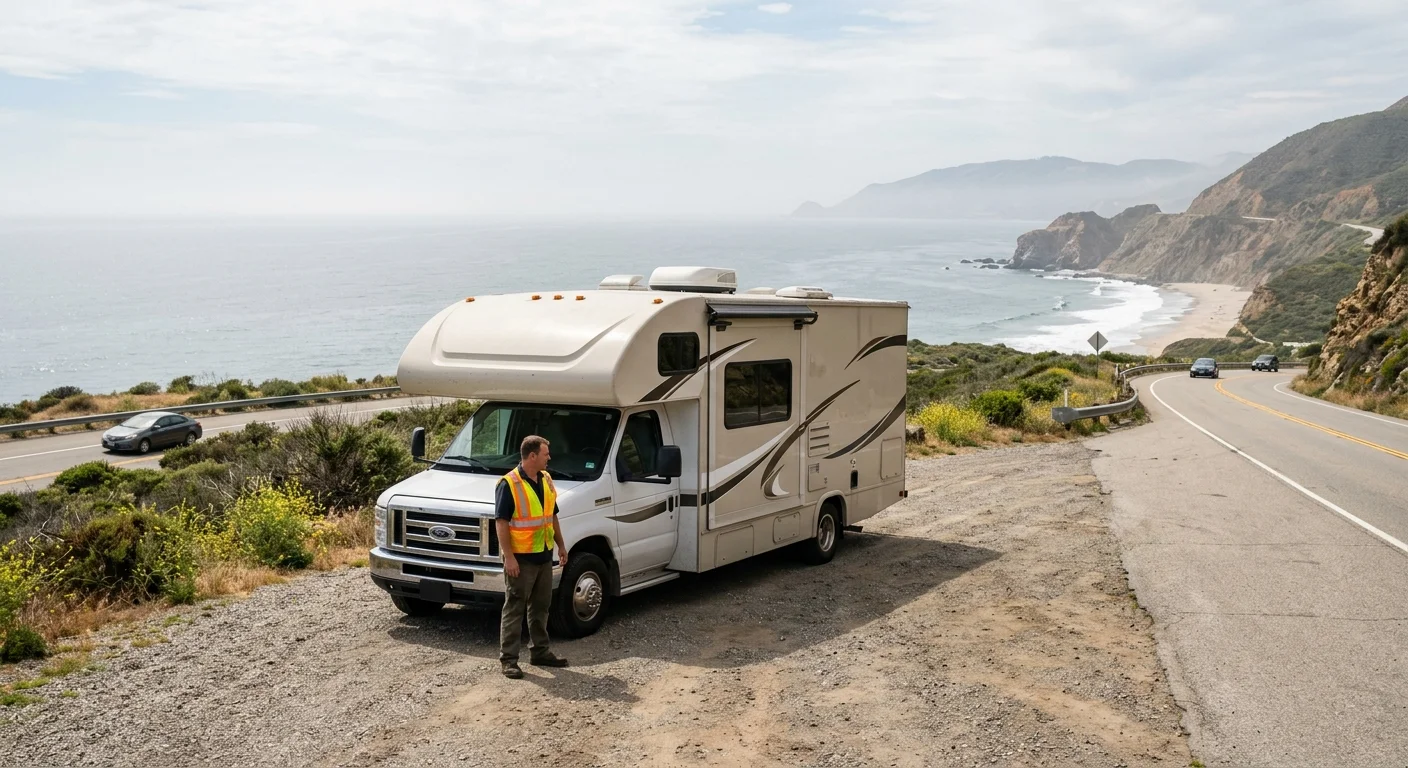
Height, length, and toad problems on LA freeways
Los Angeles freeways punish a tall, long rig in ways a sedan never sees. A Class A on the 405 through the Sepulveda Pass, a travel trailer on the 5 through Newhall, and a toy hauler on the 14 toward Palmdale each meet different ramps, different wind, and different recovery room. Posted clearances live on the structure, not in a county-wide RV chart. We could not confirm a single Los Angeles County height or length cap for private RV moves. Before you send a roof air or a satellite dome under an overpass, read the sign on that bridge. If the plate is missing or you cannot see it from the shoulder, confirm the number with Caltrans.
The toad is the second problem. Many motorhomes pull a dinghy car on a tow bar or a dolly. If that toad is still attached when the coach dies, the operator has two vehicles, two brake systems, and often two sets of keys. Leave it hooked only if you cannot unhitch off the travel lane. If the dinghy is an EV, treat it like any other EV. It usually needs a flatbed, not a wheel-lift that lets drive wheels drag.
Owners ask about the 80 percent rule and the 3-3-3 rule. Neither one is a California Vehicle Code section we can cite. The 80 percent habit is a capacity check: keep the loaded trailer well under the tow vehicle’s rating, then confirm on the door-jamb sticker and the RV’s weight label. The 3-3-3 idea is trip planning some owners use, a shorter driving day, an earlier stop, a longer stay. It does not tell a dispatcher which truck to send on the 101.
What does matter on the freeway is whether the coach will roll, whether jacks and slides are in, and whether you are on a CHP-served highway. On those roads, CHP clears disabled and collision vehicles through the Rotation Tow Program under a Tow Service Agreement. CHP does not publish one statewide rate. Operators submit rates, and CHP may reject a rate as excessive. A private request to tow your motorhome in Los Angeles is a separate call from a CHP rotation pickup. Say which one you are in when you dial.
Trailer towing in Los Angeles County adds sway, tongue weight, and brake-controller questions a bumper-pull sedan never raises. A fifth-wheel that sat level in a Palmdale driveway can sit wrong on a crowned 210 connector. Tell dispatch the hitch type, not just “it’s an RV.”
PCH, Santa Clarita storage lots, and canyon roads
Pacific Coast Highway through Malibu is the coastal version of this job. Shoulders are thin. Bluff turnouts fill up on a Saturday. There is often no room to swing a 30-foot coach plus a wrecker without blocking a lane. An RV tow in Malibu is usually a heavy unit, a spotter, and a plan for the next legal place to sit, not a quick pull into a beach lot. Those lots are run by the city or by State Parks. Their overnight and oversize rules are not in our claims file. Confirm with the lot or the city before you leave a motorhome there.
The canyons make the same coach harder. Malibu Canyon Road, Kanan Dume, Topanga, and Latigo all mix grade, tight radius, and almost no recovery shoulder. A travel trailer that tracked fine on the 101 can jackknife on a hairpin if the operator brings the wrong truck. Do not try to winch a coach off a canyon edge yourself. That is recovery work for a trained driver with the right truck.
Inland is a different map. Santa Clarita and Palmdale have more yard space, more dry wind, and easier access off the 5 and the 14. Fifth-wheels that will not fit a Malibu driveway often head to an inland storage lot after the tow. We do not publish storage-lot fees, hookup prices, or gate hours. Those are set by each yard. Call the yard with length, slide width, and whether anyone is sleeping in the coach. Ask if they take propane on board, and what the after-hours gate actually does.
The contrast is the point. Coastal north county is PCH, canyons, and beach parking you cannot assume. Inland north county is storage driveways, Santa Ana winds, and long grades on the 14. A page that swapped Encinitas for El Cajon would fail for the same reason: the road and the lot are not interchangeable. If the operator quotes a long-distance tow from a Malibu turnout to a Palmdale lot, that is mileage, permits if needed, and a destination the yard has already accepted. Quick Tow LA does not publish its own rate card. The operator who rolls sets the charge. Confirm it before the truck leaves.
What dispatch needs before a truck rolls
Dispatch cannot guess a Class B van from a 40-foot Class A. Lead with the facts that change the truck.
Give the year, make, and body: Class A, B, or C, fifth-wheel, travel trailer, or toy hauler. Give the length if you know it, and the height if a roof air or dish sits above the factory line. If the GVWR is on a sticker by the door, read it. Say whether a toad is attached, whether slides are out, and whether leveling jacks are down. Say if the coach will roll, if you have keys, and if propane is on. Then give the pin: a PCH mile marker, a canyon name, a freeway shoulder, a storage driveway in Santa Clarita, a street in the Valley.
Location changes the agency. On a CHP-served highway, rotation may already be in play. On a City of Los Angeles street, a police or LADOT tow is an Official Police Garage job, not a private RV move. The City has 17 Official Police Garages. Those City rates apply inside the City of Los Angeles for LAPD and LADOT tows. They do not apply to a private request from a Malibu turnout, a Santa Clarita driveway, or a Palmdale lot. They reset every January 1. As of January 1, 2026, an upright heavy-duty tow is $400.00 the first hour on a credit card, or $390.00 cash or check. Daily storage on that schedule is listed for a standard vehicle, not a motorhome. Confirm the actual line item with the garage if the City took the rig.
If the coach is on private property, California Vehicle Code 22658 is the private-property towing statute. It requires a posted sign at each entrance, notice to local law enforcement within one hour of authorizing the tow, and a release rule if the owner returns before the vehicle is in transit. That is a property-manager path, not a “tow my motorhome” request from the owner. Say which one you are.
Quick Tow LA connects you with local, licensed operators. We do not own an RV fleet, a yard, or a Motor Carrier Permit. The driver who arrives works for the operator. Have the coach ready to move: slides in, jacks up, awnings in, toad plan decided. That is the difference between a truck that can hook and a truck that has to wait.
When a standard truck is the wrong tool
A wheel-lift built for a Civic is the wrong tool for a loaded fifth-wheel. It is the wrong tool for a Class A with tag axles. It is the wrong tool for a coach sitting on jacks on a crowned canyon shoulder. If the operator shows up with a light truck, stop the hook until a heavier unit is on the way.
Heavy-duty towing is the usual match for motorhomes, toy haulers, and trailers that sit above a passenger-car rating. RV and trailer towing is the service lane for the coach itself: hitch type, toad, slides, propane, and a destination that will actually take the length. Those are related, and they are not the same call as a sedan on the 110.
Winch work is its own line. A coach nosed into ice plant on PCH, or a trailer dropped off the pavement on Kanan, needs recovery gear and a place to stand the truck. Do not chain it to a pickup and pull. You can fold a frame or put the coach into the lane.
Long moves need a second check. Coast to inland storage, or out of the county entirely, is not a five-mile hook. Read how long-distance tow cost is quoted in this market: mileage, equipment class, and any permit the operator says the load needs. We could not confirm a new statewide “RV towing law” for 2026 in our claims file. Social posts about abandoned-RV pilots are not a private-tow rule. For size, routing, and oversize permits, confirm with Caltrans and the DMV. The 10-year rule people mention is an insurance or lender habit, not a tow-yard statute we can cite.
If the City of Los Angeles already impounded the rig, you are in the OPG process, not a private dispatch. Find the vehicle through the City’s tools, get the police release, then pay the garage. That path does not use Quick Tow LA’s line as the yard.
Where the RV can go next without guessing legal storage rules
The tow is only half the job. The coach has to sit somewhere legal when the truck unhooks.
Do not guess a beach lot, a City street, or a friend’s driveway. Parking and overnight rules are set by the city, the county, the yard, or State Parks. We could not confirm a county-wide “park after tow” rule for RVs. Ask the destination before the truck rolls, and get a yes on length and height.
On a City of Los Angeles street or alley, a vehicle may not stand for 72 or more consecutive hours. A Traffic Officer has to observe it over that period before an impound under that rule. That is a poor plan for a 32-foot coach you just pulled off PCH. Move it to a yard that accepted it.
Inland lots in Santa Clarita and Palmdale are where many fifth-wheels go after a coastal pickup. Ask the yard: maximum length, indoor or outdoor, whether occupied coaches are allowed, propane rules, and when the gate actually opens. Do not treat a Google photo as a reservation. If the yard says no, pick another pin before the operator leaves Malibu.
Private-property tows follow CVC 22658, including the posted-sign and notice rules. An owner-requested move from a driveway is simpler, and you still need a legal destination. If the coach is being stored, the keeper’s lien and notice rules are a Civil Code and Vehicle Code path, not a blog guess. Confirm hold fees with the yard. We do not publish them.
Shoulder safety still applies while you wait. NHTSA roadside guidance is the federal reminder: get out of the travel lane when you can, keep people away from the traffic side, and let the operator set the truck. A Malibu turnout with bikes and rental convertibles is not a quiet shoulder. Give the driver room.
Quick Tow LA serves Los Angeles County, from Malibu and the canyons through the Valley, the Gateway Cities, Santa Clarita, and the Antelope Valley. Orange County and the Inland Empire are outside this map. If the next stop is out of county, say so on the first call so the operator can plan the long-distance piece.
When to call us
When the coach will not roll, the toad is still hooked, or you are on a PCH turnout with no room to turn around, this is an operator job, not a hitch adjustment. The licensed pros we connect you with handle RV and trailer work across Los Angeles County. Call (213) 410-1414 to reach dispatch.