Your Civic is wedged in a Koreatown garage aisle, and a full-size carrier won’t fit. A wheel lift tow truck is the smaller wrecker that picks up two wheels and rolls the other two. That’s why it still shows up on short hops across the Basin when a flatbed can’t even enter the lot.
What a wheel-lift is, in plain words
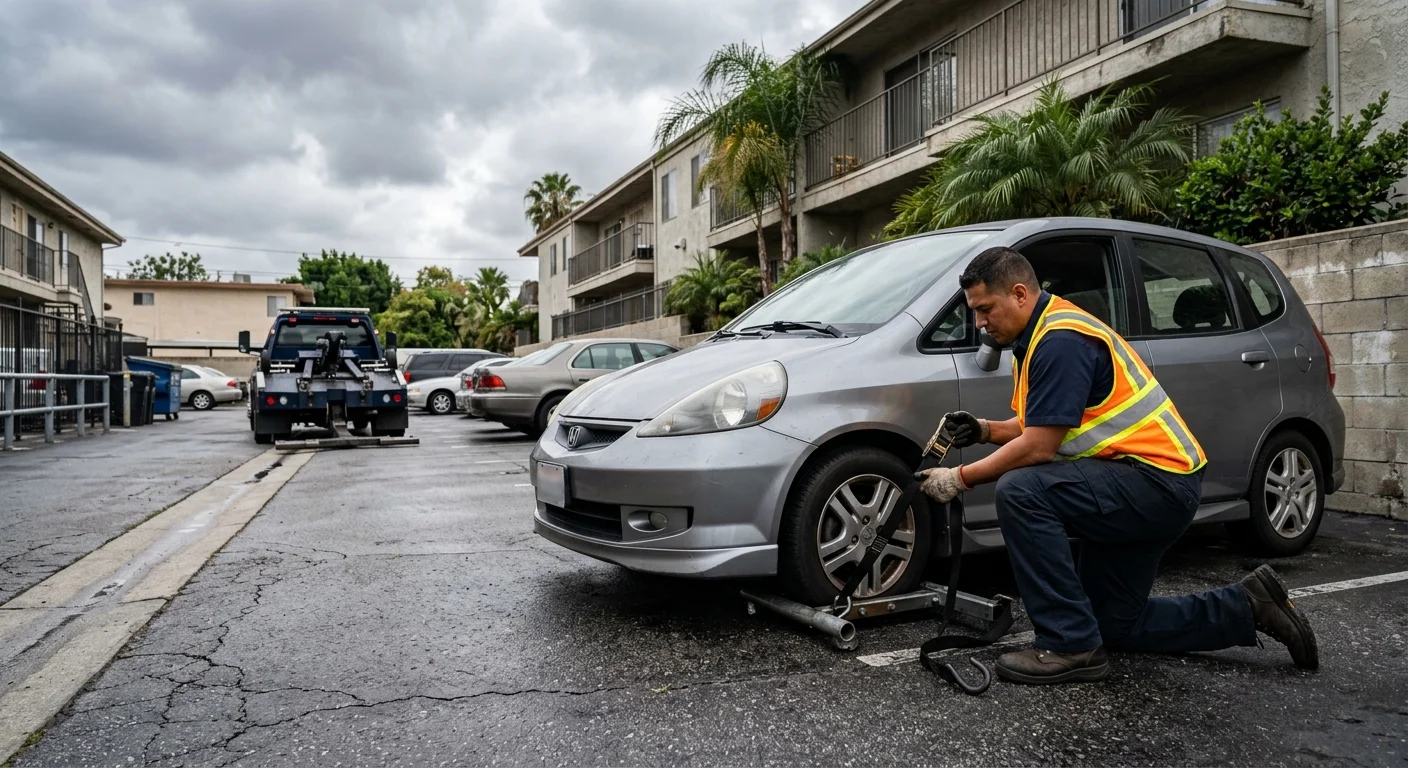
A wheel-lift is a metal yoke on a hydraulic arm at the back of a wrecker. The operator slides that yoke under two tires, locks them in, and raises that end of the car. The other two tires stay on the pavement and roll as the truck pulls away. That’s the whole machine, in one picture.
It replaced the old hook-and-chain lift for a lot of light-duty work. A chain on a bumper or a frame horn can crease sheet metal. A wheel lift tow truck holds the tires, so the lift point is the wheel, not the fascia. Two wheels still roll. The car isn’t fully off the ground.
The wrecker is usually shorter and lower than a carrier. That matters in Los Angeles more than in a wide suburban lot. A wheel-lift towing job is often the one where the truck has to back down a garage ramp, squeeze past a dumpster, or stop in a lane already half taken by parked cars.
You’ll hear people say tow truck wheel lift and wheel-lift tow truck for the same setup. Both mean the yoke under the tires. Dollies are a separate tool. They go under the rolling pair when the operator doesn’t want those tires to turn. Whether dollies come out is the operator’s call on that car, in that spot.
For a regular passenger car in LA County, dispatch is usually choosing between this and a flatbed. You don’t need to name the boom. You need to describe the car and the space so the right operator gets the call. If the car is AWD or 4x4, skip the two-wheel drag and read AWD and 4x4 towing.
If you’re already on a CHP-served freeway, the California Highway Patrol rotation program may send the wrecker. That’s a public rotation, not a private garage call. CHP doesn’t publish one statewide rate. A private call from a Koreatown garage or a Silver Lake curb is a different path.
Tight lots, FWD cars, and short hops across town
Wheel lift towing in Los Angeles earns its keep in places a bed can’t physically reach. Think of the stacked garage under a brick walk-up between Western and Vermont. The ramp is steep. The beam is low. Two compact cars share a tandem stall, nose to tail. A carrier needs a straight shot at the car. A wheel-lift can often back in at an angle, grab two tires, and roll the car out of the aisle.
Street parking in Silver Lake is the same problem with a hill added. Cars sit tight on a grade, inches from the next bumper. The operator may only have a few feet of curb. The shorter wrecker can work that gap. A long deck would block the whole block.
Short hops across the Basin are the other common fit. The car won’t start on a Mid-Wilshire side street, and the shop is a few miles away on Beverly or La Brea. The car is a ordinary front-wheel-drive sedan. The path is city streets, not a mountain pass. Operators in the network often choose a wheel-lift for that kind of local move when the car and the space allow it.
Front-wheel-drive cars show up a lot in those lots. Civics, Corollas, older Camrys, compact crossovers in apartment buildings from Koreatown through East Hollywood. That doesn’t make a wheel-lift “safe” by default. It only means this is the housing stock and the car mix the operator sees. The driver who arrives still chooses which end to lift, and whether the job should switch to a bed.
Access is the real test, not the neighborhood name. Downtown subterranean garages, West Hollywood alleys, and older lots off Sunset all share the same limits: tight turning, low clearance, cars parked too close to walk around. If the operator can’t get a carrier to the bumper, a wheel-lift is often the truck that can still make the hook.
This is a one-car tool. The wrecker tows the vehicle in the yoke. It isn’t a deck with room for extra cars. For a single disabled car in a cramped LA lot, that’s usually enough.
When AWD, EVs, and low cars should skip it
A wheel-lift leaves two tires on the ground. If those tires are driven tires, they roll while the driveline is connected. This page can’t tell you that’s fine on your car. No article should. Tell dispatch the drivetrain, and let the operator pick the truck.
All-wheel-drive and four-wheel-drive cars are the first reason to ask for a bed instead. Many of those jobs go to a flatbed so no driven wheel has to roll. Some operators will still use a wheel-lift with dollies. That is their call on the actual car, not a rule you should guess from a blog. If you know the car is AWD, say so in the first minute of the call.
EVs belong in the same conversation. Battery packs sit low. Manufacturer tow notes often call for a flatbed. Regenerative systems and park-pawl design are not things to experiment with on a curb. For Tesla and other electric cars, read how EV towing is handled on a flatbed and tell dispatch it’s an EV before a wrecker is assigned.
Low cars are the third skip. Sports cars, slammed suspensions, air-ride that has sunk, and many exotic and classic cars don’t have the ground clearance for a yoke to slide under the tires without scraping a splitter or a valence. A bed with a winch and ramps is the usual answer. Point that out when you call. “It’s lowered” is a useful sentence.
Don’t treat insurance as a drivetrain chart. This site has no verified insurer rule that names wheel-lift versus flatbed. If a carrier, a lease company, or a shop told you the car has to ride on a bed, tell dispatch that. The operator can match the request. A page on the internet can’t override a shop’s intake rule.
Weight and body style matter too. A heavy truck, a loaded van, or a vehicle sitting on a donut spare may be the wrong match for a light wrecker. Say what the vehicle is. Don’t assume a compact-car setup will take it.
If you’re unsure, ask for a flatbed. You can always describe a tight lot and let dispatch sort access. Guessing that a wheel-lift is “probably fine” is how a low front lip meets a steel yoke.
What to tell dispatch so the right truck shows
The operator we dispatch chooses the equipment. Your job is to describe the scene so that choice is possible. A short, specific call beats a vague “I need a tow.”
Start with the vehicle. Make, model, and year if you have them. Front-wheel drive, rear-wheel drive, AWD, or EV, if you know. Running or dead. Neutral or stuck in park. Keys present or not. Any body kit, air suspension, or aftermarket wheels. Flat tires, and which ones. A Tesla in a garage is a different truck than a 2012 Civic on a flat street.
Then describe the spot like a person who has to back a wrecker into it. Koreatown underground garage, one way in, low beam, tandem stall. Silver Lake hill, cars on both bumpers, no driveway. Alley behind a shop on 3rd. Surface lot with a parking boot still on the wheel. Street parking on a posted sweep route. If a carrier can’t make the turn, say that.
Say where the car needs to go. A shop three miles away in the Basin is a different plan than a long move out of the county. Wheel-lift work is often a local hop. If the car should ride fully off the pavement, ask for a bed even on a short trip.
Mention people and hazards. Kids in the car. A live lane of traffic. A garage attendant who needs the stall cleared. Oil on the floor. A parking structure with a height sign. If you’re on a shoulder, stay out of the travel lane and wait in a safe place. NHTSA’s roadside safety guidance is the federal baseline for that.
Don’t try to spec the truck by brand name. You don’t need to ask for a particular boom. Ask whether a wheel-lift can access the stall, or whether a flatbed is the better match. The licensed operators in our network decide what they can hook without tearing up the car.
If the car was already taken by a city or police tow, that’s an impound question, not a wheel-lift question. This page is for a private call when the car is still sitting where it died.
How this compares with a flatbed
The two common light-duty trucks in LA are a wheel-lift and a flatbed. A wheel-lift picks up one end. A flatbed loads the whole car onto a deck so no tire rolls. That’s the difference that decides most jobs.
A bed wins when the car should not roll at all. EVs, many AWD cars, low sports cars, wrecks that can’t steer, and cars with four flat tires. It also wins when the pickup is in a wide lot or a street with room to line up. The deck needs space in front of or behind the car. That’s why a carrier struggles in a packed Koreatown garage even when it’s the gentler ride.
A wheel-lift wins on access and bulk. The wrecker is smaller. It can often work an angle that a deck can’t. Hooking is usually faster in a tight stall because the car doesn’t have to be winched up ramps. For a short hop to a nearby shop, that can be the whole point of the call.
Don’t read that as “wheel-lift is for cheap jobs and flatbeds are for fancy cars.” The split is geometry and drivetrain, not prestige. A scuffed Civic in a subterranean stall may need the smaller truck. A lowered coupe on a wide Silver Lake street may need the bed. The operator looking at the car makes that call.
A flatbed can, on some bodies, carry more than one vehicle. A typical wheel-lift moves one. If you’re comparing the two for a single disabled car, that extra-deck trivia doesn’t help you. Access, ground clearance, and whether two tires may roll are the questions that do.
If you want the bed explained as a system, that’s a separate page. This one is only the when. Ask dispatch for wheel-lift towing when the lot is tight and the car is a ordinary short-hop candidate. Ask for a flatbed when the car shouldn’t roll, sits low, or is an EV. If you’re standing in the stall unsure, describe the car and the ramp. The driver sent out will pick the truck that fits.
When to call us
Call when the car is stuck in a stall, on a curb, or dead on a short hop, and you need a licensed local operator to choose the truck. Don’t try to drag it, bump it, or guess the drivetrain on your own. Call (213) 410-1414 to reach dispatch.