Your car has stopped on the 405, but nobody hit you. This article couldn’t confirm Metro Freeway Service Patrol’s current charges or tow limits from the approved claims record. Check those details with Metro before relying on the service. You’ll need a private towing operator when the car must reach a repair shop, your home, or another chosen address.
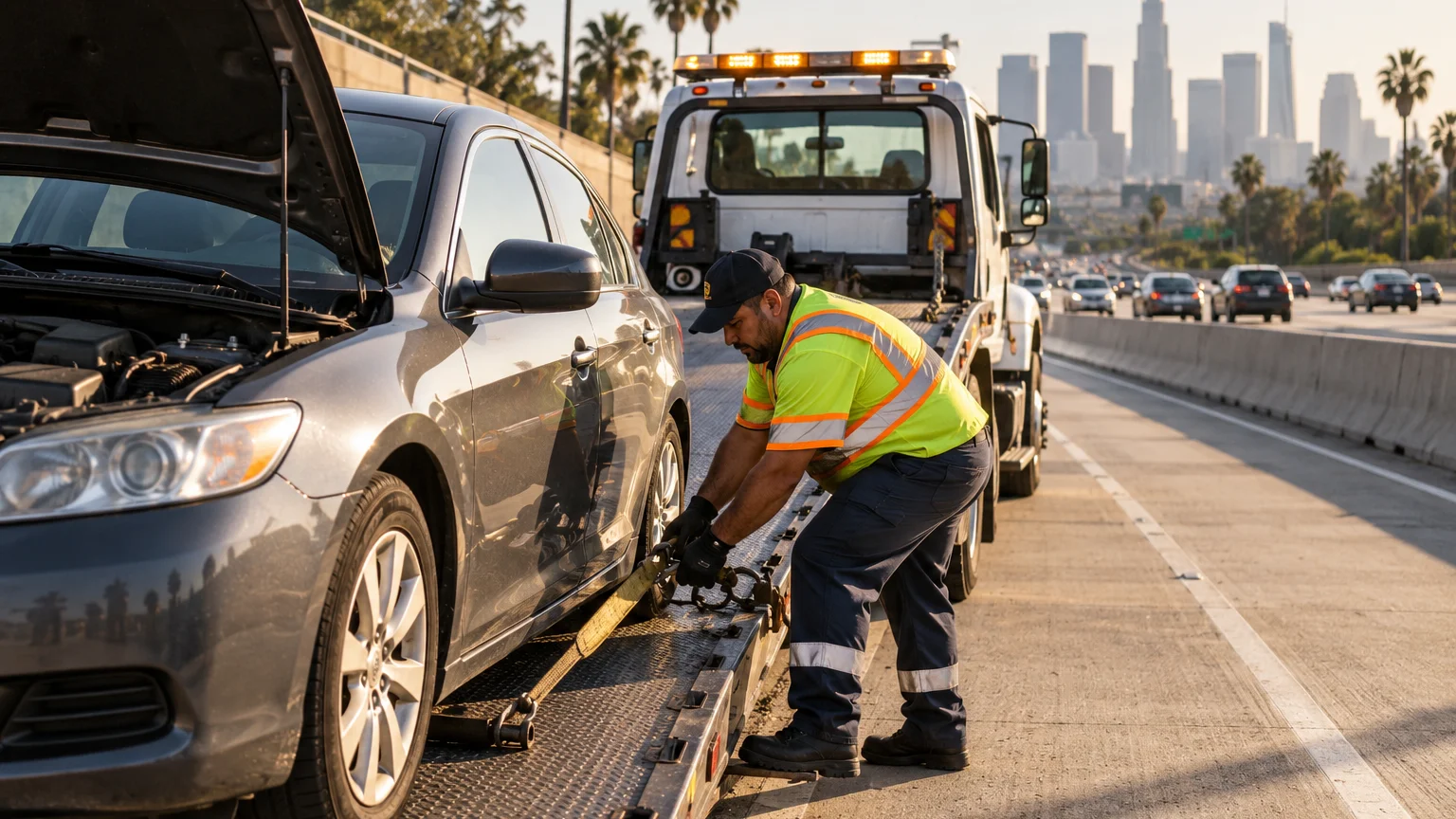
What Metro Freeway Service Patrol does
Metro Freeway Service Patrol is often shortened to FSP. This article couldn’t confirm its current services, charges, or tipping rules from the approved claims record. Check each detail with Metro before accepting assistance.
Ask whether the available service covers your specific breakdown. That may include asking about a flat tire, jump start, radiator problem, damaged hose, or an empty fuel tank.
If a roadside fix isn’t enough, ask where FSP can leave the vehicle. The approved claims record doesn’t confirm the current destination rules or whether you can request a repair shop, driveway, dealership, or storage yard.
This distinction matters across the 405 corridor. A breakdown near the Sepulveda Pass can leave you far from your regular shop. The same applies near LAX, the South Bay, or the San Fernando Valley. Getting off the freeway may solve the immediate location problem, but it may not solve the mechanical one.
The approved claims record also doesn’t confirm FSP’s emergency or non-emergency contact process. Check the current instructions with Metro or the California Highway Patrol. If a freeway call box is available, follow its posted directions.
If the vehicle only needs a basic roadside service, review the differences between a jump start and a tow. The right option depends on whether the car can operate after assistance.
Where the FSP tow ends
The approved claims record doesn’t confirm where an FSP tow currently ends. Before accepting assistance, ask whether the destination is selected by the California Highway Patrol and whether FSP can take the vehicle to a private repair shop or your home. Also ask whether the driver can recommend a repair business.
Think of the service as two possible steps. First, confirm what FSP can do at your location. Second, decide what the disabled vehicle needs after that assistance ends.
That second step may require a private tow. The destination could be a shop selected by you, a dealership, or another lawful location. The private towing operator handles that trip under a separate arrangement. The operator sets the charge, so ask for the applicable terms before agreeing to service. Quick Tow LA doesn’t publish a brand rate because the driver contracts with and pays the operator directly.
The handoff may also change who controls the destination. Confirm FSP’s destination rules with Metro or CHP. A private operator can discuss the requested destination with you before taking the job.
Don’t assume that every operator can collect a vehicle from every FSP drop point. That access detail couldn’t be confirmed for this article. Give dispatch the exact location and describe where FSP left the vehicle. The operator can then determine whether the pickup is workable.
Our roadside assistance service connects LA County drivers with local operators for problems that may not require a full tow. If the car still can’t travel, dispatch can instead help identify an appropriate towing option.
Check the current hours and freeway coverage
The source material reviewed for this article included general FSP hours, but current hours couldn’t be confirmed from the approved claims record. ExpressLanes and Big Rig patrol schedules couldn’t be confirmed either. Check the current schedule through Metro before relying on an older time listing.
Coverage should be checked the same way. This article couldn’t confirm every covered segment of the 405, 5, or 110. Give the responding agency your freeway, direction, nearest exit, and any visible location marker.
Outside confirmed FSP hours or coverage, don’t assume a patrol truck will come. The California Highway Patrol operates a Rotation Tow Program for clearing disabled and collision vehicles from CHP-served highways. However, it couldn’t be confirmed that CHP will use that program for every non-crash breakdown outside FSP service.
CHP doesn’t publish one uniform statewide rotation-tow rate. Participating operators submit rates under the CHP Tow Service Agreement, and CHP may reject an excessive rate. That program is separate from FSP.
For a non-emergency, check Metro or CHP’s current instructions for requesting assistance at your location. The approved claims record doesn’t confirm which number to call during an emergency. If the situation changes into a collision scene, the process is different. Our guide to freeway crash towing in Los Angeles explains that separate case.
When a private towing operator becomes necessary
You need a private towing operator when the available assistance can’t complete the trip you actually need. The clearest example is a vehicle that has been moved off the freeway but still can’t run. Confirm where FSP assistance ends, then arrange a private tow if the car still needs to reach your chosen destination.
A private tow may also be appropriate when FSP isn’t operating on that route or at that time. Because current patrol hours and exact route coverage weren’t confirmed here, check with Metro first. If help isn’t available, tell dispatch that the breakdown happened on a freeway and isn’t a crash.
Location details make the request clearer. Share the freeway number, travel direction, nearest exit, and current drop point. Mention whether the car is still on the freeway or has already been moved. Also describe the vehicle and the apparent problem without guessing at a diagnosis.
The operator can determine what equipment fits the job. For example, certain drivetrains or vehicle conditions may affect the towing method. Our guide to AWD and 4x4 towing in Los Angeles covers questions to raise before the vehicle moves.
Ask the operator where the vehicle will go and what charges apply. Quick Tow LA connects drivers with local, licensed towing and roadside operators. The operator performs the work, provides the terms, and receives payment.
If the car can restart and operate after assistance, a second tow may not be needed. If it remains disabled, arrange the next move from the drop location.
When to call us
Call when FSP isn’t available, or when its assistance leaves your disabled car short of the destination you need. We can connect you with a local operator for roadside help or a private tow.
Call (213) 410-1414 to reach dispatch.