A tractor that quits on Alameda Street is a different job than a sedan on a shoulder. Same for a loaded box that will not roll through a San Pedro gate at 2 a.m. You need heavy-duty towing in Los Angeles, and the Port, the 710, and Terminal Island all change how that call goes. If the unit is inland on the 5, the 60, or the 605, use the countywide 18-wheeler towing page instead.
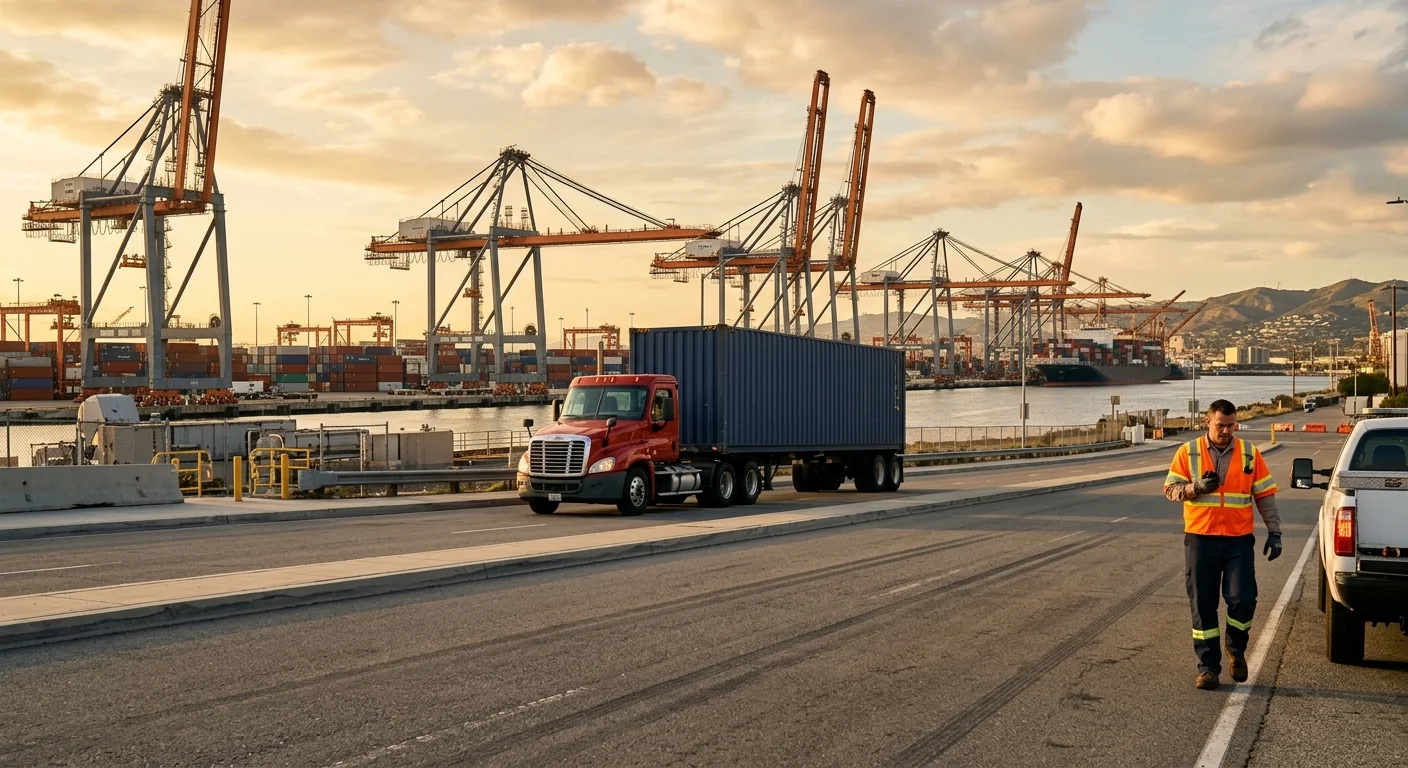
What counts as heavy-duty on the 710 and at the Port
The 710 is the truck spine of the San Pedro Bay ports. It runs off the waterfront through Wilmington and Carson and keeps climbing inland. Tractors, chassis, and loaded containers use it all day. When one of those units stops, a light wrecker is the wrong truck.
Operators in our network treat this as heavy-duty work when the unit is a class 7 or 8 commercial vehicle, a loaded box, a bus, a mixer, or yard equipment that a standard wheel-lift cannot pick. A single published GVWR cutoff for private recoveries in Los Angeles County could not be confirmed in our claims file. Each operator sizes the job by weight, height, axle count, and whether the trailer is still coupled.
That is why the phone call has to name the unit. Say tractor, box, reefer, tanker, bus, or yard goat. Say loaded or empty. Say if the air is down. Say if you are on the 710, Harry Bridges Boulevard, John S. Gibson Boulevard, Terminal Island, or a named gate in San Pedro or Wilmington. “I’m at the Port” is not a location. A dispatcher cannot send the right boom from that sentence.
City of Los Angeles Official Police Garage rates are a separate ledger. They apply when LAPD or LADOT sends the tow. They do not set the bill when you hire a recovery yourself. As of January 1, 2026, the OPG upright heavy-duty tow is $400.00 for the first hour on a credit card, and $390.00 if you pay another way. Mileage on that schedule is $12.00 per mile. Those figures reset every January 1 by the Board of Police Commissioners. They are not Quick Tow LA’s rate card. This brand does not publish one.
CHP freeway rotation is a third channel. CHP clears disabled and collision vehicles from CHP-served highways through its Rotation Tow Program. Operators work under a Tow Service Agreement. CHP does not publish one uniform statewide rate. Operators submit rates. CHP may reject a rate as excessive. If an officer already assigned a rotation truck on the 710, that truck has the job.
If you are pricing a hire you still control, start with our Los Angeles tow cost page. It separates City garage fees from a job you call in.
Boxes, buses, and equipment a light truck cannot move
A light truck can move a car. It cannot pick a loaded 40-foot box sitting on a chassis at a Wilmington gate. The underlift rating is too low. The boom is too light. The truck itself cannot hold the combination.
These are the units that usually need a heavy operator around the Port. Semi truck towing in Los Angeles: tractors, bobtail or still on a chassis. Loaded and empty containers in the 710 truck lanes. Transit and charter buses dead on Gaffey, Harbor Boulevard, or the Vincent Thomas approaches. Refuse trucks, mixers, and vocational chassis in Carson industrial parks. Yard tractors and other powered equipment that will not roll.
A medium-duty rollback sometimes handles an empty bobtail on a quiet street. A loaded combination is a different recovery. So is a unit on its side, in a ditch, or jammed against a gate arm. That is accident recovery work: cribbing, winching, and a rotator when the geometry demands it. Quick Tow LA does not own rotators or a heavy fleet. The licensed operators we connect you with run that equipment.
Cargo matters as much as weight. A dry box and a tanker are different calls. If the load is placarded, say so on the phone. The operator has to know before they roll. A Port of Los Angeles hazmat escort rule, a specific axle limit for a recovery truck, and a published after-hours terminal procedure could not be confirmed from our approved sources. The terminal, the Harbor Department, and the responding agency set those. Ask them. Then tell dispatch what they said.
Buses add a second problem: people. Get passengers off the travel lane and onto a sidewalk or a safe pad. Then call for the heavy truck. Do not try to drag a coach with a light wrecker. You will fold the frame and block Gaffey twice.
If the drop is far from San Pedro, the same recovery turns into a long haul to a shop in Vernon, the South Bay, or the San Fernando Valley. Distance changes the bill. Read what counts as a long-distance tow before you assume a local hourly rate covers a Valley drop.
Terminal gates, staging, and access we will not invent
A truck can sit 40 feet from a gate and still be on property the terminal controls. The operator you hire cannot invent a way in. Port Police, the Los Angeles Harbor Department, and the terminal operator set access. A specific credential list, escort rule, appointment window, or after-hours gate fee for the Port of Los Angeles could not be confirmed in our claims file. Confirm it with the gate and with your company dispatcher before you wave anyone in.
Tell dispatch the terminal name, the gate number, and the closest public street. San Pedro and Wilmington gates do not share one staging pad. Some frontage roads around the Port are legal places for a wrecker to wait. Some are not. We will not publish a made-up staging map. The person in the booth, or your own night dispatcher, has the current instruction.
Carson yards and open Wilmington industrial streets are simpler. Public right of way is public right of way. Once you are inside a marine terminal, you are on their clock and their rules. If they want the unit dragged to a named pad before the wrecker hooks it, that is their call. If they want the operator to wait outside until a clerk walks the truck in, that is their call too.
Have the facts ready: company name, callback, unit number, loaded or empty, and where the truck is allowed to go. A shop in San Pedro is a short tow. A drop across the county is not.
If a security contractor already called their own tow, ask who authorized it. Private-property tows in California sit under CVC 22658. That statute covers posted signs, notice to local law enforcement within one hour of authorizing the tow, and what counts as an excessive charge. It is the state rule. It is not a Port handbook. The terminal may already have a contract truck. If that truck is assigned, a second wrecker will not get the job.
Stay out of travel lanes while you wait. NHTSA roadside safety guidance is plain: make the scene visible, keep people away from live trucks, and do not stand between the disabled unit and traffic.
How a heavy recovery is usually sequenced
A heavy recovery is a sequence. It is not a hook-and-go on a sedan.
Start with location. Mile marker on the 710. Exit name. Gate. Berth. Cross street in San Pedro or Wilmington. A vague pin on “the harbor” wastes the first truck. If you can see a crane row, a bridge, or a named boulevard, say that.
Next, condition. Will it roll. Are the brakes locked. Is the driveline broken. Is the trailer still coupled. Is anyone hurt. If it is a collision, CHP or local police may already own the scene. Then you wait for their release before anyone hooks.
Then equipment. The operator decides wrecker, rotator, landoll, or a second truck for the trailer. Quick Tow LA does not pick the boom from a yard we own. We connect you with a licensed operator who does this work. They size it from the facts you give.
Scene control follows. On a CHP highway, the officer runs that. On a surface street in Wilmington, the operator still has to protect the work area. Nobody should be under a loaded box until it is cribbed and the air is understood. Do not stand in the path of the winch. Do not climb on the box to help. The crew running the job runs the recovery.
The move itself varies. Sometimes the tractor goes on the wrecker and the box stays on its axles. Sometimes the combination has to come apart. Sometimes the unit is upright and still needs a heavy underlift because it will not roll. An “upright heavy-duty tow” on the City of LA OPG board is that kind of job when the police garage does it. A private operator will describe it in their own words and on their own invoice.
Last is the drop: shop, yard, another terminal, or a legal spot your company names. Storage is its own clock. The OPG schedule we have lists daily storage for a standard vehicle at $68.00 a day on a credit card as of January 1, 2026, and $66.00 otherwise, plus $18.00 a day for a motorcycle. A separate heavy-unit storage line on that City board was not in our claims file. Do not treat the standard-vehicle figure as a tractor rate. Confirm the current line with the garage before you pay.
If City of Long Beach towing took the unit to 3111 E. Willow Street, their published heavy tow rate as of October 1, 2025 is $463.00 per hour, minimum. Daily storage there is $83.00 for a standard vehicle 20 feet and under, and $102.00 for a large vehicle 21 feet and over. Those numbers belong to Long Beach’s city lot. They do not set a private San Pedro recovery.
When the terminal or CHP directs the tow instead of you
You do not always get to pick the truck.
On a CHP-served highway, including stretches of the 710 used for 710 truck towing after a breakdown, a disabled or collision vehicle is often a rotation call. CHP uses the Rotation Tow Program and a Tow Service Agreement. The next qualified heavy operator on the list gets the job. Calling a second company does not bump that truck. If an officer already assigned it, ask for the company name and the yard.
Inside the City of Los Angeles, which includes San Pedro and Wilmington, LAPD and LADOT tow requests go to the Official Police Garage system. There are 17 designated Official Police Garages. They handle those agency tows. If your tractor was taken that way, it is an impound, not a roadside hire. Release runs through the impounding LAPD Area station, then the garage. You need ID, registration or proof of ownership, and a licensed driver if you cannot legally drive it away. The City vehicle release fee is $115.00 per vehicle under LAMC 80.77.1.
Carson is its own city. A unit sitting in Carson is not automatically on the LA OPG board. The Los Angeles County Sheriff’s Department does not run one central impound. Each station directs its own tow. The LASD release admin fee amount was not verified in our claims file, so we do not print a number.
If the terminal directed the tow, the truck is probably heading to a contract yard, not to a shop you chose. Get the company name, the yard address, and the incident number before you leave the gate. Call that yard. Calling us after the unit is already hooked by someone else will not redirect it.
People searching for a towed car in Los Angeles are usually looking for an OPG. A tractor at the Port is a different desk. Start with the agency that moved it: CHP, LAPD, the terminal, or the operator you hired. California Vehicle Code 22651 lists when a peace officer may remove a vehicle, including a hazard on the roadway. That is the officer’s authority. It is not a menu you order from.
If you still control the unit, you still control the call. That is the case for a breakdown on a public street in San Pedro, a dead bus on Gaffey, or a box on a legal shoulder where no officer has assigned a rotation truck yet. A heavy duty tow in San Pedro at that point is a hire. Make it while you still can.
When to call us
A loaded combination, a bus, or a tractor that will not roll needs a licensed heavy operator, and it is not a DIY winch. If you are on the 710, Terminal Island, or at a San Pedro or Wilmington gate, call with the unit, the load, and the exact spot. Call (213) 410-1414 to reach dispatch.